Recreating Paintings By Teaching An AI To Paint

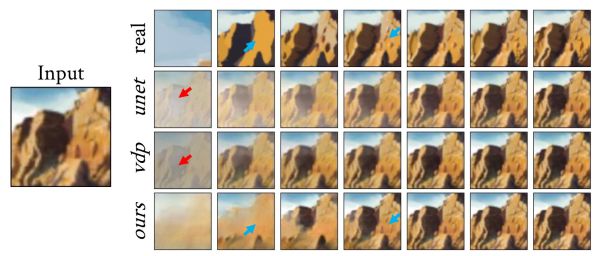
The Timecraft project by [Amy Zhao] and team members uses machine learning to figure out a way how an existing painting may have been originally been painted, stroke by stroke. In their paper titled ‘Painting Many Pasts: Synthesizing Time Lapse Videos of Paintings’, they describe how they trained a ML algorithm using existing time lapse videos of new paintings being created, allowing it to probabilistically generate the steps needed to recreate an already finished painting.
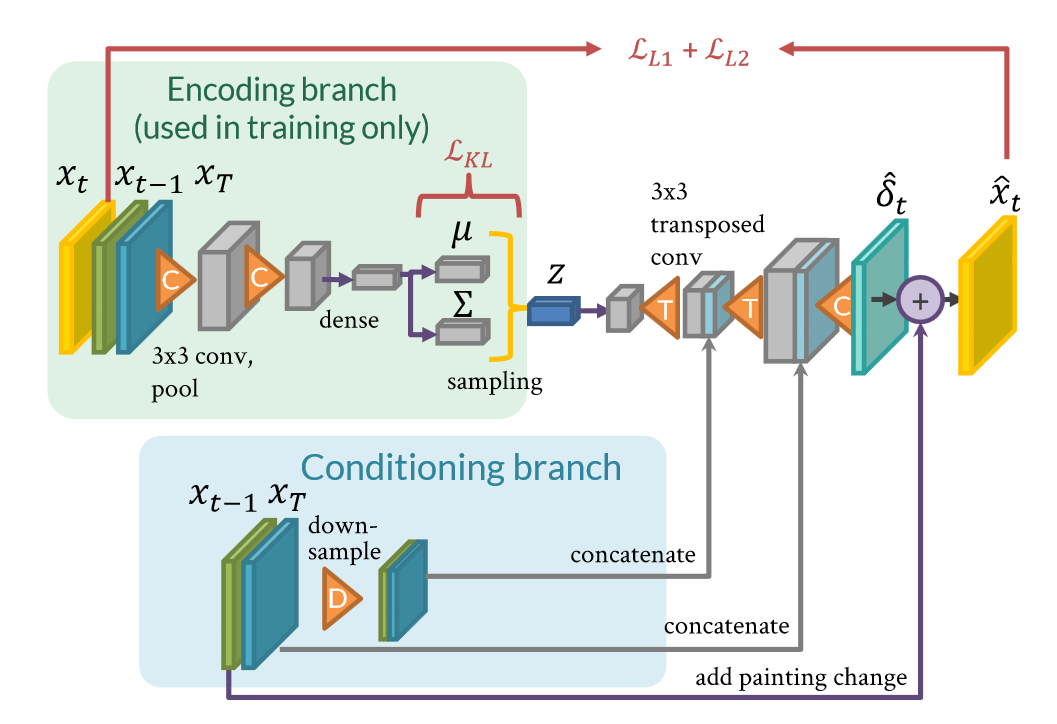
The probabilistic model is implemented using a convolutional neural network (CNN), with as output a time lapse video, spanning many minutes. In the paper they reference how they were inspired by artistic style transfer, where neural networks are used to generate works of art in a specific artist’s style, or to create mix-ups of different artists.

A lot of the complexity comes from the large variety of techniques and materials that are used in the creation of a painting, such as the exact brush used, the type of paint. Some existing approaches have focused on the the fine details here, including physics-based simulation of the paints and brush strokes. These come with significant caveats that Timecraft tried to avoid by going for a more high-level approach.

The time lapse videos that were generated during the experiment were evaluated through a survey performed via Amazon Mechanical Turk, with the 158 people who participated asked to compare the realism of the Timecraft videos versus that of the real time lapse videos. The results were that participants preferred the real videos, but would confuse the Timecraft videos for the real time lapse videos half the time.

Although perhaps not perfect yet, it does show how ML can be used to deduce how a work of art was constructed, and figure out the individual steps with some degree of accuracy.

Continue reading “Recreating Paintings By Teaching An AI To Paint”
The Trouble With Tamagotchis…

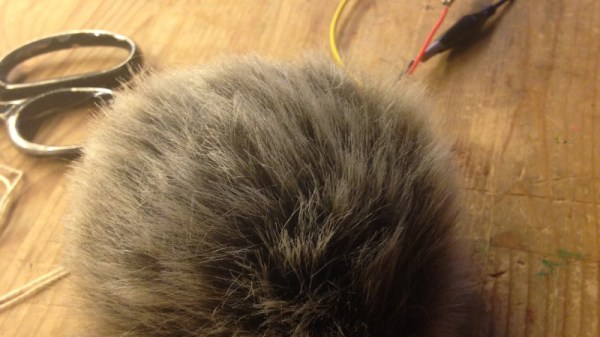
The must-have toy of a couple of decades ago was the Tamagotchi, a virtual pet in an LCD screen on a keyring, that demanded your attention and which would die were you to neglect it. Fortunately it had a reset button on the back through which it could be resuscitated, but even so it lacked a satisfying tactile experience. [Nadine] has done something about this with her Tamagotchi-style Tribble, an anthropomorphic ball of fluff that demands attention and purrs when it receives some.

Inside the ball of fake fur is an Adafruit Circuit Playground with a capacitive touch pad and a haptic motor. After a random time with no attention it “cries”, and its owner strokes it, after which it responds with a purring vibration. It’s quite cute as you can  see in the Twitter video below, and fortunately it won’t multiply and fill up your starship. We wonder whether a small resistive heater to give it a body temperature would complete its appeal as a virtual pet.

Given the popularity of Star Trek TOS among Hackaday readers perhaps it’s surprising that we don’t see more Tribble related projects. They have made a notable appearance as a DEF CON badge though.

Continue reading “The Trouble With Tamagotchis…”

Reliving Heathkit’s Glory Days Through A Teardown And Rebuild

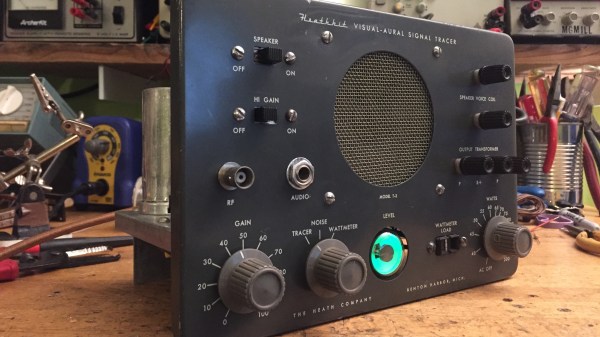
In its heyday, the experience offered by the Heath Company was second to none. Every step of the way, from picking something out of the Heathkit catalog to unpacking all the parts to final assembly and testing, putting together a Heathkit project was as good as it got.

Sadly, those days are gone, and the few remaining unbuilt kits are firmly in the unobtanium realm. But that doesn’t mean you can’t tear down and completely rebuild a Heathkit project to get a little taste of what the original experience was like. [Paul Carbone] chose a T-3 Visual-Aural signal tracer, a common enough piece that’s easy to find on eBay at a price mere mortals can afford. His unit was in pretty good shape, especially for something that was probably built in the early 1960s. [Paul] decided that instead of the usual recapping, he’d go all the way and replace every component with fresh ones. That proved easier said than done; things have changed a lot in five decades, and resistors are a lot smaller than they used to be. Finding hookup wire to match the original was also challenging, as was disemboweling some of the electrolytic cans so they could be recapped. The finished product is beautiful, though — even the Magic Eye tube works — and [Paul] reports that the noise level is so low he wasn’t sure if turned it on at first.

We’ve covered the rise and fall of Heathkit, as well as their many attempted comebacks, including an inexplicable solder-free radio and the “world’s most reliable” clock. Looking at these offerings, we think [Paul] may be onto something here.

Slipping Sheets Map Multiple Bends In This Ingenious Flex Sensor

When thoughts turn to measuring the degree to which something bends, it’s pretty likely that strain gauges or some kind of encoders on a linkage come to mind. Things could be much simpler in the world of flex measurement, though, if [Fereshteh Shahmiri] and [Paul H. Dietz]’s capacitive multi-bend flex sensor catches on.

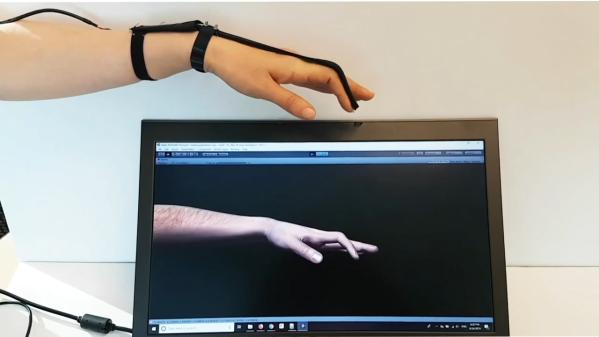
This is one of those ideas that seems so obvious that you don’t know why it hasn’t been tried before. The basic idea is to leverage the geometry of layered materials that slip past each other when bent. Think of the way the pages of a hardbound book feather out when you open it, and you’ll get the idea. In the case of the ShArc (“Shift Arc”) sensor, the front and back covers of the book are flexible PCBs with a series of overlapping pads. Between these PCBs are a number of plain polyimide spacer strips. All the strips of the sensor are anchored at one end, and everything is held together with an elastic sleeve. As the ShArc is bent, the positions of the electrodes on the top and bottom layers shift relative to each other, changing the capacitance across them. From the capacitance measurements and the known position of each pad, a microcontroller can easily calculate the bend radius at each point and infer the curvature of the whole strip.

The video below shows how the ShArc works, as well as several applications for the technology. The obvious use as a flex sensor for the human hand is most impressive — it could vastly simplify [Will Cogley]’s biomimetic hand controller — but such sensors could be put to work in any system that bends. And as a bonus, it looks pretty simple to build one at home.

Continue reading “Slipping Sheets Map Multiple Bends In This Ingenious Flex Sensor”

Hinge Brings New Meaning To Flexible PCB

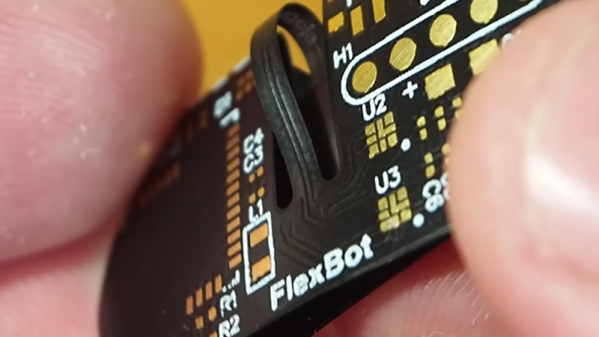
It is not a secret that flexible PC boards can bend. But despite the substrate’s flexibility, you can’t really fold them completely over. That bothered [Carl] so he developed a hinge design so that he can fold a board completely in half. You can watch a video showing an example, FlexBox, below.

Normal boards can fold over, but the copper traces can’t tolerate a very tight bend radius. [Carl’s] trick is to make the folding part have no traces at all. Only a small bridge carries traces between the two halves and it is allowed to bend almost like an interconnecting cable.

Continue reading “Hinge Brings New Meaning To Flexible PCB”

Smart Toilet Paper Holder Keeps Track Of White Gold

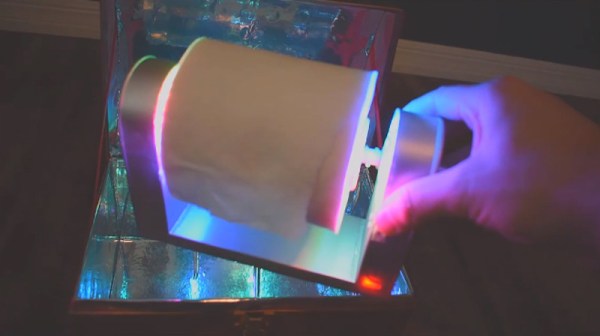
As we all woke up in 2020 on New Year’s Day, few of us would have predicted how terrible everything would get in just a few short months. Worldwide shortages of toilet paper were just the tip of the iceberg, making everyone more keenly aware of their stocks at home. This was something [thepenguinmaster] decided to take a stab at managing in the cloud. Enter the Smart Toilet Paper Roll.

The device consists of a 3D printed toilet roll holder, outfitted with sensors to track usage of the precious material. A magnetic rotary encoder is used to monitor rotation of the roll, with a LIDAR device used to sense when a user’s hand is in close proximity. Data is trucked to the cloud by an Avnet Azure Sphere MT3620. The link with Azure allows for the automatic generation of graphs and access from anywhere over the Internet.

The project goes to show that just about anything around the house can be monitored over the Internet. We’d love to see the tracker go even further, measuring usage on a per-sheet basis and automatically ordering more when supplies get low. We’ve seen similar work before, too.

Smart Thermometer Can Tell Flu From Cold

Before the outbreak of coronavirus, the seasonal flu was one of the most dangerous infectious diseases, but a lot of people have trouble telling the difference between a flu and a cold by their symptoms alone. This gave [M. Bindhammer] the idea to design a smart thermometer that can distinguish between flu and cold.

Automated medical diagnostics is certainly an important technology of the future. [M. Bindhammer]’s project, named F°LUEX, is the second version of his iF°EVE thermometer. After taking the body temperature it asks the patient a set of questions about his symptoms and then calculates the probability of whether it is more likely to be a flu or a cold. [M. Bindhammer] uses a method commonly used in medical diagnostics based on Bayesian statistics which assigns a probability score to both hypotheses. It takes into account how often a certain symptom occurs when you have a common cold or flu as well as the overall probability of catching one or the other.

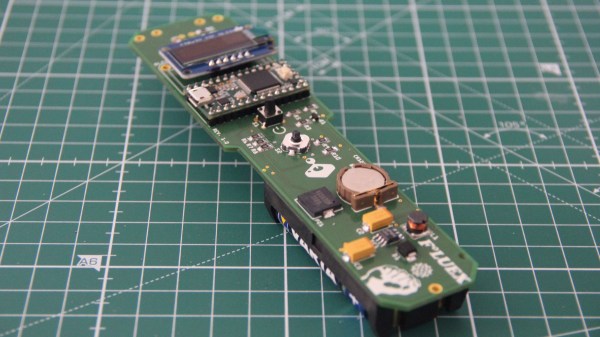
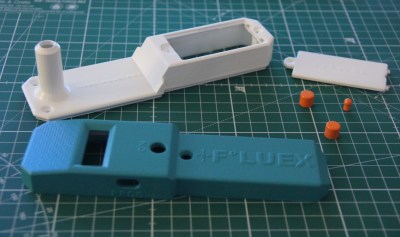
The hardware of the project is based on a custom PCB that includes a medical-grade MLX90614 infrared thermometer with an accuracy of ±0.2˚C around the human body temperature. The sensor is being read out by a Teensy 3.2 and information is displayed on a small OLED screen. Everything is housed in a 3D printed enclosure that received a nice finishing by painting with primer and acrylic spray paint. Unfortunately, [M. Bindhammer] project also got delayed by the corona crisis as his order for the temperature sensor got canceled due to the current high demand. But that does make us wonder how useful this could be to discriminate between cold, flu, and COVID-19.

An IR thermometer is something useful to have around not only for medical applications and can also be built without a custom PCB and minimal parts.