Sky Is New Limit For Dot Com Domain Prices

Earlier this week, domain name registrar Namecheap sent out an email to all customers advising them of a secret deal that went down between ICANN and Verisign sometime late last year. It has the potential to change the prices of domain names drastically over time, and thus change the makeup of the Internet as we know it.

Domain names aren’t really owned, they’re rented with an option to renew, and the annual rate that you pay depends both on your provider’s markup, but also on a wholesale rate that’s the same for all names in that particular domain. This base price is set by ICANN, a non-profit.

Officially, this deal is a proposed Amendment 3 to the contract in place between Verisign and ICANN that governs the “.com” domain. The proposed amendment would let Verisign increase the wholesale rental price of “.com” domain names by 7% per year for the next four years. Then there will be a two-year breather, followed by another four years of 7% annual hikes. And there is no foreseeable end to this cycle. We think it seems reasonable to assume that the domain name registrars might pass the price gouging on to the consumer, but that really remains to be seen.

The annual wholesale domain name price has been sitting at $7.85 since 2012, and as of this writing, Namecheap is charging $8.88 for a standard “.com” address. If our math is correct, ten years from now, a “.com” domain will cost around $13.50 wholesale and $17.50 retail. This almost-doubling in price will affect both small sites and companies that hold many domain names. And the increase will only get more dramatic with time.

So let’s take a quick look at the business of domain names.
Continue reading “Sky Is New Limit For Dot Com Domain Prices”
Tell Time Contest Winners: Clocks To Knock Your Socks Off

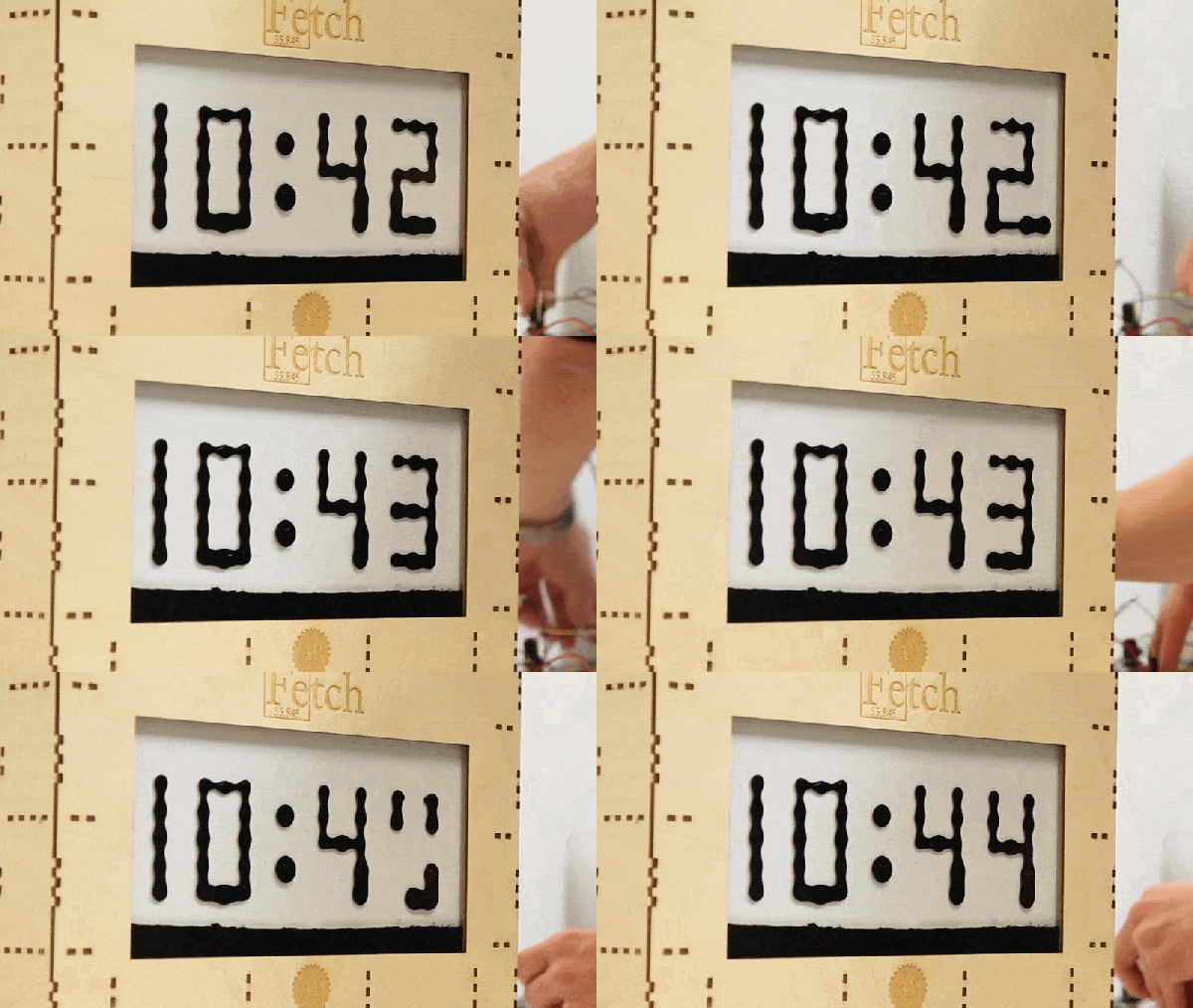
The results are in and the Tell Time Contest was a spectacular showing of creativity. Five winners and a number of runners-up have have been chosen based on craftsmanship, functionality, and creativity.

The one that’s going to steal your heart is Fetch: A Ferrofluid Display. Pitting the force of gravity against electromagnetism, this project manages to wrangle a liquid into the segments of a display and the animations used to change between numbers are fascinating. It’s a wickedly complicated system and the gang over at Applied Procrastination did a great job of documenting the research and development that went into building this open source marvel. Has anyone tried to replicate it? We’d love to hear from you in the comments!

Mechanical movements date back to the transition away from sundials and hourglasses, but these two modern takes on “clockwork” prove there’s still plenty of room for creativity. The first is a plotter that uses two servo motors and a UV LED to draw hours and minutes on a phosphorescent material.

The second is both minimal and a stunning mastery of a traditional clock mechanism. TORLO uses the voice coil from a hard drive to move the gears. It’s 3D-printed and does it all in plain sight, superb!

Fans of the Alien franchise will immediately recognize this insect-like “facehugger”, the second stage of a developing Xenomorph. Embracing the tradition of the Cuckcoo clock, at the top of the hour a “Chestburster” pops through the chest of the bust to mark the passage of time. Creepy but well executed.

The flip-dot display uses a beautiful home-etched circuit board to keep things tidy inside of the case. Of course the question with these displays is always “where did you get the flip dots?”. This panel is on it’s second life after serving a tour of duty as a bus info sign.

Runners Up and Eight Score of Entries

Congratulations to all of our runners-up in the Tell Time contest. It was a tight field with 160 total entries, each of them a fascinating take on the simple, yet very complex practice of watching the seconds tick away. Add this to your weekend bucket list as you’ll certainly get lost in the details of many of these projects.

Flywheel Stores Energy To Power An Airplane – Eventually

Question: Can a flywheel store enough energy to power an airplane? Answer: Yes it can, for certain values of “flywheel” and “airplane.”

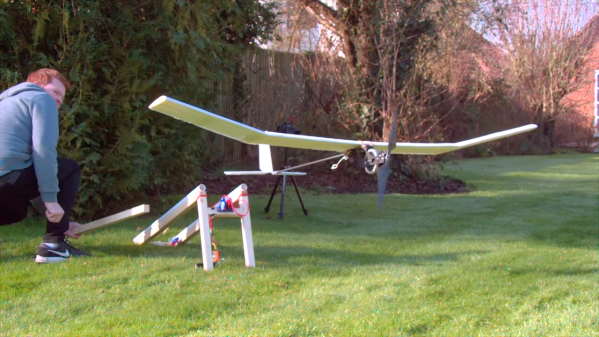
About the only person we can think of who would even attempt to build a flywheel-powered airplane is [Tom Stanton]. He’s a great one for off-the-wall ideas that often pay off, like his Coandă effect hovercraft, as well as for ideas that never got far off the ground, or suddenly met it again. For most of the video below, it seems like his flywheel-powered plane is destined to stay firmly in the last category, and indeed, the idea of a massive flywheel taking flight seems counterintuitive. But [Tom] reminds us that since the kinetic energy stored by a flywheel increases as the square of angular velocity, how fast it’s turning is more important than how massive it is. The composite carbon fiber and aluminum flywheel is geared to the propeller of a minimal airplane through 3D-printed bevel gears, and is spun up with an external BLDC motor.

Sadly, the plane never made it very far, no matter how much weight was trimmed. But [Tom] was able to snatch victory from the jaws of defeat by making the propeller the flywheel – he printed a ring connecting the blades of the prop and devised a freewheel clutch to couple it to the motor. The flywheel prop stored enough energy to complete a few respectable flights, as well as suffer a few satisfyingly spectacular disintegrations.

As always, hats off to [Tom] for not being bashful about sharing his failures so we can all learn, and for the persistence to make his ideas take flight.

Continue reading “Flywheel Stores Energy To Power An Airplane – Eventually”

Mars 2020 Rover: Curiosity’s Hi-Tech Twin Is Strapped For Science; Includes A Flying Drone

While Mars may be significantly behind its sunward neighbor in terms of the number of motor vehicles crawling over its surface, it seems like we’re doing our best to close that gap. Over the last 23 years, humans have sent four successful rovers to the surface of the Red Planet, from the tiny Sojourner to the Volkswagen-sized Curiosity. These vehicles have all carved their six-wheeled tracks into the Martian dust, probing the soil and the atmosphere and taking pictures galore, all of which contribute mightily to our understanding of our (sometimes) nearest planetary neighbor.

You’d think then that sending still more rovers to Mars would yield diminishing returns, but it turns out there’s still plenty of science to do, especially if the dream of sending humans there to explore and perhaps live is to come true. And so the fleet of Martian rovers will be joined by two new vehicles over the next year or so, lead by the Mars 2020 program’s yet-to-be-named rover. Here’s a look at the next Martian buggy, and how it’s built for the job it’s intended to do.

Continue reading “Mars 2020 Rover: Curiosity’s Hi-Tech Twin Is Strapped For Science; Includes A Flying Drone”

Emulating A Bluetooth Keyboard With The ESP32

Most people associate the ESP family of microcontrollers with WiFi, which makes sense as they’ve become the solution of choice for getting your project online quickly and easily. But while the WiFi capability might be the star of the show, the ESP32 also comes equipped with Bluetooth; we just don’t see people using it nearly as often. If you’re looking to get started using Bluetooth on the ESP32, then this simple wireless macro keypad from [Brian Lough] would be a great way to get started.

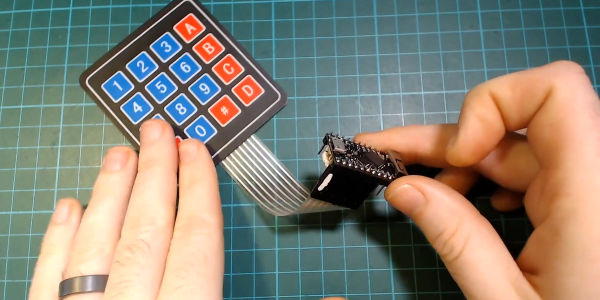
From a hardware standpoint, this project is incredibly straightforward. All you need to do is connect a membrane keypad up to the GPIO pins on the ESP32. Adding in a battery is a nice touch, and you probably would want to put it into a enclosure of some sort, but as a proof of concept it doesn’t get much easier than this. In this case [Brian] is using the TinyPICO board, but your personal ESP32 variant of choice will work just as well.

The rest of the project is all software, which [Brian] walks us through in the video after the break. There’s a preexisting library for Bluetooth Human Interface Device (HID) emulation on the ESP32, but it needs to be manually installed in the Arduino IDE. From there, he demonstrates how you can build up a functioning keyboard, including tricks such as sending multiple virtual keys at once.

In the past we’ve seen the ESP32 used to create a Bluetooth game controller, but the ability to emulate a keyboard obviously offers quite a bit more flexibility. With a practical demonstration of how easy as it is to turn this low-cost microcontroller into a wireless input device, hopefully we’ll start seeing more projects that utilize the capability.

Continue reading “Emulating A Bluetooth Keyboard With The ESP32”

Star Wars Themed Laser Badge: All That Is Missing Is The Pew Pew Sound Effect

In the quest to advance the art of the electronic badge, the boundaries of what is possible to manufacture in small quantities are continually tested. Full-colour PCBs, injection moulding, custom keyboards, and other wow factor techniques have all been tried, leading to some extremely impressive creations. With all this innovation then it’s sometimes easy to forget that clever design and a really good idea can produce an exceptional badge with far more mundane materials.

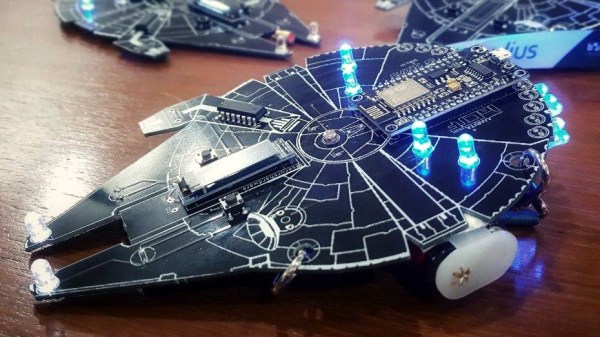
The 10th InCTF cybersecurity contest held at Amrita, Kerala, India, had a Star Wars themed badge designed by Team bi0s for the event. It takes the form of a Millennium Falcon-shaped PCB, with a NodeMCU ESP8266 board mounted on it, a shift register, small OLED display, and the usual array of buttons and LEDs. The fun doesn’t stop there though, because it also packs a light-dependent resistor and a laser pointer diode that forms part of one of its games. Power for this ensemble comes courtesy of a set of AA cells on its underside.

They took a novel approach to the badge’s firmware, with a range of different firmwares for different functions instead of all functions contained in one. These could be loaded through means of a web-based OTA updater. Aside from a firmware for serial exploits there was an Asteroids game, a Conway’s Game Of Life, and for us the star of the show: a Millennium Cannon laser-tag game using that laser. With this, attendees could “shoot” others’ LDRs, with three “hits” putting their opponent’s badge out of action for a couple of minutes.

Unusually this badge is a through-hole design as a soldering teaching aid, but its aesthetics do not suffer for that. We like its design and we especially like the laser game, we look forward to whatever next Team bi0s produce in the way of badges.

This isn’t the first badge packing a laser we’ve seen, at last year’s Def Con there was a laser synth badge. No laser tag battles though.

Werewolf Ears With A Sense For Danger

When walking down a dark street, it’s common to get a sense that one is being followed. It pays to check, of course, but what if we could get better data than simply a vague feeling from the unknown? [caitlinsdad] built a project that can do just that, with a cute pair of ears to boot.

The werewolf ears claim to be ISO Standard, though we’re yet to see the relevant documents to bear that out. Regardless, they use an Adafruit Gemma M0 microcontroller to run the show, hooked up to an infrared proximity sensor to detect movement. When triggered, the Gemma responds to the signal by twitching the wolf ears attached to a headband, alerting the wearer that someone is closing in.

Built and calibrated properly, this could be a useful invention for those who regularly find themselves followed by those skulking on the sidewalk and for whom moving to another neighbourhood is a more expensive option. We’ve seen other responsive wearables, too. Video after the break.

Continue reading “Werewolf Ears With A Sense For Danger”