Fail Of The Week: Z-Tape Is No Substitute For Solder

Here at Hackaday, we see all kinds of mechanical construction methods. Some are impressively solid and permanent, while others are obviously temporary in nature. The latter group is dominated by adhesives – sticky stuff like cyanoacrylate glue, Kapton tape, and the ever-popular hot glue. They’ve all got their uses in assembling enclosures or fixing components together mechanically, but surely they have no place in making solid electrical connections, right?

Maybe, maybe not. As [Tom Verbeure] relates, so-called Z-tape just might be an adhesive that can stand in for solder under certain circumstances. Trouble is, he couldn’t find the right conditions to make the tape work. Z-tape, more properly called “Electrically Conductive Adhesive Transfer Tape 9703”,  derives its nickname from the fact that it’s electrically conductive, but only in the Z-axis. [Tom] learned about Z-tape in [Joe FitzPatrick]’s malicious hardware prototyping workshop at the 2019 Hackaday Superconference, and decided to put it to the test.

A card from a Cisco router served as a testbed thanks to an unpopulated chip footprint. The 0.5-mm pin spacing on the TSOP-48 chip was within spec for the Z-tape, but the area of each pin was 30 times smaller than the recommended minimum bonding area. While the chip was held down mechanically by the Z-tape, only five of the 48 pins were electrically connected to the pads. Emboldened by the partial success, [Tom] tried a 28-pin SOIC chip next. The larger pins and pads were still six times smaller than the minimum, and while more of the pins ended up connected by the tape, he was unable to make all 28 connections.

Reading the datasheet for the adhesive revealed that constant pressure from a clamp or clip might be necessary for reliable connections, which suggests that gluing down SMD chips is probably not the best application for the stuff. Still, we appreciate the effort, and the fine photomicrographs [Tom] made showing the particles within the Z-tape that make it work – at least in some applications.
Progressive Or Thrash? How Metal Detectors Discriminate

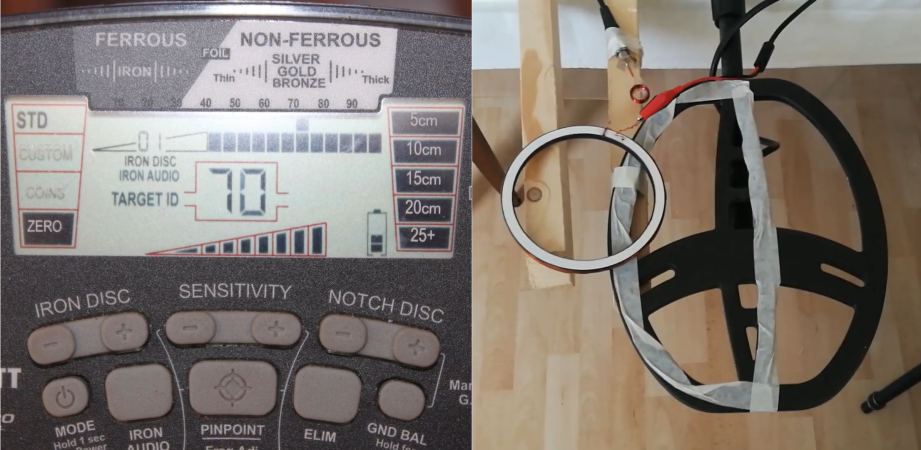
Metal detecting is a fun pastime, even when all you can find is a little bit of peace and a whole lot of pop tabs. [Huygens Optics] has a VLF-based metal detector that offers much more feedback than just a beep or no beep. This thing is fancy enough to discriminate between types of metal and report back a numerical ID value from a corresponding range of conductivity.

Most pop tabs rated an ID of 76 or 77, so [Huygens Optics] started ignoring these until the day he found a platinum wedding band without looking at the ID readout. Turns out, the ring registered in the throwaway range. Now thoroughly intrigued by the detector’s ID system, [Huygens Optics] set up a test rig with an oscilloscope to see for himself how the thing was telling different metals apart. His valuable and sweeping video walk-through is hiding after the break.

A Very Low-Frequency (VLF) detector uses two coils, one to emit and one to receive. They are overlapped just enough so that the reception coil can’t see the emission coil’s magnetic field. This frees up the reception coil’s magnetic field to be interrupted only by third-party metal, i.e. hidden treasures in the ground.

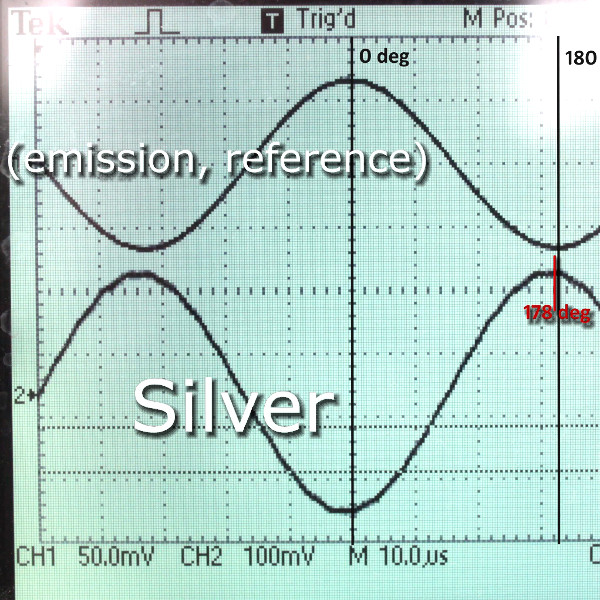
Once [Huygens Optics] determined which coil was which, he started passing metal objects near the reception coil to see what happened on the ‘scope. Depending on the material type and the size and shape of the object, the waveform it produced showed a shift in phase from the emission coil’s waveform. This is pretty much directly translated to the ID readout — the higher the phase shift value, the higher the ID value.

We’ve picked up DIY metal detectors of all sizes over the years, but this one is the ATtiny-ist.

Continue reading “Progressive Or Thrash? How Metal Detectors Discriminate”

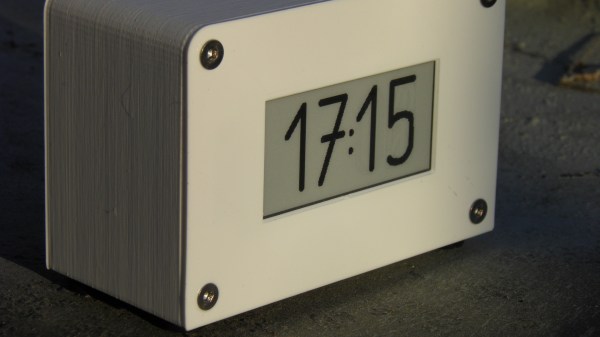
Agora, A Hackable E-Paper Clock

[Daniel Zilinec] appreciates the aesthetics of e-paper and thought it would make a great clock. 

The natural appearance of e-paper certainly appeals to a lot of hackers. We’ve seen everything from typewriters to trackers for imaginary money. The Agora clock is designed to be battery powered,;a classic night-stand alarm clock. With its wide angle viewing and even response to light it will be easily viewable even at dawn.

He saves the user a lot of time by designing the PCB up-front. It’s got a charging IC built in, back-light LEDs and pads for buttons. All you need to do is print out the case from the available thingiverse files and assemble. The schematic and firmware are available for the more enterprising hacker to work out as well.

There’s also a somewhat puzzling watch version of the clock. It would certainly be a fashion statement to wear one of these. Still, the is something nice about the organic feel and possible fonts that make it worth considering.

The Young Engineers Guide To University Capstone Projects

Engineering degrees are as wide and varied as the potential careers on offer out in the real world. There’s plenty of maths to learn, and a cavalcade of tough topics, from thermodynamics to fluid mechanics. However, the real challenge is the capstone project. Generally taking place in the senior year of a four-year degree, it’s a chance for students to apply everything they’ve learned on a real-world engineering project.

Known for endless late nights and the gruelling effort required, it’s an challenge that is revered beforehand, and boasted about after the fact. During the project, everyone is usually far too busy to talk about it. My experience was very much along these lines, when I undertook the Submarine That Can Fly project back in 2012.  The project taught me a lot about engineering, in a way that solving problems out of textbooks never could. What follows are some of the lessons I picked up along the way. Continue reading “The Young Engineers Guide To University Capstone Projects”

A Super Easy Laser Engraver

CNC comes in all shapes and sizes, from huge industrial lathes to homebuilt wire benders. [MJKZZ] has built their own compact rig, using optical drive parts to create a cute but effective laser engraver. (Video embedded below.)

The build aims to keep things simple by holding the laser stationary, and moving the bed instead. The laser in question is a 500 mW unit, driven by the Z axis on the Arduino CNC shield used to run the system. A DVD drive is taken apart, and the worm drive stepper motor assembly is used to slew the carriage back and forth, atop which is glued a bed. Upon this bed, a copy of the same assembly is then installed, offset 90 degrees, giving the X and Y axes.

The result of this setup is a lightweight moveable bed, controllable through Gcode with GRBL. With the laser situated above on some camera mounting gear, paper can be installed on the bed and engraved with ease. The resulting accuracy is admirable, and at full power, the laser is capable of cutting through the paper.

While it’s a lightweight rig, it could serve a purpose as a cheap and easy way to produce stencils from computerized artwork. Optical drives remain popular in the DIY CNC scene, as they’re a great way to source a moveable platform with all the mechanical considerations already worked out.

Continue reading “A Super Easy Laser Engraver”

The Strain Of Flu Shot Logistics

Did you get a flu shot this year? How about last year? In a world of next-day delivery and instant downloads, making the yearly pilgrimage to the doctor or the minute clinic feels like an outdated concept. Even if you get your shots free at the office, it’s still a pain to have to get vaccinated every year.

Unfortunately, there’s really no other way to deal with the annual threat of influenza. There’s no single vaccine for the flu because there are multiple strains that are always mutating. Unlike other viruses with one-and-done vaccinations, influenza is a moving target. Developing, producing, and distributing millions of vaccines every year is a massive operation that never stops, or even slows down a little bit. It’s basically Santa Claus territory — if Santa Claus delivered us all from mass epidemics.

The numbers are staggering. For the 2018-19 season, as in last year, there were 169.1 million doses distributed in the United States, up from 155.3 million doses the year before. How do they do it? We’re gonna roll up our sleeves and take a stab at it.

Continue reading “The Strain Of Flu Shot Logistics”

PixMob LED Wristband Teardown (Plus IR Emitters And How To Spot Them)

PixMob units are wearable LED devices intended for crowds of attendees at events like concerts. These devices allow synchronized LED effects throughout the crowd. [yeokm1] did a teardown of one obtained from a preview for the 2019 Singapore National Day Parade (NDP), and in the process learned about the devices and their infrastructure.

Suspected IR emitter for the PixMob units, mounted on a lighting tower (marked here in white).

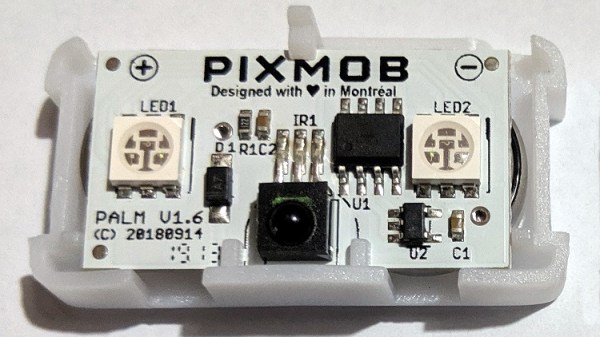
PixMob hardware has been known to change over time. This version has two RGB LEDs (an earlier version had only one), an unmarked EEPROM, an unmarked microcontroller (suspected to be the Abov MC81F4104), and an IR receiver module. Two CR1632 coin cells in series power the device. [yeokm1] has made the schematic and other source files available on the teardown’s GitHub repository for anyone interested in a closer look.

One interesting thing that [yeokm1] discovered during the event was the apparent source of the infrared emitter controlling the devices. Knowing what to look for and reasoning that such an emitter would be mounted with a good view of the crowd, [yeokm1] suspected that the IR transmitter was mounted on a lighting tower. Viewing the tower through a smartphone’s camera revealed a purplish glow not visible to the naked eye, which is exactly the way one would expect an IR emitter to look.

Sadly, there wasn’t any opportunity to record or otherwise analyze the IR signals for later analysis but it’s possible that the IR protocol might be made public at some point. After all, running custom code on an earlier PixMob board was made possible in part by asking the right people for help.