A Guide For Building Rubber Dome Keyboards

Let’s talk about computer keyboards for a second. The worst keyboards in the world are the cheap ‘rubber dome’ keyboards shipped with every Dell, HP, and whatever OEM your company has a purchasing agreement with. These ‘rubber dome’ keyboards use a resistive touchpad to activate a circuit, and the springiness of the key comes from a flexible rubber membrane. Mechanical keyboards are far superior to these rubber dome switches, using real leaf springs and bits of metal for the click clack happiness that is the sole respite of a soul-crushing existence. MX blues get bonus points for annoying your coworkers.

Mechanical key switches like the Cherry MX, Gateron, or whatever Razer is using aren’t the be-all, end-all mechanical keyswitch. History repeats, horseshoe theory exists, and for the best mechanical keyswitch you need to go back to rubber domes. Torpre switches are surprisingly similar to the crappy keyboards shipped out by OEMs, but these switches have actual springs, turning your key presses into letters through a capacitive touchpad. Is this a superior switch? Well, a keyboard with Torpre switches costs more than a keyboard with Cherry MX switches, so yeah, it’s a better switch.

It seems everyone is building their own mechanical keyboards these days, and the recipe is always the same: get a few dozen Cherry MX (or clone) switches, build a PCB, grab a Teensy 2, and use the tmk keyboard firmware. There’s not much to it. DIY Torpre boards are rare because of the considerations of building a capacitive switching PCB, but now there’s a DIY guide to making the perfect rubber dome keyboard.

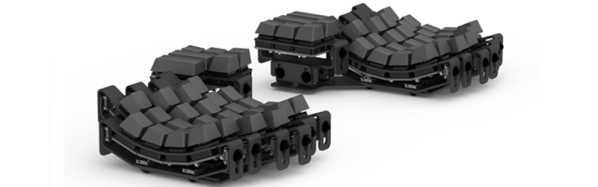
[tomsmalley] put together this guide after reviewing a few amazing projects scattered around the web. Over on Deskthority, [attheicearcade] is building a custom, sculpted, split Torpre board and a split Happy Hacking Keyboard. These are projects worthy of a typing god, but so far there has been no real beginner’s guide for interfacing with these weird capacitive switches.

As far as circuitry goes on these capacitive boards, the PCB is the thing. Each key has a pair of semi-circular pads on the PCB to serve as plates on a capacitor. These pads are connected to a microcontroller through an analog mux, with a little opamp magic thrown into the mix.

With a relatively decent guide to the hardware, [tomsmalley] has also been working on his own firmware for capacitive switches. Shockingly, this firmware is compatible with the Teensy 3.0, which will provide enough horsepower to read a bunch of analog values and spit out USB.

Mechanical keyboards are great, and we really like to see all these hardware creators pushing the state of the art. You can only see so many custom sculpted keycaps or DIY MX boards, though, and we’re really eager to see where the efforts to create a custom Torpre board take us. If you’re building one of these fantastic keyboards, send it in on the tip line.
PVC Submersible ROV

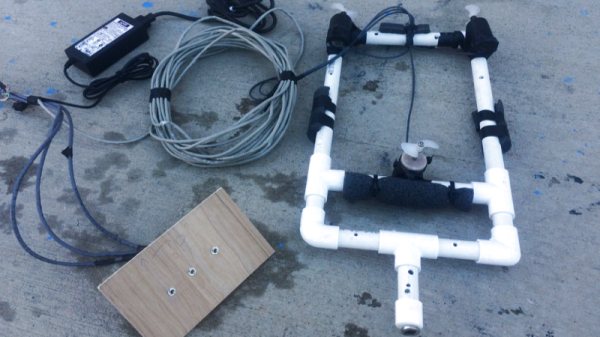
[mark.brubaker.1] and his crew decided to make a submersible for a school project using PVC pipes as a frame. It has two motors on the back to provide forward thrust and steering as well as a horizontal mounted motor in the middle of the PVC chassis to provide up and down thrust. They used regular motors which they waterproofed by inserting them inside a case full of plumbers wax. We’re not sure how long this will hold at the bottom of the ocean, but it works fine for a school project in the pool. Here’s the instructions on how to make one.

The build is completely analog, the controller is a board with three switches which individually control the different motors. So if you want to turn left, you fired up the right motor. For right you do the opposite and fire up the left motor. Up and down, well, you get the picture. If you have a swimming pool, lake or some water body nearby and you’re looking for a weekend project with your kids, this is a great tip. It’s not an Arduino controlled robot fish, but it’s a first step in that direction; you can later on use the frame to improve on the design and add some electronics.

Continue reading “PVC Submersible ROV”

Microscope DSLR Mount Using PVC & Heat

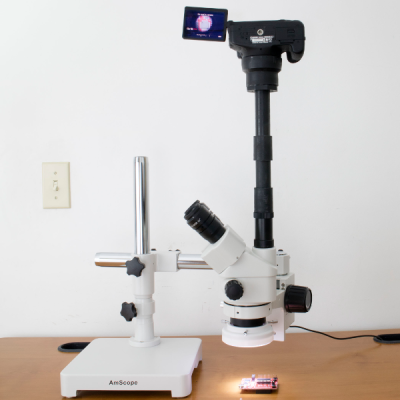
Microscopes are a great way to see the mysteries of the universe hidden at the smaller scale. When they were first developed, scientists had to rely on illustration to convey their findings through the lens. Thankfully we can  now rely on photography to help us out instead. Many microscopes come with a special port — often called a trinocular port — for mounting a camera. Using this, [Brian] developed a DSLR mount for his microscope using a hacker staple: PVC pipe.

squareThe virtues of PVC pipe are many and varied. It’s readily available in all manner of shapes and sizes, and there’s a wide variety of couplers, adapters, solvents and glues to go with it. Best of all, you can heat it to a point where it becomes soft and pliable, allowing one to get a custom fit where necessary. [Brian] demonstrates this in using a heat gun to warm up a reducer to friction fit the DSLR lens mount. Beyond that, the mount uses a pair of lenses sourced from jeweller’s loupes to bring the image into focus on the camera’s sensor, mounted tidily inside the PVC couplers.


PVC’s a great way to quickly and easily put a project together — so much so that there are fittings available specifically for using PVC to build stuff. Video below the break.

Continue reading “Microscope DSLR Mount Using PVC & Heat”

Acoustic Mirrors: How To Find Planes Without RADAR

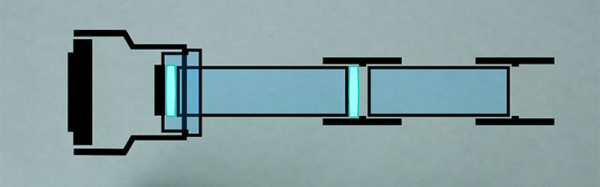
A lot of science museums and parks feature something called an acoustic mirror. The one at Houston’s Discovery Green park is called the listening vessels. [Doug Hollis] created two acoustic mirrors 70 feet apart, pointing at each other. If you stand or sit near one of the vessels, you can hear a whisper from someone near the other vessel. The limestone installations (see right) are concave and focus sound like a parabolic mirror will focus light.

mirrorJust a science curiosity, right? Maybe today, but not always. The story of these devices runs through World War II and is an object lesson in how new technology requires new ways of thinking about things.


Continue reading “Acoustic Mirrors: How To Find Planes Without RADAR”

Danger, Will Robinson: Sweet B9 Build

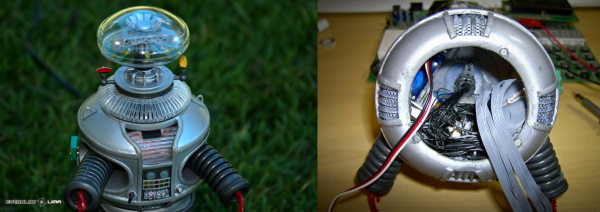
3If you’ve ever seen “Lost in Space” in Portuguese, you’d definitely recognize the phrases that [Everaldo]’s B9 robot reads off of the SD card inside its belly. If not, you can check out the video below and learn such important phrases as “Warning! Alien approaching.” or “The planet’s breaking up” (we presume). Or head over to [Everaldo]’s website and check out the great model build log. And while you’re there, check out his model TRS80 too.)

There’s a lot of solid model-building going on here, but hidden inside the pretty exterior is some good old-fashioned hacking. Once the audio was stored on the SD card, [Everaldo] simply soldered it straight into the project. There’s also an IR daughterboard that drives the robot, while blinky lights and servo motors bring it to life. We want one for our desk!

If you haven’t made an IR-remote-based project, you really should. It’s still among the most hackable of methods to transmit data to or from a microcontroller, while making use of one of those superfluous IR remotes you have kicking around the house. If you’re short on inspiration, and not a model-builder, check out this Hacklet dedicated to IR, or our favorite smart-home(r) device of all time.

Are you thinking what we’re thinking? This would make an excellent entry in the Hackaday Sci-Fi contest which is accepting entries through March 6th.

Continue reading “Danger, Will Robinson: Sweet B9 Build”

A Micro RC Plane Builder Shares His Tricks

There are individuals who push tools, materials, and craftsmanship to the limit in the world of micro RC aircraft, and [Martin Newell] gives some insight into the kind of work that goes into making something like a 1:96 scale P-51 Mustang from scratch. The tiny plane is 100% flyable. It even includes working navigation lights and flashing cannons (both done with 0402 LEDs) and functional, retractable landing gear. It weighs an incredible 2.9 grams. Apart from the battery, everything in the plane was built or assembled from scratch. A video is embedded below.

Continue reading “A Micro RC Plane Builder Shares His Tricks”

Ikea Standing Desk Goes Dumb To Smart On LIN Bus

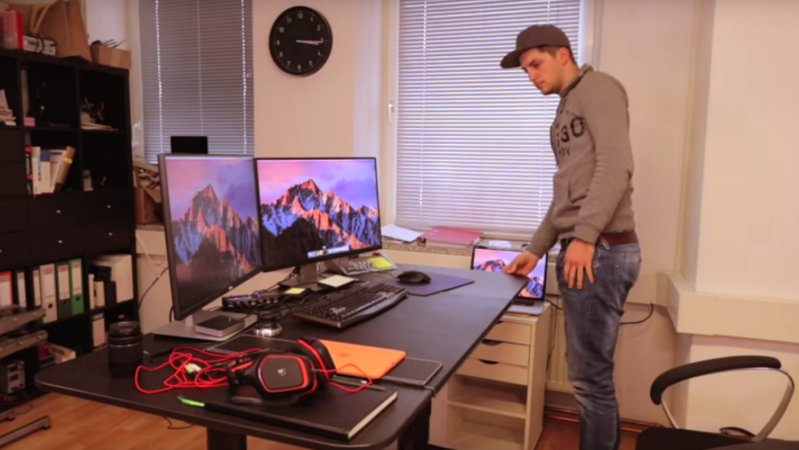
IKEA’s products are known for their clean, Scandinavian design and low cost, but it is their DIY or “assemble it yourself” feature that probably makes them so popular with hackers. We seem to receive tips about IKEA hacks with a consistent regularity. [Robin Reiter] has a Bekant Sit/Stand motorized table with buttons to raise and lower the surface, but it doesn’t have any memory presets. That’s a shame because it requires a lot of fiddling with the up/down buttons to get it right every time. It would be nice to press a button, go grab a Coffee, and come back to find it adjusted at the desired height. With a little bit of hacking, he was able to not only add memory preset buttons, but also a USB interface for future computer control.

The existing hardware consists of a PIC16LF1938 micro-controller with two buttons for movement control and a LIN bus  protocol which communicates with the automotive grade motors with integrated encoders that report position values. After a bit of sniffing around with his oscilloscope and analyzer, he was able to figure out the control codes for the motor movements. For some strange reason, however, the LIN signals were inverted, so he had to introduce a transistor signal inverter between the PIC master and the Arduino Nano that would act as a slave LIN node. Software was made much easier thanks to an Arduino library developed by [Zapta] for the LIN Bus signal Injector, The controls now have four buttons — two to replicate the original up/down movements, and the other two to act as memory presets.

The code, schematic and a simple wiring layout are posted on Github, in case there are others out there who’d like to replicate this hack. Check out the video after the break where he gives a walk through the code.

Continue reading “Ikea Standing Desk Goes Dumb To Smart On LIN Bus”