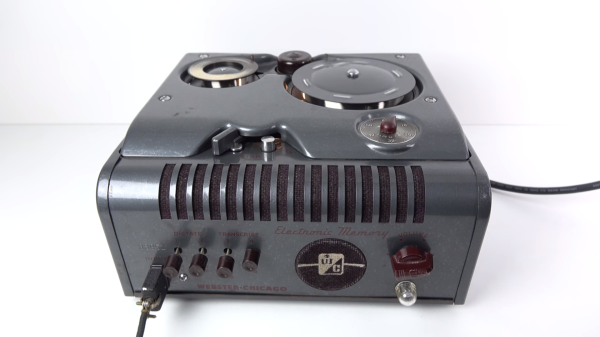
A Tech That Didn’t Make It: Sound On Stainless Steel Wire

For a brief period in the 1940’s it might have been possible for a young enamored soul to hand his hopeful a romantic mix-spool of wire. This was right before the magnetic tape recorder and its derivatives came into full swing and dominated the industry thoroughly until the advent of the compact disk and under a hundred kilogram hard disk drives. [Techmoan] tells us all about it in this video.

The device works as one would expect, but it still sounds a little crazy. Take a ridiculously long spool of steel wire the size of a human hair(a 1 hour spool was 2.2km of wire), wind that through a recording head at high speed, magnetize the wire, and spool it onto a receiving spool.

If you’re really lucky the wire won’t dramatically break causing an irreversible tangle of wire. At that point you can reverse the process and hear the recorded sound. As [Techmoan] shows, the sound can best be described as… almost okay. Considering that its chief competition at the time was sound carved into expensive aluminum acetate plates, this wasn’t the worst.

The wire recorder lived on for a few more years in niche applications such as airplane black boxes. It finally died, but it does sound like a really fun couple-of-weekends project to try and build one. Make sure and take good pictures and send it in if any of you do.

Continue reading “A Tech That Didn’t Make It: Sound On Stainless Steel Wire”

Creating Unbeatable Videogame AI

Super Smash Bros. Melee is a multiplayer fighting game released for the Nintendo GameCube in 2001. For the last decade and a half, it has become one of the premier fighting game eSports, and it is the reason Nintendo still makes a GameCube controller for the Wii U. Smash Melee has an intense following, and for years the idea of an AI that could beat top-tier players at Melee was inconceivable – the game was just far too complex, the strategies too demanding, and the tactics too hard.

[Dan] a.k.a. [AltF4] wasn’t satisfied that a computer couldn’t beat players at Melee, and a few years ago started work on the first Melee AI that could beat any human player. He just released Smashbot at this year’s DEF CON, and while the AI is limited, no human can beat this AI.

Continue reading “Creating Unbeatable Videogame AI”

Retrotechtacular: Tom Carter Revolutionized Your Phone

It is hard to remember, but there was a time when you couldn’t hook much to a telephone line except a telephone. Although landlines are slowly falling out of favor, you can still get corded and wireless phones, answering machines, and even dial up modems. Alarm systems sometimes connect to the phone system along with medical monitoring devices and a host of other accessories.

All of that’s possible because of a Texan named Tom Carter. Tom Carter was the David that stood up to one of the biggest Goliath’s of his day: the phone company. The phone company had a legal monopoly on providing phone service. The reasoning was that it didn’t make sense to have multiple competing companies trying to run wires to every house and business in the country. Makes sense, right?

Continue reading “Retrotechtacular: Tom Carter Revolutionized Your Phone”

Skin Bling: Wearable Electronics From Golden Temporary Tattoos

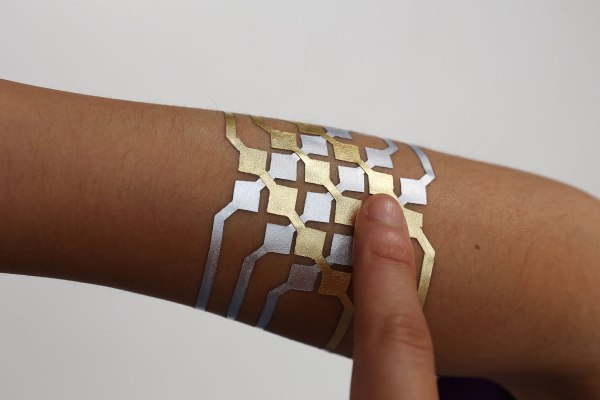
MIT Media Lab and Microsoft have teamed up to take wearable devices one step further — they’ve glued the devices directly to the user’s skin. DuoSkin is a temporary tattoo created with gold leaf. Metallic “Flash” temporary fashion tattoos have become quite popular recently, so this builds on the trend. What the team has done is to use them to create user interfaces for wearable electronic devices.

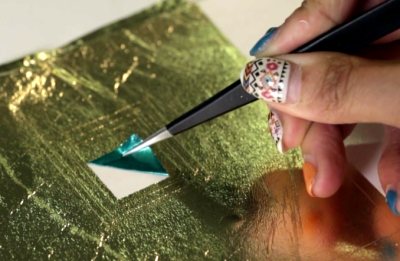
weeding-gold-leaf-temporary-tattooGenerally speaking, gold leaf is incredibly fragile. In this process to yield the cleanest looking leaf the gold is not actually cut. Instead, the temporary tattoo film and backer are cut on a standard desktop vinyl cutter. The gold leaf is then applied to the entire film surface. The cut film/leaf can then be “weeded” — removing the unwanted portions of film which were isolated from the rest by the cutting process — to complete the temporary tattoo. The team tested this method and found that traces 4.5 mm or more thick were resilient enough to last the entire day on your skin.
The gold leaf tattoos make excellent capacitive touch sensors. The team was able to create sliders, buttons, and even 2 dimensional diamond grids. These controls were used to move a cursor on a computer or phone screen. They were even able to create a wearable NFC tag. The gold leaf is the antenna, and the NFC chip itself is mounted on the temporary tattoo backer.

These devices all look great, but with the exception of the NFC chip, we’re not seeing the electronics driving them. Capacitive touch sensors used as a UI for a phone will have to have a Bluetooth radio and a battery somewhere. We’re that’s all hidden under the arm of the user. You can see what we’re taking about in the video after the break. That said, the tools and materials are ubiquitous and easy to work with. Take a quick read through the white paper (PDF) and you can be making your own version of this today.

Continue reading “Skin Bling: Wearable Electronics From Golden Temporary Tattoos”

Filling The Automation Gap In Garment Manufacturing

Even in this age of wearable technology, the actual fabric in our t-shirts and clothes may still be the most high-tech product we wear. From the genetically engineered cotton seed, though an autonomous machine world, this product is manufactured in one of the world’s largest automation bubbles. Self-driving cotton pickers harvest and preprocess the cotton. More machines blend the raw material, comb it, twist and spin it into yarn, and finally, a weaving machine outputs sheets of spotless cotton jersey. The degree of automation could not be higher. Except for the laboratories, where seeds, cotton fibers, and yarns are tested to meet tight specifications, woven fabrics originate from a mostly human-free zone that is governed by technology and economics.

Continue reading “Filling The Automation Gap In Garment Manufacturing”

Blob Grid Array Technique Mounts Board-To-Board

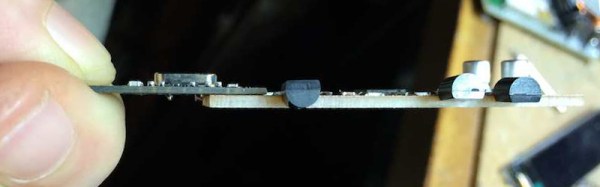
[Howard Matthews] mills his own PCBs, and man, does he hate drilling through-holes. Manually changing the bits between engraving and drilling after isolation routing? What is this? The stone age? [Howard] decided to rethink his DIY PCB manufacturing process, and came to one essential conclusion: Only a fraction of these drills are actually necessary.

Continue reading “Blob Grid Array Technique Mounts Board-To-Board”

Beer Gun Shoots Non-Lethal Doses Of Beverages

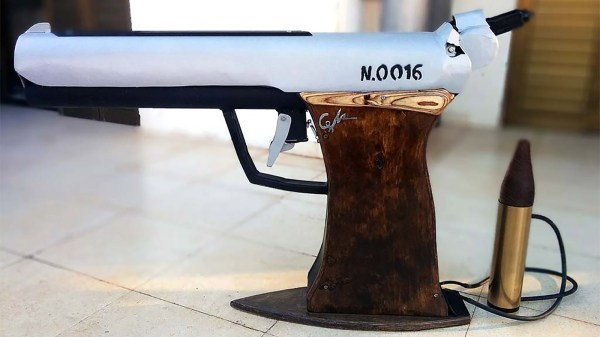
[Michalis Mavros] likes building things from steel. Guns are from steel. He and his friends also like action movies and beer. To address everybody’s needs [MakeItExtreme] style, he built a gigantic beer gun. At the size and caliber of a small field artillery cannon, the spectacular piece of art dispenses chilled pop cans for unsuspecting movie night visitors.

Continue reading “Beer Gun Shoots Non-Lethal Doses Of Beverages”