Hacking When It Counts: Spy Radios

World War II can be thought of as the first electronic war. Radio technology was firmly established commercially by the late 1930s and poised to make huge contributions to the prosecution of the war on all sides. Radio was rapidly adopted into the battlefield, which led to advancements in miniaturization and ruggedization of previously bulky and fragile vacuum tube gear. Radios were soon being used for everything from coordinating battlefield units to detonating anti-aircraft artillery shells.

But it was not just the battlefields of WWII that benefitted from radio technology. From apartments in Berlin to farmhouses in France, covert agents toiled away over sophisticated transceivers, keying in coded messages and listening for instructions. Spy radios were key clandestine assets, both during the war and later during the Cold War. Continue reading “Hacking When It Counts: Spy Radios”

Hedberg Is A Bionic Hand Made From A Single Keurig

Developing into a modern hacker and tinkerer requires a lot of things: electronics study, programming knowledge, and patience (among many other things). But, the most important quality a hacker can have is curiosity. The desire to see how things work is what drives most budding hackers towards the dismantling of family appliances and electronic gadgets.

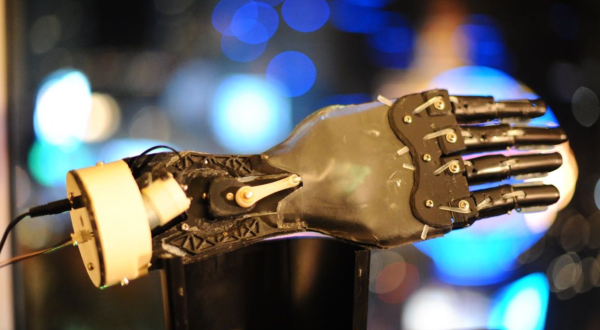
Many end up scavenging parts from the things around the house for their first projects. But, with money and more ambitious builds comes the need to purchase parts off the shelf. There is, however, something to be said for the ingenuity that comes with building something solely with scavenged parts, and that’s what [Evan Booth] decided to do, in a spectacular fashion.

Continue reading “Hedberg Is A Bionic Hand Made From A Single Keurig”

From Project To Kit: Instructions Are Everything

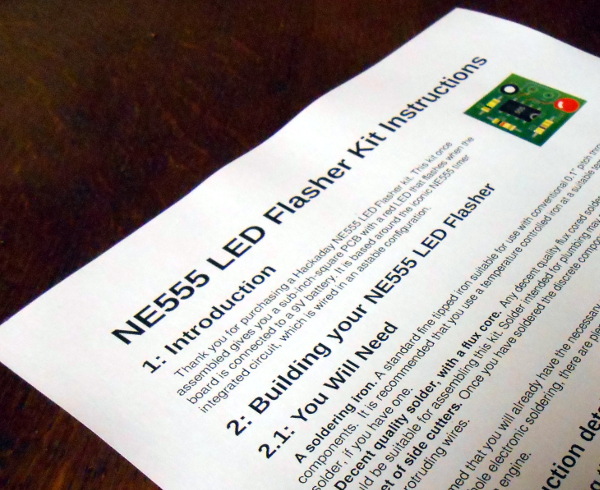
A printed copy of the instructions for our example kit

We’ve had two previous articles in this series on turning a personal electronic project into a saleable kit, in which we’ve examined the kit market in a broader context for a new entrant, and gone on to take a look at the process of assembling the hardware required to create a product. We’ve used an NE555 LED flasher as a simple example , from which we’ve gone through the exercise of setting a cost of production and therefore a retail price.

The remaining task required to complete our kit production is to write the documentation that will accompany it. These will be the instructions from which your customers will build the kit, and their success and any other customers they may send your way will hang on their quality. So many otherwise flawless kits get this part of the offering so wrong, so for a kit manufacturer it represents an easy win into which to put some effort.
Continue reading “From Project To Kit: Instructions Are Everything”

Tattoos By Robotic Arm With Pinpoint Accuracy

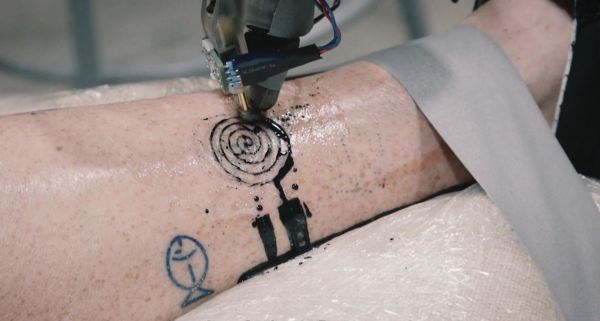
Tattoos are an ancient art, and as with most art, is usually the domain of human expertise. The delicate touch required takes years to master, but with the capacity for perfect accuracy and precision movements, enlisting a robotic arm and some clever software to tattoo a willing canvas is one step closer thanks to the efforts of [Pierre Emm] and [Johan da Silveira].

They began by using a 3D printer modified to ‘print’ with a tattoo needle. Catching the interest of the Applied Research Lab at Autodesk, the next logical step was to use an industrial robot arm get a human under the tattooing machine — dubbed Tatoué — after scanning the limb in question and loading it into Dynamo, their parametric design environment to map the design onto the virtual limb.

Continue reading “Tattoos By Robotic Arm With Pinpoint Accuracy”

Technically A Hack. Still Questionable. Remote Control Food.

We thought we were going to read an article about, perhaps, a quadcopter that could fetch beer, or donuts. What we got was more along the lines of a donut dragging itself across the floor, rendering it pitiful and advisibly indigestible.

Sometimes people joke about not wanting to get in mind of a crazy person. We understand. While we could certainly follow [Michael Kohn]’s logic, the motivation was alien. Either way, in a rare turn of events there was not a single Arduino to be seen; just reverse engineering, unique solutions, and even a custom board. This is what some of you have been asking for… we think.

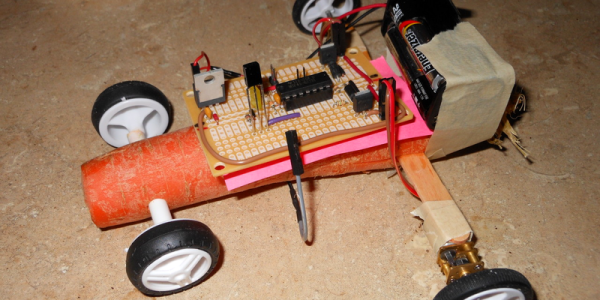
The brain of the questionable contraption is a TI MSP430G2231 and a tiny forward only motor driver circuit. The MSP waits for a signal from a hacked IR remote control from a cheap RC car. It then turns those into the appropriate motor control signals which go to some of those nice tiny metal gearboxes.

There were, naturally, a lot of technical issues in mounting the electronics to the food that, well… they didn’t need to be solved, but they were solved. For example, masking tape apparently does not stick well to green peppers, so toothpicks must be employed to pin the tape in place. Hopefully knowledge like this is scheduled for the nightly wipe while we sleep, but we’ll probably hold onto  it till we die, unlike expensive piano lessons.

In the end we had a good laugh, and the idea is so dumb it will probably be an educational Kickstarter next week. Video after the break.

Continue reading “Technically A Hack. Still Questionable. Remote Control Food.”

Hackaday Prize Entry: Autorouters Are For The Weak

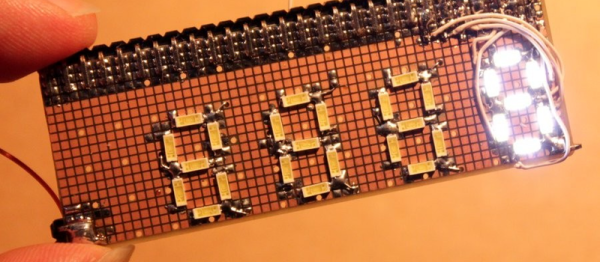
[Yann]’s DYPLED entry into this year’s Hackaday Prize isn’t very useful to most people. It’s a tiny module that connects to a 16-bit parallel bus, and displays a hexadecimal number on a few LEDs. It’s useful if you’re diagnosing a problem on a computer from 1982, but just barely. The real wonder here is how [Yann] is doing this cheaply and easily using some weird techniques and strange parts.

The display for this tiny device is an array of 36 LEDs, arranged into a set of five seven-segment displays. Homebrew seven-segment displays are cool, but how is he driving it? Not with a microcontroller, that’s for sure. Instead, [Yann] is using an old trick of using parallel memory to store the patterns of the seven-segment displays. This parallel memory comes in the form of a two megabit Flash chip, with the data inputs tied to the 16-bit input on the board and the data outputs connected directly to the LEDs. It’s a brute force approach, but it works.

There are a few additional features for this tiny board, including a switch to display a 16-bit bus in hexadecimal or decimal, signed or unsigned, and a pot to change how bright the LEDs are. The most amazing part is how [Yann] managed to fit all of this on a very, very small PCB. Most of that trick is due to using a thin, small TSSOP package for the Flash memory, but fitting this circuit onto a two layer board is amazing work, and a great entry for the Hackaday Prize.

Wake Up With A NeoPixel Sunrise Alarm Clock

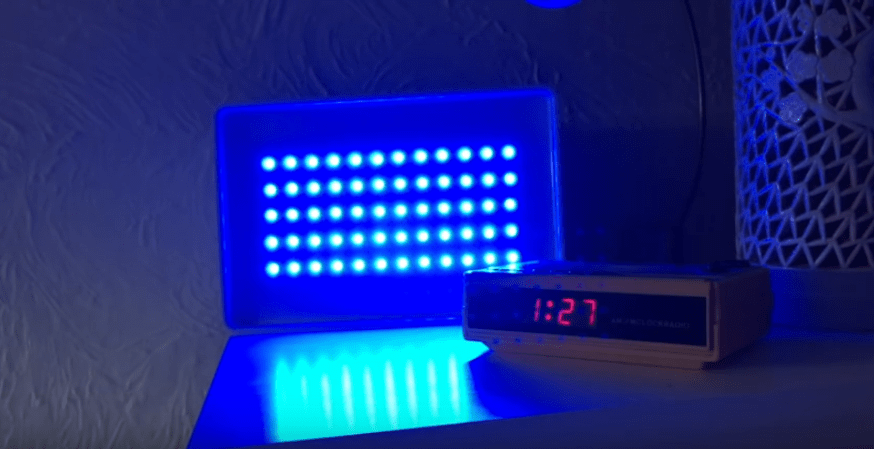
Like many of us, [Lee] wakes up every morning grumpy and tired. Once he decided to try to do something about it, he settled on making a sunrise alarm clock using NeoPixels. Over the course of thirty minutes the clock illuminates 60 NeoPixels one by one in blue mode to simulate a sunrise.

The clock has three modes: 30-minute sunrise, analog time display, and a seconds counter that uses the full RGB range of the LEDs to light up one for each passing second. It runs on an Arduino Pro Mini knockoff and an RTC module for the sake of simplicity. [Lee] chained NeoPixel strips together in five rows of eight, which allowed him to use a 3×5 font to display the time. The only other electronics are passives to protect the LEDs.

NeoPixels are great, but powering them becomes an issue pretty quickly. [Lee] did the math and figured that he would need 3.4 A to drive everything. He found a 3-outlet USB power adapter that delivers 3.4 A total while shopping at IKEA for an enclosure. [Lee] took his first Instructable from beginner to intermediate level by cracking the adapter open and using two of the USB ports wired in parallel to provide 5 V at 3.4 A. [Lee] has the code available along with detailed instructions for replicating this build. Be sure to check out the demo after the break.

We love a good clock build around here, especially when they involve Blinkenlights. For those less interested in building an alarm clock, here’s a word clock that pulls time and weather data with an ESP8266.

Continue reading “Wake Up With A NeoPixel Sunrise Alarm Clock”