Super Strong 3D Component Carbon Fiber Parts

[prubeš] shows that parts printed with carbon fiber filament are as strong, or at least as stiff, as you’d expect. He then shows that his method for producing carbon fiber parts with a mixture of traditional lay-up and 3D printing is even stronger and lighter.

[prubeš] appears to be into the OpenR/C project and quadcopters. These things require light and strong parts for maximum performance. He managed to get strength with carbon fiber fill filament, but the parts weren’t light enough. Then he saw [RichMac]’s work on Thingiverse. [RichMac] designed parts with pre-planned grooves in which he ran regular carbon fiber tow with epoxy. This produced some incredibly strong parts. There’s a section in his example video, viewable after the break, where he tests a T joint. Even though the plastic starts to fail underneath the carbon fiber, the joint is still strong enough that the aluminum tube inside of it fails first.

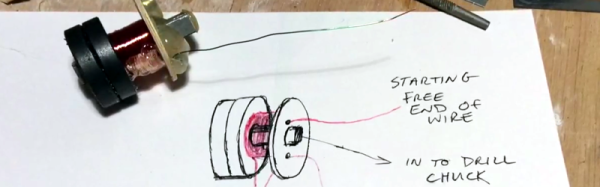
[prubeš] innovation on [RichMac]’s method is to remove as much of the plastic from the method as possible. He designs only the connection points of the part, and then designs a 3D printable frame to hold them in place. After he has those in hand, he winds the tow around the parts in a sometimes predetermined path. The epoxy cures onto the 3D print creating a strong mounting location and the woven carbon fiber provides the strength.

His final parts are stronger than 100% infill carbon fill prints, but weighs 8g instead of 12g.  For a quadcopter this kind of saving can add up fast.

Continue reading “Super Strong 3D Component Carbon Fiber Parts”

Propane Tanks Transformed Into Extreme Sandblaster

The [Make It Extreme] team has been racking up the builds lately, and a lot of them are heavy with metalworking. When you’re doing that kind of work, and you put as much care into finishing your builds like they do, it’s a good idea to have access to a sandblaster. So naturally, they built a really nice one.

We’ve featured a couple of [Michalis Mavros] and team’s build recently; you’ll no doubt recall this viciously effective looking spot welder and a sketchy angle grinder cum belt sander. The sandblaster build, centered as it is around scrap propane tanks, has some lethal potential, but luckily the team displaced any remaining gas from the tanks with water before doing any cutting. The design allows for a lot of sand in the tanks, with plans to provide a recycling system for the grit, which is a nice touch. And it works great – they even used it to clean it up before final finishing in the trademark [Make It Extreme] green and black paint job.

What we really like about the video, though, is that it’s a high-speed lesson on metalworking techniques. There’s a ton to learn here about all the little tricks needed to bring a large-scale metalworking project to fruition. It also demonstrates that we really, truly need a plasma cutter and a metalworking lathe.

Continue reading “Propane Tanks Transformed Into Extreme Sandblaster”

Taming A Variac With A Thermistor

The folks at TOG, Dublin Hackerspace, have a large variac. A variac is a useful device for testing some fault conditions with AC mains powered equipment, it allows an operator to dial in any AC output voltage between zero, and in the case of TOG’s variac, 250V.

Their problem was with such a magnificent device capable of handling nearly 3KW, it presented an inductive load with a huge inrush current at power-on that would always take out the circuit breakers. Breakers come with different surge current handling capabilities, evidently their building is fitted with the domestic rather than the industrial variants.

Their solution was a simple one, they fitted an NTC surge limiter in series with the variac input. This is a thermistor whose resistance falls with temperature. Thus on start-up it presented an extra 12 ohm load which was enough to keep the breaker happy, but soon dropped to a resistance which left the variac with enough juice.

This is a simple fix to a problem that has faced more than one hackerspace whose imperfect lodgings are wired to domestic-grade spec. In a way it ties in neatly with our recent feature on mains safety; making the transformer no longer a pain to use means that it is more likely to be used when it is needed.

Via: TOG, Dublin Hackerspace.

Hackaday Prize Entry: DIY Ceramic PCBs

We’ve seen hundreds of ways to create your own PCBs at home. If you have a laser printer, you can put traces on a piece of copper clad board. If you have some hydrogen peroxide and acid, you can etch those traces. Don’t have either? Build a tiny mill and cut through the copper with a Dremel. Making your own PCBs at home is easy, provided your boards are made out of FR4 and copper sheets.

Printed circuit boards can be so much cooler than a piece of FR4, though. Ceramic PCBs are the height of board fabrication technology, producing a very hard board with near perfect electrical properties, high thermal conductivity, and a dielectric strength similar to mineral transformer oil. Ceramic PCBs are for electronics going to space or inside nuclear reactors.

For his entry into this year’s Hackaday Prize, [Chuck] is building these space grade PCBs. Not only is he tackling the hardest challenge PCB fabrication has to offer, he’s building a machine to automate the process.

The basic process of building ceramic PCBs is to create a sheet of alumina, glass powder, and binder. This sheet is first drilled out, then silver ink is printed on top. Layers of these sheets are stacked on top of each other, and the whole stack is rammed together in a press and fired in a furnace.

Instead of making his own unfired ceramic sheets, he’s just buying it off the shelf. It costs about a dollar per square inch. This material is held down on a laser cutter/inkjet combo machine with a vacuum table. It’s just a beginning, but [Chuck] has everything he needs to start his experiments in creating truly space grade PCBs.

The HackadayPrize2016 is Sponsored by:

DIY PCB Fixture Helps You Spread The Paste

(Yeah, we don’t know what that title means either.) But holding your PCBs down in one place and nicely registered while you spread solder paste over them is a problem that needs solving, and [Carsten] did it nicely.

High volume PCB manufacturers have expensive screen printers to do this. The standard hardware hacker solution is to tape some scrap PCBs of the same thickness down to the table to hold the PCBs solidly in place. But if you’re doing a large run, and if you’re already firing up the laser to cut out mylar stencils, you might as well cut out some PCB-holding fixtures to match.

[Carsten]’s blog entry is short on details, but you get the idea just from looking at the picture, right? Adding registration pins to the holder that engage with the stencils could make this a real time-saver as well. As long as you’re lasering the stencil and the holder, there’s nothing stopping you. It’s a simple idea, but a good one, so we thought we’d share. Our only remaining question: what’s a Karate Light?

Building A Sturdy Remote Control Mailbox

This DIY mailbox pretty much has it all. Not only is it waterproof and secure, it’s beautifully built and unlikely to arouse the suspicion of or induce fear in the mailman.

It’s made of 2mm thick sheet metal and features accents made of merri, a rather nice blood wood native to Western Australia. [George] of Make It Extreme built this mailbox primarily for remote control access, the idea being that each of his family members would have a key fob remote to open it. There’s an input panel under the lid in case someone loses or forgets their remote.

The setup is simple. That 12V solar panel under the address number is connected to a solar charge controller and charges a small battery. Pushing the A button on the key fob remote triggers the latch to slide over, unlocking the door. A push of the B button turns on an interior light for late-night mail collecting. The tube on the side is for leaflets and other postal miscellany. Now, the coolest feature: when mail passes through the slot, it lets [George] know by calling his cell phone. Check out the build/demo video after the break.

We’ve featured all kinds of mailboxen over the years. This wifi-enabled ‘box uses an Amazon Dash button and a Pi to play the AOL notification on the owner’s phone. The flag on this adorable mini mailbox goes up when there’s mail in the real one outside.

Continue reading “Building A Sturdy Remote Control Mailbox”

Custom Case Lends Retro Look To Smart TV

Refits of retro TVs and radios with the latest smart guts are a dime a dozen around Hackaday. And while a lot of these projects show a great deal of skill and respect for the original device, there’s something slightly sacrilegious about gutting an appliance that someone shelled out a huge portion of their paycheck to buy in the middle of the last century. That’s why this all-new retro-style case for a smart TV makes us smile.

GE 806 restored by Steve O'Bannon
1940s GE 806 restored by Steve O’Bannon

Another reason to smile is the attention to detail paid by [ThrowingChicken]. His inspiration came from a GE 806 TV from the 1940s, and while his build isn’t an exact replica, we think he captured the spirit of the original perfectly. From the curved top to the deep rectangular bezel, the details really make this a special build. One may quibble about not using brass for the grille like the original and going with oak rather than mahogany. In the end though, you need to work with the materials and tooling you have. Besides, we think the laser cut birch ply grille is pretty snazzy. Don’t forget the pressure-formed acrylic dome over the screen – here’s hoping that our recent piece on pressure-forming helped inspire that nice little touch.

This project was clearly a labor of love – witness the bloodshed after a tangle with a tablesaw while building the matching remote – and brought some life to an otherwise soulless chunk of mass-produced electronics.

[via r/DIY]