Hackaday Links Column Banner

Hackaday Links: February 12, 2017

Taking small LCD screens, a tiny computer running Linux, and a 3D printed enclosure to build miniature versions of old computers is a thing now. Here’s [Cupcakus]’s tiny little Apple II, complete with Oregon Trail. This Apple II is running on a C.H.I.P., uses a 3s lithium battery from a drone, and works with a Bluetooth keyboard and joystick. Yes, the power button on the monitor works.

At Hackaday, we get a lot of emails from people asking the most important question ever: “how do you become a hardware hacker?” [Tex Projects] lays it all out on the line. All you need to do is to buy five of something every time you need one. Need some header pins? Buy five. A sensor? five. Come to the realization that anything you build could be bought for less money.

Are we still doing low-poly Pokemon? [davedarko] has an idea for the Sci-Fi contest we’re running. He’s going to give children seizures. He’s refreshing a project of mine by putting lights, blinkies, and noisy things in a 3D printed Porygon, the original 3D printed Pokemon. Porygon was the subject of that one episode of the Pokemon cartoon that sent 635 Japanese children to the hospital. The episode was banned in America, but it was actually Pikachu that caused the flashing lights.

‘Member Clickspring? He’s the guy who made a fantastic mechanical clock using nothing except a few bits of brass, a blowtorch, a tiny mill and lathe, and a lot of patience. Now he’s building the Antikythera mechanism. The Antikythera mechanism is a 2000-year-old device designed to calculate the phases of the moon, the motion of the planets, and other local astronomical phenomena. This is going to be a masterpiece, and will eventually end up in a museum, so be sure to subscribe to his YouTube channel.

Acoustic Mirrors: How To Find Planes Without RADAR

A lot of science museums and parks feature something called an acoustic mirror. The one at Houston’s Discovery Green park is called the listening vessels. [Doug Hollis] created two acoustic mirrors 70 feet apart, pointing at each other. If you stand or sit near one of the vessels, you can hear a whisper from someone near the other vessel. The limestone installations (see right) are concave and focus sound like a parabolic mirror will focus light.

mirrorJust a science curiosity, right? Maybe today, but not always. The story of these devices runs through World War II and is an object lesson in how new technology requires new ways of thinking about things.

Continue reading “Acoustic Mirrors: How To Find Planes Without RADAR”

Good In A Pinch: The Physics Of Crimped Connections

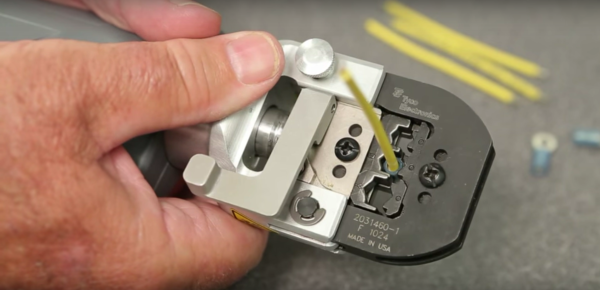
I had a friend who was an electronics assembly tech for a big defense contractor. He was a production floor guy who had a chip on his shoulder for the engineers with their fancy book-learnin’ who couldn’t figure out the simplest problems. He claimed that one assembly wasn’t passing QC and a bunch of the guys in ties couldn’t figure it out. He sidled up to assess the situation and delivered his two-word diagnosis: “Bad crimp.” The dodgy connector was re-worked and the assembly passed, much to the chagrin of the guys in the short-sleeved shirts.

Aside from the object lesson in experience sometimes trumping education, I always wondered about that “bad crimp” proclamation. What could go wrong with a crimp to so subtly futz with a circuit that engineers were baffled? How is it that we can rely on such a simple technology to wire up so much of the modern world? What exactly is going on inside a crimped connection anyway?

Continue reading “Good In A Pinch: The Physics Of Crimped Connections”

Taking The Leap Off Board: An Introduction To I2C Over Long Wires

If you’re reading these pages, odds are good that you’ve worked with I²C devices before. You might even be the proud owner of a couple dozen sensors pre-loaded on breakout boards, ready for breadboarding with their pins exposed. With vendors like Sparkfun and Adafruit popping I²C devices onto cute breakout boards, it’s tempting to finish off a project with the same hookup wires we started it with.

Image result for i2c sensor array
prototyping starts here, but we’re in danger when projects finish with this sort of wiring

It’s also easy to start thinking we could even make those wires longer — long enough to wire down my forearm, my robot chassis, or some other container for remote sensing. (Guilty!) In fact, with all the build logs publishing marvelous sensor “Christmas-trees” sprawling out of a breadboard, it’s easy to forget that I²C signals were never meant to run down any length of cable to begin with!

As I learned quickly at my first job, for industry-grade (and pretty much any other rugged) projects out there, running unprotected SPI or I²C signals down any form of lengthy cable introduces the chance for all sorts of glitches along the way.

I thought I’d take this week to break down that misconception of running I²C over cables, and then give a couple examples on “how to do it right.”

Heads-up: if you’re just diving into I²C, let our very own [Elliot] take you on a crash course. Continue reading “Taking The Leap Off Board: An Introduction To I2C Over Long Wires”

Friday Hack Chat: Making And Breaking Hardware With Bunnie

bunnie03-01This Friday, February 10th, at 9am PST, Hackaday.io will be graced with one of the greatest hardware creators in recent memory. [Bunnie Huang] will be talking about making and breaking hardware in the Hackaday.io Hack Chat.

[Bunnie] is a nearly peerless hardware hacker. He literally wrote the book on hacking the XBox, developed the Chumby, and developed the Novena, an open source Laptop. He’s torn down the Form 2 3D printer, explored the iPhone’s hackability with [Edward Snowden], wrote the book you want to have on your carryon when flying into Hong Kong, and recently released The Hardware Hacker, a retelling of his adventures in hardware hacking. He’s now working on the Love to Code platform.

[Bunnie] is a bridge across worlds. There is no one else so deeply embedded in the world of electronics manufacturing that is also willing to tell the world about what he’s found. If you want to learn about electronics, the Bunnie Studios blog is a mandatory read.

For this week’s Hack Chat, [Bunnie] will be taking questions from the Hackaday.io community. If you’ve ever wanted to know what it takes to build a few thousand things, this is the guy to ask.

Having trouble figuring out when 09:00 PST is in your local time zone? Here’s a countdown timer!

Here’s How To Take Part:

Buttons to join the project and enter the Hack Chat

Our Hack Chats are live community events on Hackaday.io Hack Chat group messaging. Log into Hackaday.io, visit that page, and look for the ‘Join this Project’ Button. Once you’re part of the project, the button will change to ‘Team Messaging’, which takes you directly to the Hack Chat.

You don’t have to wait until Friday; join whenever you want and you can see what the community is talking about.

Upcoming Hack Chats

These Hack Chats are a weekly thing, and we have a few more on the books. Next week, we’ll be covering RF design with [Jenny List], and later going over mechanical manufacturing with Fictiv. You can check out all the upcoming Hack Chats on this project.

Using A Lecher Line To Measure High Frequency

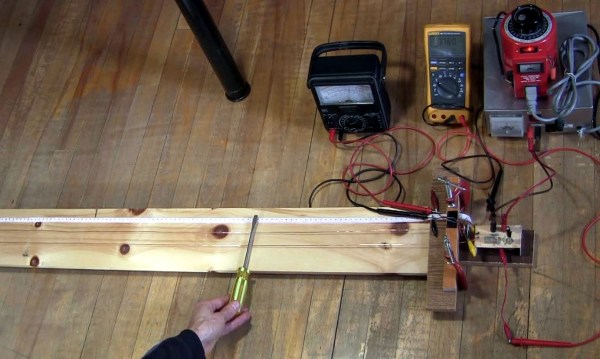
How do you test the oscillator circuit you just made that runs between 200MHz and 380MHz if all you have is a 100MHz oscilloscope, a few multimeters and a DC power supply? One answer is to put away the oscilloscope and use the rest along with a length of wire instead. Form the wire into a Lecher line.

That’s just what I did when I wanted to test my oscillator circuit based around the Mini-Circuits POS-400+ voltage controlled oscillator chip (PDF). I wasn’t going for precision, just verification that the chip works and that my circuit can adjust the frequency. And as you’ll see below, I got a fairly linear graph relating the control voltages to different frequencies.

What follows is a bit about Lecher lines, how I did it, and the results.

Continue reading “Using A Lecher Line To Measure High Frequency”

Hackaday Links Column Banner

Hackaday Links: February 5, 2017

A lot of people around here got their start in electronics with guitar pedals. This means soldering crappy old transistors to crappy old diodes and fawning over your tonez, d00d.  Prototyping guitar pedals isn’t easy, though, and now there’s a CrowdSupply project to make it easier The FX Development Board is just that — a few 1/4″ jacks, knobs, pots, power supply, and a gigantic footswitch to make prototyping guitar pedals and other musical paraphernalia easy. Think of it as a much more feature-packed Beavis Board that’s still significantly cheaper.

How do Communicators in Star Trek work? Nobody knows. Why don’t the crew always have to tap their badge before using it? Nobody knows. How can the com badge hear, ‘Geordi to Worf’, and have Worf instantly respond? Oh, we’ve argued about this on IRC for years now. Over on Hackaday.io, [Joe] is building a Star Trek com badge. The electronics are certainly possible with modern microcontrollers, but for the enclosure, we’ll have to review a few scenes from Time’s Arrow and The Enemy.

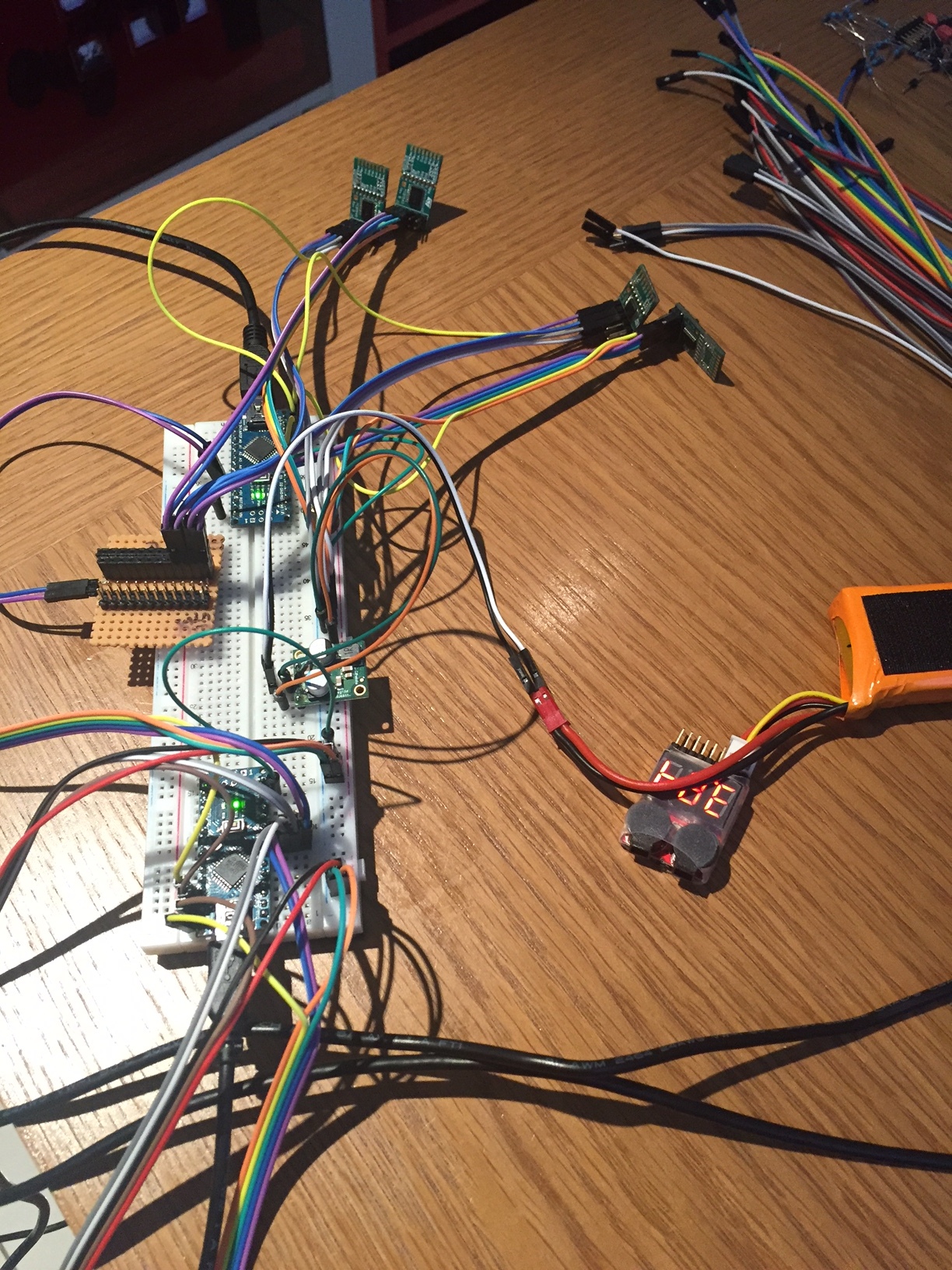
[Alois] was working with an Intel Edison on a breadboard. He was generating a signal, and sending it through a little tiny breadboard wire to an oscilloscope. The expected waveform should have been a nice square wave at 440MHz. What he got out of this wire was a mess. You shouldn’t use long wires when probing circuits. That little breadboard wire was a perfect radiator for 440MHz, and the entire setup turned into an antenna.

[Douglas] is running a Kenwood TM-D710A as his amateur radio rig. This radio does APRS stuff, but it requires an external GPS and power source to do it right. GPS receivers are now very small and very cheap, so [Douglas] just stuffed a GPS module inside his radio. The module itself is a GP-20U7, a tiny GPS module the size of a postage stamp, and wired it up to a few pads on the radio PCB.

Here’s an upcoming Kickstarter that’s going straight to the front page of Boing Boing. It’s Pong, in coffee table format which we first saw last Spring. Instead of racing the beam, this version of Pong is mechanical. The ball is a cube, the paddles are slightly longer cubes, and the entire game is a highly refined CNC machine. Here’s something from seven years ago that’s also Pong in coffee table format. Pongmechanik is electromechanical Pong, built entirely out of switches, relays, and a few motors.