Developed On Hackaday: $50k Reached In A Week!

Around 500 awesome people backed the Mooltipass offline password keeper crowdfunding campaign, raising a total of $50k in less than a week… which is nearly half our goal.

The development team and I would therefore like to thank our readers for their support. We were featured by several electronics websites, which definitely helped spreading the world of open source security devices. Many interesting discussions spawned in either our comments section or official Google Group. One new contributor even started looking into implementing TOTP on the Mooltipass.

Another hot topic was a possible smaller and more powerful Mooltipass v2, implementing other functionalities like U2F and encrypted file storage. You may therefore wonder why we didn’t start with it… the reason is simple: limited resources. Our project is made by (great) non-remunerated contributors who took a lot of their spare time to work on the Mooltipass v1. We therefore preferred working on something we’d be sure we could deliver rather than wasting $4M by making promises. We therefore hope that our crowdfunding campaign might allow an even bigger collaboration around a Mooltipass v2!

Ask Hackaday: Why Don’t We Have Flexible Displays Yet?

A few times a month we receive extremely well crafted crowdfunding campaigns in our tip line that make us doubt our sense of reality. While this article therefore isn’t a hack, we felt it would be a good place to start a discussion around OLED flexible displays.

As the dedicated Wikipedia article states flexible displays have been around for a few years already. In 2013, the Samsung Galaxy Round was unveiled as the world’s first mobile phone with a 5.7″ flexible display. The phone (and the screen) were curved in shape but the phone itself was solid. The same goes for the recent Samsung Gear S smart watch.

Yet for only $350 in a $50k goal crowdfunding campaign the Portal flexible wearable smartphone seems to have all the answers. It is scratch & shatter proof, water-resistant, flexible, includes a ‘Portal proprietary flexible battery’, the ‘Fastest multi-core CPU’, gyro, compass, barometer, Bluetooth 4.0, NFC, GPS…. Specifications are even subject to change to ensure the best available components… and it is 89% funded. As they mention,

building a smartphone or a tech company isn’t rocket science.

We also found a 70% funded €100k crowdfunding campaign for a watch bracelet (right click to translate) that will include GPS, Bluetooth, NFS (not a typo), a uSD card, a 4 lines LED screen and a battery for a few days autonomy… how surprising that no major manufacturer thought of that.

This leads us to the title of this post: why don’t we have truly flexible displays yet? We’ll let our readers discussion this point in the comments section below…

Retrotechtacular: The Jet Story

A plane from Britain is met in the US by armed security. The cargo? An experimental engine created by Air Commodore [Frank Whittle], RAF engineer air officer. This engine will be further developed by General Electric under contract to the US government. This is not a Hollywood thriller; it is the story of the jet engine.

The idea of jet power started to get off the ground at the turn of the century. Cornell scholar [Sanford Moss]’ gas turbine thesis led him to work for GE and ultimately for the Army. Soon, aircraft were capable of dropping 2,000 lb. bombs from 15,000 feet to cries of ‘you sank my battleship!’, thus passing [Billy Mitchell]’s famous test.

The World War II-era US Air Force was extremely interested in turbo engines. Beginning in 1941, about 1,000 men were working on a project that only 1/10 were wise to. During this time, American contributions tweaked [Whittle]’s design, improving among other things the impellers and rotor balancing. This was the dawn of radical change in air power.

Six months after the crate arrived and the contracts were signed, GE let ‘er rip in the secret testing chamber. Elsewhere at the Bell Aircraft Corporation, top men had been working concurrently on the Airacomet, which was the first American jet-powered plane ever to take to the skies.

In the name of national defense, GE gave their plans to other manufacturers like Allison to encourage widespread growth. Lockheed’s F-80 Shooting Star, the first operational jet fighter, flew in June 1944 under the power of an Allison J-33 with a remarkable 4,000 pounds of thrust.

GE started a school for future jet engineers and technicians with the primary lesson being the principles of propulsion. The jet engine developed rapidly from this point on.

Continue reading “Retrotechtacular: The Jet Story”

Hacklet 21 – Halloween Hacks Part 2

We asked, you listened! Last weeks Hacklet ended with a call for more Halloween themed projects on Hackaday.io. Some great hackers uploaded awesome projects, and this week’s Hacklet is all about featuring them. Every one of our featured projects was uploaded to Hackaday.io within the last 7 days.

masseffect2Mass Effect meets Daft Punk in [TwystNeko’s] 5-Day SpeedBuild Mass Effect Armor.  As the name implies, [TwystNeko] built the armor in just 5 days. Ethylene-vinyl acetate (EVA) foam was used to make most of the costume. Usually EVA foam needs to be sealed. To save time, [TwystNeko] skipped that step, and just brushed on some gold acrylic paint.  The actual cuts were based on an online template [TwystNeko] found. To top the armor off, [TwystNeko] used a custom built Daft Punk Guy Manuel helmet. Nice!

 

rat[Griff] wins for the creepiest project this week with Rat Bristlebot. Taking a page from the Evil Mad Scientist Labs book, [Griff] built a standard bristlebot based on a toothbrush and a vibrating pager motor. He topped off the bristlebot with a small rubber rat body from the party store. The rat did make the ‘bot move a bit slower, but it still was plenty entertaining for his son. [Griff] plans to use a CdS cell to make the rat appear to scamper when room lights are turned on. Scurrying rats will have us running for the hills for sure!

pumpkin[MagicWolfi] was created Pumpkin-O-Chain to light up Halloween around the house. This build was inspired by [Jeri Ellsworth’s] motion sensing barbot dress from 2011. Pumpkin-O-Chain uses the a similar RC delay line with 74HC14 inverters to make the LEDs switch on in sequence. He wanted the delay to be a bit longer than [Jeri’s] though, so he switched to 100K ohm resistors in this build. The result is a nice effect which is triggered when someone passes the PIR motion sensor.

pumpkinlite[Petri] got tired of his Jack-o’-lantern candles burning out, so he built his own Pumpkin Light. The light made its debut last year with a Teensy 2.0++ running the show. This year, [Petri] decided to go low power and switched to an MSP430 processor on one of TI’s launchpad boards. With plenty of outputs available on the Teensy and the MSP430, [Petri] figured he might as well use and RGB LED. The new improved Jack-o’-lantern can run for hours with no risk of fire.

We ccuth2an’t end this week without mentioning [Griff’s] updated Crochet Cthulhu Mask. We featured the mask in last week’s Hacklet, and called  [Griff] out for an update. Well, the final project is up, and it looks great! We’re sure [Griff’s] son will be raking in the candy this year!

It’s time for trick-or-treating, which means we have to end this episode of The Hacklet. As always, see you next week. Same hack time, same hack channel, bringing you the best of Hackaday.io!

Developed On Hackaday: The Answer Is Below

In one month the Mooltipass offline password keeper project will be one year old.

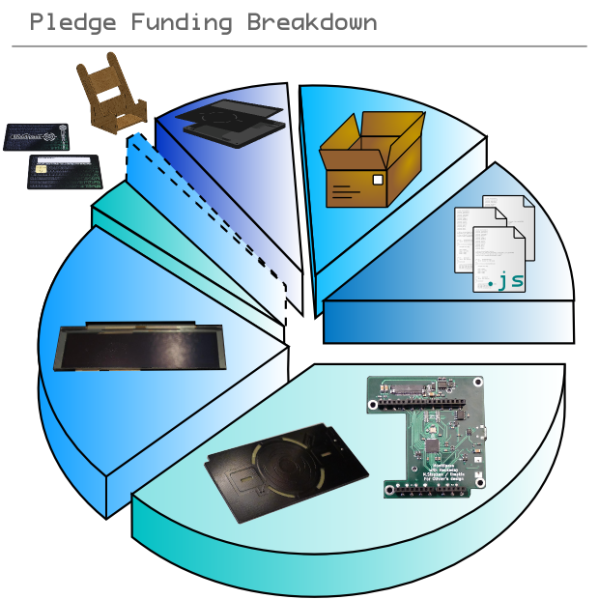
We hope that our twice a month Developed on Hackaday series posts allowed our dear readers to see what are the steps involved in a device’s life, going from idea to prototype to crowdfunding-ready product. The Mooltipass is the fruit of a unique world-wide collaboration around open source, developed by and for security minded people who (for most of them) never saw each other. Relating our progress here enabled us to benefit from our readers’ feedback and make sure that we didn’t miss important wanted features. Contrary to other campaigns that we often debunk on Hackaday, we preferred to wait until we had a beta-tester approved device to move to the crowdfunding stage. Our geekiest readers will therefore find the launch date embedded in this post, other may want to subscribe to our official Google group to stay updated.

Retrotechtacular: Fire Control Computers In Navy Ships

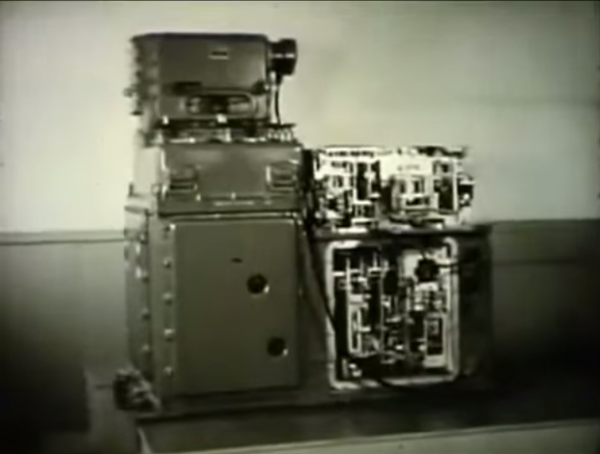
Here is a two-part Navy training film from 1953 that describes the inner workings of mechanical fire control computers. It covers seven mechanisms: shafts, gears, cams, differentials, component solvers, integrators, and multipliers, and does so in the well-executed fashion typical of the era.

Fire control systems depend on many factors that occur simultaneously, not the least of which are own ship’s speed and course, distance to a target, bearing, the target’s speed and course if not stationary, initial shell velocity, and wind speed and direction.

The mechanisms are introduced with a rack and pinion demonstration in two dimensions. Principally speaking, a shaft carries a value based on revolutions. From this, a system can be geared at different ratios.

Cams take this idea further, transferring a regular motion such as rotation to an irregular motion. They do so using a working surface as input and a follower as output. We are shown how cams change rotary motion to linear motion. While the simplest example is limited to a single revolution, additional revolutions can be obtained by extending the working surface. This is usually done with a ball in a groove.

Continue reading “Retrotechtacular: Fire Control Computers In Navy Ships”

GaTech's Invention Studio

Adventures In Hackerspacing: GA Tech’s Invention Studio

We feature hacker/makerspaces of all kinds here at Hackaday, and these days, encountering a hackerspace at a college or university isn’t uncommon. School-backed spaces are often mildly impressive, too, with plenty of room and better-than-most equipment.

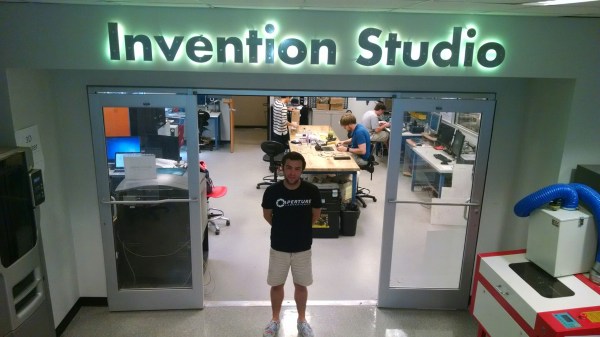
Georgia Tech’s Invention Studio, however, is different. This space is nothing short of staggering.

Once you’ve walked past the wall of commercial-grade 3D printers lining the entryway, you’ll find yourself in the Electro-lounge, a general meeting and hangout room with some basic tools. Each room beyond has a specific purpose, and is packed full of equipment. We aren’t just going on a tour, though, because this is Adventures in Hackerspacing. Click through the break for a behind-the-scenes look at how this hackerspace provides a top-rate experience for its makers and how Invention Studio thrives with an entirely student-run leadership.

Continue reading “Adventures In Hackerspacing: GA Tech’s Invention Studio”