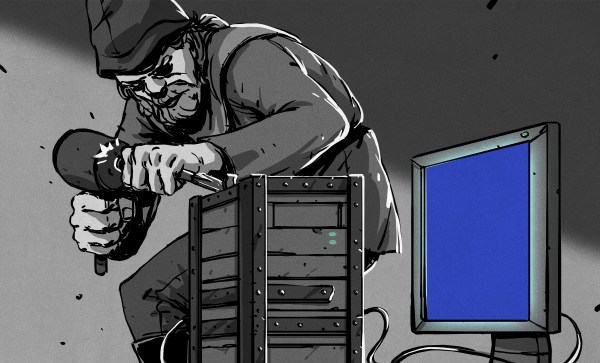
It seems there’s a service for everything, but sometimes you simply learn more by doing it yourself. If you haven’t enjoyed the somewhat anachronistic pleasures of running your own server and hosting your own darn website, well, today you’re in luck!
Yes, we’re going to take an old computer of some sort and turn it into a web server for hosting all of your projects at home. You could just as easily use a Raspberry Pi –even a Zero W would work — or really anything that’ll run Linux, but be aware that not all computing platforms are created equally as we’ll discuss shortly.
Yes, we’re going to roll our own in this article series. There are a lot of moving parts, so we’re going to have to cover a lot of material. Don’t worry- it’s not incredibly complicated. And you don’t have to do things the way we say. There’s flexibility at every turn, and you’re encouraged to forge your own path. That’s part of the fun!
Note: For the sake of space we’re going to skip over some of the most basic details such as installing Linux and focus on those that have the greatest impact on the project. This article gives a high level overview of what it takes to host your project website at home. It intentionally glosses over the deeper details and makes some necessary assumptions.
Scientists estimate that approximately 900 species have gone extinct in the last five centuries alone, to say nothing of the thousands or millions that vanished from life in the billions of years before that.
Every high school physics student knows c, or the speed of light, it’s 3 x 10^8 metres per second. More advanced or more curious students will know that this is an approximation, and the figure of 299,792,458 metres per second that forms the officially accepted figure comes from a resonance of the caesium atom from which is derived a value for the second.
Galileo Galilei, whose presence in this story should come as no surprise. Justus Sustermans, Public domain.
But for those who are really curious about measuring the speed of light the question remains: Just how did we arrive at that figure and how long have we been measuring it? The answer contains some surprises, and some exceptionally clever scientific thought and experimentation over the centuries.
The nature of light and whether it had a speed at all had been puzzling philosophers and scientists since antiquity, but the first experiments performed in an attempt to measure it were you will not be surprised to hear, performed by Galileo sometime in the early 17th century. His experiment involved his observation of assistants uncovering lanterns at known distances away, and his observations failed to arrive at a figure.
Later that century in 1676 the first numerical estimate of the speed of light was made by the Danish astronomer Ole Rømer, who observed an apparent variation in the period of one of Jupiter’s moons depending upon whether the Earth was approaching it or moving away from it. From this he was able to estimate the time taken for light to cross the Earth’s orbit, and from there the mathematician Christiaan Huygens was able to produce a figure of 220,000,000 metres per second.
Spinning Cogs And Mirrors: Time Of Flight
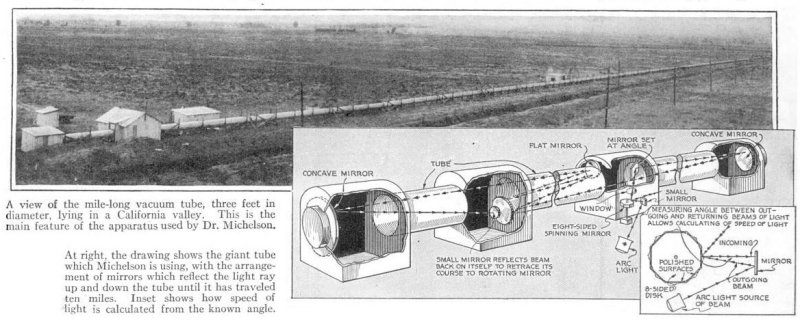
The mile-long evacuated tube used in Michelson’s time-of-flight experiment. H. H. Dunn, Public domain.
The experiments with which we will perhaps be the most familiar are the so-called time of flight measurements, which take Galileo’s idea of observing the delay as light travels over a distance, and bring to it ever higher precision. This was first performed in the middle of the 19th century by the French physicist Hippolyte Fizeau, who reflected a beam of light from a mirror over several kilometres, and used a toothed wheel to chop it into pulses. The pulses could be increased in frequency by moving the wheel faster until the time taken for the light to travel the distance from wheel to mirror and back again matched the separation between teeth and the returning pulse could be observed. His calculation of 313,300,000 metres per second was successively improved upon through the work of succession of others including Léon Foucault, culminating in the series of experiments by the American physicist Albert A. Michelson in the 1920s. Michelson’s final figure stood at 299,774,000 metres per second, measured through a multi-path traversal of a mile-long evacuated tube in the California desert. In the second half of the century the techniques shifted to laser interferometry, and in the quest to define the SI units in terms of constants, eventually to the definition mentioned in the first paragraph.
The most fascinating part of the story probably encapsulates the essence of scientific discovery, namely that while to arrive at something takes the work of many scientists building on the work of each other, it can then often be rendered into a form that can be understood by a student who hasn’t had to pass through all that effort. We could replicate Fizeau and Michelson’s experiments with a pulse generator, laser diode, and oscilloscope, which while of little scientific value nearly a century after Michelson’s evacuated tube, is still immensely cool. Has anyone out there given it a try?
Tales of Raspberry Pi SD card corruption are available online by the fistful, and are definitely a constant in Pi-adjacent communities. It’s apparent that some kind of problems tend to arise when a Raspberry Pi meets an SD card – which sounds quite ironic, since an SD card is the official and recommended way of booting a Pi. What is up with all of that?
I can start with a history lesson. Back when Raspberry Pi launched in 2012 – which is now 10 years ago – there were SD card controller driver problems, which makes sense given the wide variety of SD cards available out there. They were verifiably fixed one by one at some point in time, as debugging goes, their impact decreased and bugs with individual cards got smoothed over. This is how the “Pi SD card corruption” meme was originally born; however, if the problems were to end there, so would the meme. Yet, tales of broken SD cards plague us to this day – way less severe than they were in the beginning, but pronounced enough that you’ll see people encounter them every now and then.
Over the years, a devoted base of Pi SD card haters has grown. Their demand has been simple – Raspberry Pi has to get an ability to boot from something else, in large part because of corruption reasons, but also undeniably because of speed and capacity/cost limitations of SD cards. Thanks to their demands and work, we’ve seen a series of projects grow from unofficial efforts and hacks into officially supported Raspberry Pi abilities – USB boot being initially more of a workaround but now something you can enable out of the box, SSD-equipped Pi enclosures becoming more of a norm, and now, NVMe boot appearing on the horizon. Every few years, we get a new way to boot a Pi. Continue reading “Raspberry Pi And The Story Of SD Card Corruption”→
Early in the morning of February 24th, Dr. Jeffrey Lewis, a professor at California’s Middlebury Institute of International Studies watched Russia’s invasion of Ukraine unfold in realtime with troop movements overlaid atop high-resolution satellite imagery. This wasn’t privileged information — anybody with an internet connection could access it, if they knew where to look. He was watching a traffic jam on Google Maps slowly inch towards and across the Russia-Ukraine border.
As he watched the invasion begin along with the rest of the world, another, less-visible facet of the emerging war was beginning to unfold on an ill-defined online battlefield. Digital espionage, social media and online surveillance have become indispensable instruments in the tool chest of a modern army, and both sides of the conflict have been putting these tools to use. Combined with civilian access to information unlike the world has ever seen before, this promises to be a war like no other.
Modern Cyberwarfare
The first casualties in the online component of the war have been websites. Two weeks ago, before the invasion began en masse, Russian cyberwarfare agents launched distributed denial of service (DDoS) attacks against Ukrainian government and financial websites. Subsequent attacks have temporarily downed the websites of Ukraine’s Security Service, Ministry of Foreign Affairs, and government. A DDoS attack is a relatively straightforward way to quickly take a server offline. A network of internet-connected devices, either owned by the aggressor or infected with malware, floods a target with request, as if millions of users hit “refresh” on the same website at the same time, repeatedly. The goal is to overwhelm the server such that it isn’t able to keep up and stops replying to legitimate requests, like a user trying to access a website. Russia denied involvement with the attacks, but US and UK intelligence services have evidence they believe implicates Moscow. Continue reading “The Invisible Battlefields Of The Russia-Ukraine War”→
Spacecraft rocket engines come in a variety of forms and use a variety of fuels, but most rely on chemical reactions to blast propellants out of a nozzle, with the reaction force driving the spacecraft in the opposite direction. These rockets offer high thrust, but they are relatively fuel inefficient and thus, if you want a large change in velocity, you need to carry a lot of heavy fuel. Getting that fuel into orbit is costly, too!
Ion thrusters, in their various forms, offer an alternative solution – miniscule thrust, but high fuel efficiency. This tiny push won’t get you off the ground on Earth. However, when applied over a great deal of time in the vacuum of space, it can lead to a huge change in velocity, or delta V.
This manner of operation means that an ion thruster and a small mass of fuel can theoretically create a much larger delta-V than chemical rockets, perfect for long-range space missions to Mars and other applications, too. Let’s take a look at how ion thrusters work, and some of their interesting applications in the world of spacecraft!
Neural networks have become a hot topic over the last decade, put to work on jobs from recognizing image content to generating text and even playing video games. However, these artificial neural networks are essentially just piles of maths inside a computer, and while they are capable of great things, the technology hasn’t yet shown the capability to produce genuine intelligence.
Cortical Labs, based down in Melbourne, Australia, has a different approach. Rather than rely solely on silicon, their work involves growing real biological neurons on electrode arrays, allowing them to be interfaced with digital systems. Their latest work has shown promise that these real biological neural networks can be made to learn, according to a pre-print paper that is yet to go through peer review. Continue reading “Researchers Build Neural Networks With Actual Neurons”→