A Lowly 8-Bit Micro Busts Copy Protection From The 16-Bit Era

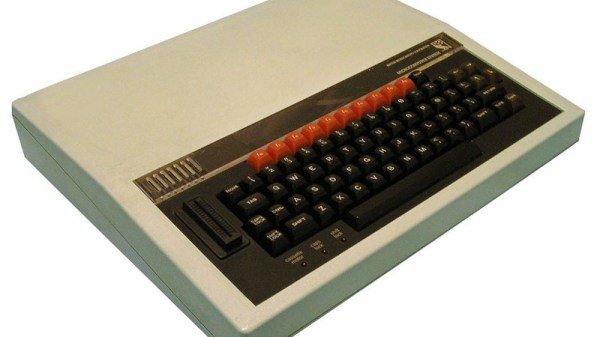
When floppy disks were the data storage medium of choice, software companies and in particular game developers came up with ever more inventive ways to make them difficult to copy. Tinkering at the edges of the disc format standards didn’t come cheap though, and for example the Dungeon Master game for the Atari ST was reported as using $40,000 worth of custom hardware to achieve its so-called “fuzzy bit” technique. [Chris Evans] set out to recreate it, not by building a modern version of the custom hardware, but by doing it the hard way, with an early-1980s 8-bit BBC Micro home computer.

One could be forgiven for thinking that a computer sporting a 2 MHz 6502 would be unable to manage this task without extra hardware, and were it simply the 6502 itself you would of course be right. So to get anywhere he had to get creative with the Beeb’s built-in peripherals. Eschewing the floppy controller it was hooked up directly to the parallel port, and after a voltage problem courtesy of the drive’s termination resistors we’re taken through some of the 6522 VIA’s different modes in order to achieve a higher speed data burst than would normally be possible. All of these approaches hit the buffers though, until he looks at the 6845 video chip and uses its video output as a very fast shift register. With a custom cable and some work on special video modes, a home computer that would have cost several hundred dollars in the early 1980s can do the work of $40,000 custom hardware from later in the decade. Colour us impressed!

If you’d like to know more about the Dungeon Master copy protection, we’ve been there in the past.

BBC Micro header image: StuartBrady / Public domain.
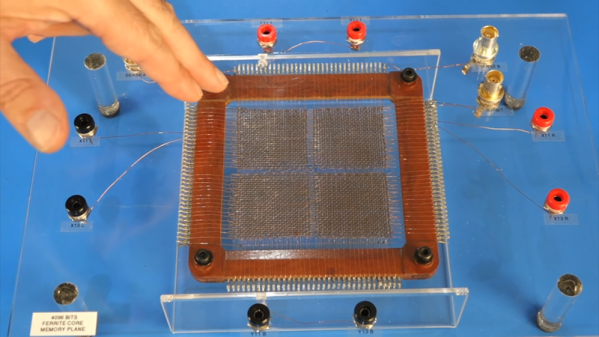
Soviet Core Memory Experiments

What do you do when you’ve bought some old Soviet core memory modules on eBay? If you are [CuriousMarc], you wire it up to some test connectors and use your test bench to see if the core memory still works. Spoiler alert: it does.

While it seems crude by today’s standard, there was a time when these memory modules would have been the amazing miniature tech of their day. Each little magnetic torus represents a bit and the modules have 1,024 and 4,096 tiny little donuts strung together in a grid.

Continue reading “Soviet Core Memory Experiments”

Jerry Lawson biography

Jerry Lawson And The Fairchild Channel F; Father Of The Video Game Cartridge

The video game console is now a home entertainment hub that pulls in all forms of entertainment via an internet connection, but probably for most readers it was first experienced as an offline device that hooked up to the TV and for which new game software had to be bought as cartridges or for later models, discs. Stepping back through the history of gaming is an unbroken line to the 1970s, but which manufacturer had the first machine whose games could be purchased separately from the console? The answer is not that which first comes to mind, and the story behind its creation doesn’t contain the names you are familiar with today.

The Fairchild Channel F never managed to beat its rival, the Atari 2600, in the hearts of American youngsters so its creator Jerry Lawson isn’t a well-known figure mentioned in the same breath as Atari’s Nolan Bushnell or Apple’s two Steves, but without this now-forgotten console the history of gaming would have been considerably different.

Continue reading “Jerry Lawson And The Fairchild Channel F; Father Of The Video Game Cartridge”

Modern Mice On Old Computers

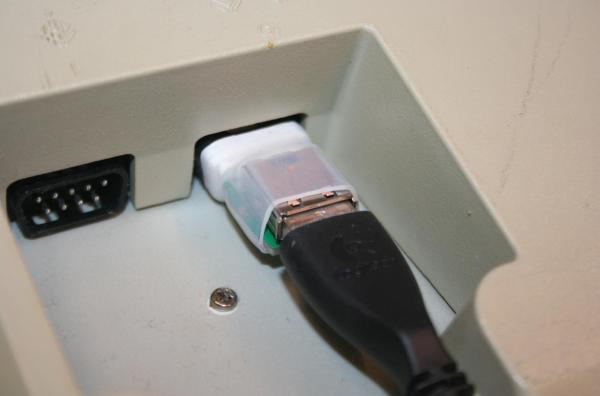
Getting retro hardware up and running again is sometimes a feat, and the amount of effort needed tends to go up exponentially with increased hardware age. Getting an IDE hard drive running again is one thing, but things like peripherals on truly “retro” computers like Commodores and Amigas is another beast altogether if you even have a 30-year-old mouse still lying around. That’s why adapters like Project mouSTer are here to help you connect modern USB hardware to truly ancient computers.

This piece of equipment was built for the Atari ST (hence the name), a 8-bit  computer from the mid-80s. It mates a DB9 plug with USB via a small microcontroller which does the translating. The firmware can be flashed over the USB connection so there’s planned support for other machines of this vintage. The chip supports all the features the original mouse did, too, including PS4 pad support and support for joysticks, and comes in an impressively tiny package once assembled which blends in seamlessly.

The project is a great step to getting retro computers working again, even if you can’t find exact OEM replacements anymore. That’s a common problem, and we’ve seen this solved in other ways for other old Ataris. It’s not uncommon to put modern power supplies in retro computers, either, as long as they power up and work after everything’s wired together.

Changing System Architectures And The Complexities Of Apple’s Butterfly Approach To ISAs

Apple computers will be moving away from Intel chips to its own ARM-based design. An interesting thing about Apple as a company is that it has never felt the need to tie itself to a particular system architecture or ISA. Whereas a company like Microsoft mostly tied its fortunes to Intel’s x86 architecture, and IBM, Sun, HP and other giants preferred vertical integration, Apple is currently moving towards its fifth system architecture for its computers since the company was formed.

What makes this latest change possibly unique, however, is that instead of Apple relying on an external supplier for CPUs and peripheral ICs, they are now targeting a vertical integration approach. Although the ARM ISA is licensed to Apple by Arm Holdings, the ‘Apple Silicon’ design that is used in Apple’s ARM processors is their own, produced by Apple’s own engineers and produced by foundries at the behest of Apple.

In this article I would like to take a look back at Apple’s architectural decisions over the decades and how they made Apple’s move towards vertical integration practically a certainty.

Continue reading “Changing System Architectures And The Complexities Of Apple’s Butterfly Approach To ISAs”

(Re)Making A ColecoVision

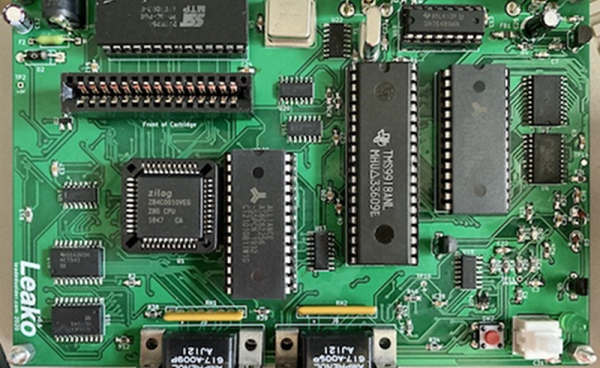
[Leaded Solder] found some ColecoVision game cartridges at a flea market, and like most of us would, thought, “I’ll build a ColecoVision console from scratch to play them!” Well, maybe most of us would think of that, but not actually do it. He did and you can read about the results in great detail since he wrote up two posts, one covering the design and one covering the construction.

The ColecoVision was a game console that famously could be expanded into a nice — for its day — personal computer. It even had a daisy wheel printer in that configuration. However, in either configuration, the game console was the brains of the operation. According to [Leaded Solder] the price of a unit in working order is high even though over 2 million were made because of several design problems that make them less likely to survive the decades. Rather than repair and modify an original unit, it was cheaper and much more educational to build new.

Continue reading “(Re)Making A ColecoVision”

A ZX80 With A Proper Case

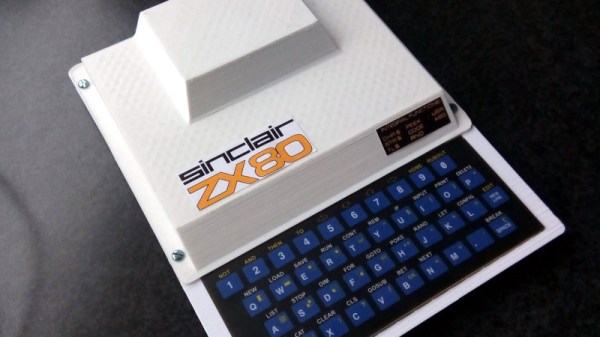
A popular project among Hackaday readers is to recreate a piece of home computing or gaming hardware from the past, and in that endeavour we’ve seen some truly amazing projects. Usually they take the form of bare PCBs or custom cases that look nothing like the original, but not [Cees Meijer]’s Sinclair ZX80 clone. It sports a 3D printed replica of the original computer’s vacuum-formed case, which from a distance you could be mistake for the real thing.

Internally it’s not a ZX80 at all, but a Raspberry Pi Zero running an emulator. But  with a case like this one that’s not the point. It doesn’t have the full-length PCB of the original but a modern ZX80 membrane keyboard, and the Pi appears to be hiding somewhere in the “hump” used by the Astec UHF modulator on the original. There is more information in a blog post, and the model can be downloaded via Thingiverse. Handily, the files also include the original CAD file from RS DesignSpark, should you wish to modify it to your own tastes. If somebody could mate it with Tynemouth Software’s ZX80 kit then our cup would run over.

Of course, this isn’t the only retrocomputer for which a replacement case can be found.