Op Amp Contest: A Slice Of The ’70s

The 1970s was a great time to be an electronics hobbyist, as a whole new world of analogue integrated circuits was coming down in price while new devices would appear to tempt the would-be constructor. Magazines and project books were full of simple circuits to do all manner of fun things, including many synthesizers and sound generators.

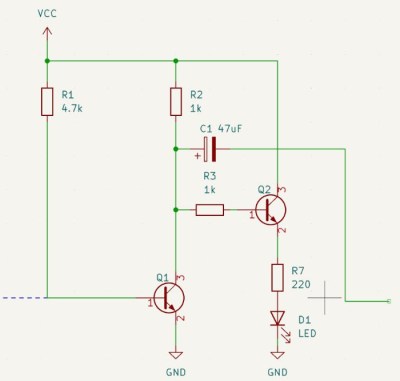
We’re reminded of those days by [Burkhard Kainka]’s triggered sound generator, which couples an op-amp timer to another op-amp phase shift oscillator to produce a sound described as “the unwilling meowing of a cat, which does not want to be disturbed“. Yes, we did make things like this back in the day.

The timer is triggered by a few millivolts on its input, which can come from a bit of mains hum or a flash of light to an LED operating as a photodiode. This provides enough DC voltage to the input of the phase shift oscillator to start oscillation, and in turn the oscillator drives a piezo speaker. It’s a fun little project, it shows that a microcontroller isn’t always needed to make something work, and maybe those of you without the experience of a 1970s childhood can learn a little bit of analogue magic from it. Need to know op-amps better? Read our primer!

Half Crystal Radio, Half Regenerative Radio

A rite of passage in decades past for the electronics experimenter was the crystal radio. Using very few components and a long wire antenna, such a radio could pick up AM stations with no batteries needed, something important in the days when a zinc-carbon cell cost a lot of pocket money. The days of AM broadcasting may be on the wane, but it’s still possible to make a crystal set that will resolve stations on the FM band. [Andrea Console] has done just that, with a VHF crystal set that whose circuit also doubles as a regenerative receiver when power is applied.

The key to a VHF crystal set lies in the highest quality tuned circuit components to achieve that elusive “Q” factor. In this radio that is coupled to a small-signal zero voltage threshold FET that acts as a detector when no power is applied, and the active component in a regenerative radio when it has power. The regenerative radio increases sensitivity and selectivity by operating at almost the point of oscillation, resulting in a surprisingly good receiver for so few parts. Everyone should make a regenerative radio receiver once in their life!

A High Precision ADC That You Can Understand!

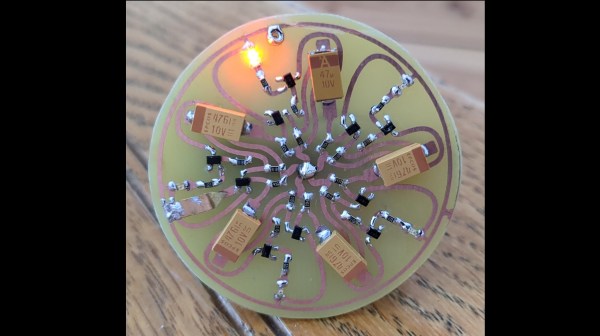
In a world where an analogue to digital converter is all too often an integrated peripheral buried inside a microcontroller, it’s easy to forget how simple these devices can be when built from first principles. An entry in our Op-Amp Challenge from [NNNI] demonstrates this perfectly, it’s a high resolution multi-slope ADC for instrumentation purposes, constructed using a mixture of op-amps, logic chips, and a Raspberry Pi Pico. Best of all, it’s easy to understand, so there’s little of that analogue mystique to worry about.

This type of ADC measures an analogue value by counting how long it takes to charge a capacitor to that voltage. A simple version that measures charge time has a few drawbacks, so this project goes from single slope to multi slope by measuring both charge and discharge times compared to the voltage. Pay attention to component matching and reference stability, and such a design can offer a very high resolution measurement.

The value in this project lies not only in the design itself, but also in the extremely comprehensive description of its operation, which should teach most readers a thing or two. That curvy-line PCB is rather nice, too. We used single slope ADCs to read analogue joysticks back in the day, but we certainly learned something here. Want to see another? This isn’t the first dual slope ADC we’ve seen.

Raspberry Pi Camera Conversion Leads To Philosophical Question

The Raspberry Pi HQ camera module may not quite reach the giddy heights of a DSLR, but it has given experimenters access to a camera system which can equal the output of some surprisingly high-quality manufactured cameras. As an example we have a video from [Malcolm-Jay] showing his Raspberry Pi conversion of a Yashica film camera.

Coming from the viewpoint of a photographer rather than a hardware person, the video is particularly valuable for his discussion of the many lens options beyond a Chinese CCTV lens which can be used with the platform. It uses only the body from the Yashica, but makes a really cool camera that we’d love to own ourselves. If you’re interested in the Pi HQ camera give it a watch below the break, and try to follow some of his lens suggestions.

The broken camera he converted is slightly interesting, and raises an important philosophical question for retro technology geeks. It’s a Yashica Electro 35, a mid-1960s rangefinder camera for 35 mm film whose claim to fame at the time was its electronically controlled shutter timing depending on its built-in light meter. The philosophical question is this: desecration of a characterful classic camera which might have been repaired, or awesome resto-mod? In that sense it’s not just about this project, but a question with application across many other retro tech fields.

A working Electro 35 is a fun toy for an enthusiast wanting to dabble in rangefinder photography, but it’s hardly a valuable artifact and when broken is little more than scrap.  One day we’d love to see a Pi conversion with a built-in focal length converter allowing the use of the original rangefinder mechanism, but we’ll take this one any day!

How about you? Would you have converted this Yashica, repaired it somehow, or just hung onto it because you might get round to fixing it one day? Tell us in the comments!

Continue reading “Raspberry Pi Camera Conversion Leads To Philosophical Question”

The Eyes Have It With This Solid State Magic Eye

The classic “Magic Eye” tuning indicator was a fantastic piece of vacuum tube technology that graced all kinds of electronic gear for a fair fraction of the 20th century. But despite its prevalence, finding a new-old-stock Magic Eye tube is a tall order these days, especially for the rare versions like the 6T5. No worries, though, since direct plug-in solid-state replacements for the 6T5 are now a thing, thanks to [Gord Rabjohn]. Continue reading “The Eyes Have It With This Solid State Magic Eye”

IBM Selectric Typewriters Finally Get DIY Typeballs

IBM’s Selectric line of typewriters were quite popular in the 1960s, thanks in part to an innovation called the typeball which allowed for easy font changes on a single machine. Unfortunately, as if often the case when specialized components are involved, it’s an idea that hasn’t aged particularly well. The Selectric typewriters are now around 60 years old and since IBM isn’t making replacement parts, those restoring these machines have had to get somewhat creative like using a 3D printer to build new typeballs.

It sounds like it would be a simple, but much like the frustration caused with modern printers, interfacing automated computer systems with real-world objects like paper and ink is not often as straightforward as we would like. The main problem is getting sharp edges on the printed characters which is easy enough with metal but takes some more finesse with a printed plastic surface. For the print, each character is modelled in OpenSCAD and then an automated process generates the 3D support structure that connects the character to the typeball.

This process was easier for certain characters but got more complicated for characters with interior sections or which had a lot of sharp angles and corners. Testing the new part shows promise, although the plastic components will likely not last as long as their metal counterparts. Still, it’s better than nothing.

Regular Hackaday readers may recall that the ability to 3D print replacement Selectric typeballs has been on the community’s mind for years. When we last covered the concept in 2020 we reasoned that producing them on resin printers might be a viable option, and in the end, that does indeed seem to have been the missing element. In fact, this design is based on that same one we covered previously — it’s just taken this long for desktop resin 3D printing technology to mature enough.

Mechanical GIF Animates With The Power Of Magnets

It doesn’t matter how you pronounce it, because whichever way you choose to say “GIF” is guaranteed to cheese off about half the people listening. Such is the state of our polarized world, we suppose, but there’s one thing we all can agree on — that a mechanical GIF is a pretty cool thing.

What’s even better about this thing is that [Mitch], aka [Hack Modular], put some very interesting old aircraft hardware to use to make it. He came upon a set of cockpit indicators from a Cold War-era RAF airplane — sorry, “aeroplane” — that used a magnetically driven rack and pinion to swivel a set of prism-shaped pieces to one of three positions. Which of the three symbols displayed depended on which faces were turned toward the pilot; they were highly visible displays that were also satisfyingly clicky.

After a teardown in which [Mitch] briefly discusses the mechanism behind these displays, he set about customizing the graphics. Rather than the boring RAF defaults, he chose three frames from the famous Horse in Motion proto-motion picture by [Eadweard Muybridge]. After attaching vertical strips from each frame to the three sides of each prism, [Mitch] came up with a driver for the display; he could have used a 555, but more fittingly chose series-connected relays to do the job. Capacitors slow down the switching cascade and the frame rate; a rotary switch selects different caps to make the horse appear to be walking, trotting, cantering, or galloping — yes, we know they’re each physically distinct motions, but work with us here.

The whole thing looks — and sounds — great mounted in a nice plastic enclosure. The video below shows it in action, and we find it pretty amazing the amount of information that can be conveyed with just three frames. And we’re surprised we’ve never seen these displays before; they seem like something [Fran Blanche] or [Curious Marc] would love.

Continue reading “Mechanical GIF Animates With The Power Of Magnets”