radio direction finding

Where’s That Radio? A Brief History Of Direction Finding

We think of radio navigation and direction finding as something fairly modern. However, it might surprise you that direction finding is nearly as old as radio itself. In 1888, Heinrich Hertz noted that signals were strongest when in one orientation of a loop antenna and weakest 90 degrees rotated. By 1900, experimenters noted dipoles exhibit similar behavior and it wasn’t long before antennas were made to rotate to either maximize signal or locate the transmitter.
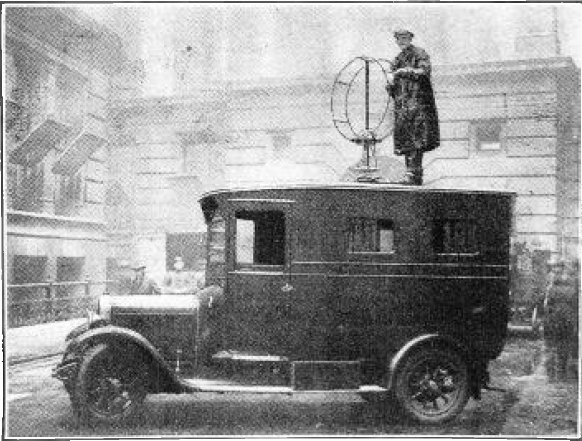
British radio direction finding truck from 1927; public domain

Of course, there is one problem. You can’t actually tell which side of the antenna is pointing to the signal with a loop or a dipole. So if the antenna is pointing north, the signal might be to the north but it could also be to the south. Still, in some cases that’s enough information.

John Stone patented a system like this in 1901. Well-known radio experimenter Lee De Forest also had a novel system in 1904. These systems all suffered from a variety of issues. At shortwave frequencies, multipath propagation can confuse the receiver and while longwave signals need very large antennas. Most of the antennas moved, but some — like one by Marconi — used multiple elements and a switch.

However, there are special cases where these limitations are acceptable. For example, when Pan Am needed to navigate airplanes over the ocean in the 1930s, Hugo Leuteritz who had worked at RCA before Pan Am, used a loop antenna at the airport to locate a transmitter on the plane. Since you knew which side of the antenna the airplane must be on, the bidirectional detection wasn’t a problem.

Continue reading “Where’s That Radio? A Brief History Of Direction Finding”

Airdropping Live Fish Is A Thing And It Looks Magnificent

Utah is a place that features a wonderful and varied wilderness. Its mountainous terrain is home to many valleys, ponds, and streams. They’re a particular favorite of recreational anglers who visit the region for the great fishing. Oftentimes, however, these areas are fished out by visitors and need to be restocked. Other environmental factors also come into play in reducing populations, too.

A plane delivering live fish to the lakes of Utah via air drop. Source: Utah DWR

When this happens in some areas, it’s as simple as driving up a truck full of water and fish and dumping them into the lake. The problem is that many of these lakes and streams are difficult to access by foot or by road. Believe it or not, the most practical method found to deal with the problem thus far is dropping in live fish by air. Here’s how it all goes down.

Live Cargo

Typically, the fish dropped into these remote watercourses are quite young, and on the order of 1-3″ long. The fish are specifically raised to later be fished, and are also usually sterile, making it easier for Utah’s Division of Wildlife Resources to manage numbers. When it comes time to restock remote lakes, waterbombing planes are pumped full of water and loaded up with fish.

Continue reading “Airdropping Live Fish Is A Thing And It Looks Magnificent”

Thor does battle with a man shooting lasers from his hands

Of Lasers And Lightning: Thwarting Thor With Technology

Most of us don’t spend that much time thinking about lightning. Every now and then we hear some miraculous news story about the man who just survived his fourth lightning strike, but aside from that lightning probably doesn’t play that large a role in your day-to-day life. Unless, that is, you work in aerospace, radio, or a surprisingly long list of other industries that have to deal with its devastating effects.

Humans have been trying to protect things from lightning since the mid-1700s, when Ben Franklin conducted his fabled kite experiment. He created the first lightning rod, an iron pole with a brass tip. He had speculated that the conductor would draw the charge out of thunderclouds, and he was correct. Since then, there haven’t exactly been leaps and bounds in the field of lightning rod design. They are still, essentially, a metal rods that attract lightning strikes and shunt the energy safely into the earth. Just as Ben Franklin first did in the 1700s, they are still installed on buildings today to protect from lightning and do a fine job of it. While this works great for most structures, like your house for example, there are certain situations where a tall metal pole just won’t cut it.

Continue reading “Of Lasers And Lightning: Thwarting Thor With Technology”

Charles Lindbergh The Famous… Inventor?

Most people remember Charles Lindbergh for his non-stop solo flight across the Atlantic which made him an international celebrity. If you are a student of history, you might also know he was at the center of a very controversial trial surrounding the kidnapping of his child or even that he had a dance named after him. But did you know he was also the co-inventor of a very important medical device? Turns out, medicine can thank Lindbergh for the creation of the perfusion pump.

Continue reading “Charles Lindbergh The Famous… Inventor?”

Better Mousetraps (or Screw Drives) Don’t Always Win

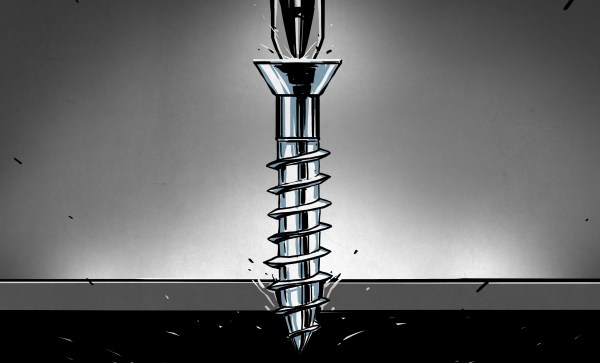
I’ve noticed, lately, that slotted screw heads are all but gone on new equipment. The only thing that I find remarkable about that is that it took so long. While it is true that slotted heads have been around for ages, better systems are both common and have been around for at least a century.

Check out those cool threads.

The reason slotted heads — technically known as the drive — are so common is probably because they are very easy to make. A hacksaw is sufficient for the job and there are other ways to get there, too. The only advantages I know of for the user is that you can easily clean a slotted drive and — possibly — use field expedient items like butter knives and quarters to turn the screw. I’ve heard people claim that it also is a feature that the screwdriver can pry things like paint can lids, but that’s a feature of the tool, not the screw drive.

The disadvantages, though, are significant. It is very hard to apply lots of torque to a slotted screw drive without camming it out or snapping the head off the screw. The screwdriver isn’t self-centering either, so applying force off-axis is common and contributes to the problem.

Continue reading “Better Mousetraps (or Screw Drives) Don’t Always Win”

Gladys West Modelled The Earth So That We Can Have GPS

The name Gladys West is probably unfamiliar, but she was part of creating something you probably use often enough: GPS. You wouldn’t think a child who grew up on a sharecropping farm would wind up as an influential mathematician, but perhaps watching her father work very hard for very little and her mother working for a tobacco company made her realize that she wanted more for herself. Early on, she decided that education was the way out. She made it all the way to the Naval Surface Warfare Center.

While she was there she changed the world with — no kidding — mathematics. While she didn’t single-handedly invent satellite navigation, her work was critical to the systems we take for granted today.

Continue reading “Gladys West Modelled The Earth So That We Can Have GPS”

GitHub Copilot And The Unfulfilled Promises Of An Artificial Intelligence Future

In late June of 2021, GitHub launched a ‘technical preview’ of what they termed GitHub Copilot, described as an ‘AI pair programmer which helps you write better code’. Quite predictably, responses to this announcement varied from glee at the glorious arrival of our code-generating AI overlords, to dismay and predictions of doom and gloom as before long companies would be firing software developers en-masse.

As is usually the case with such controversial topics, neither of these extremes are even remotely close to the truth. In fact, the OpenAI Codex machine learning model which underlies GitHub’s Copilot is derived from OpenAI’s GPT-3 natural language model,  and features many of the same stumbles and gaffes which GTP-3 has. So if Codex and with it Copilot isn’t everything it’s cracked up to be, what is the big deal, and why show it at all?

Continue reading “GitHub Copilot And The Unfulfilled Promises Of An Artificial Intelligence Future”