AI Creates Your Spreadsheets, Sometimes

We’ve been interested in looking at how AI can process things other than silly images. That’s why the “Free AI Bot that Generates the Excel Formula for Any Problem” caught our eye. Based on GPT-3, it supposedly transforms your problem description into a formula suitable for Excel or Google Sheets.

Our first prompt didn’t work out very well. But that was sort of our fault. When they say “Excel formula” they mean that quite literally. So trying to describe the actual result you want in terms of columns or rows seems to be beyond it. Not realizing that, we asked:

If the sum of column H is greater than 50, multiply column A by 0.33

And got:

=IF(SUM(H:H)>50,A*0.33,0)

A Better Try

Which is close, but not really how anyone even mildly proficient with Excel would interpret that request. But that’s not fair. It really needs to be a y=f(x) sort of problem, we suppose.

Continue reading “AI Creates Your Spreadsheets, Sometimes”

Martian Successes Reshape Sample Return Plans

For as long as humans have been sending probes to Mars, there’s been a desire to return rock, soil, and atmosphere samples back to Earth for more detailed analysis. But the physics of such a mission are particularly demanding — a vehicle that could land on the Martian surface, collect samples, and then launch itself back into orbit for the return to Earth would be massive and prohibitively expensive with our current technology.

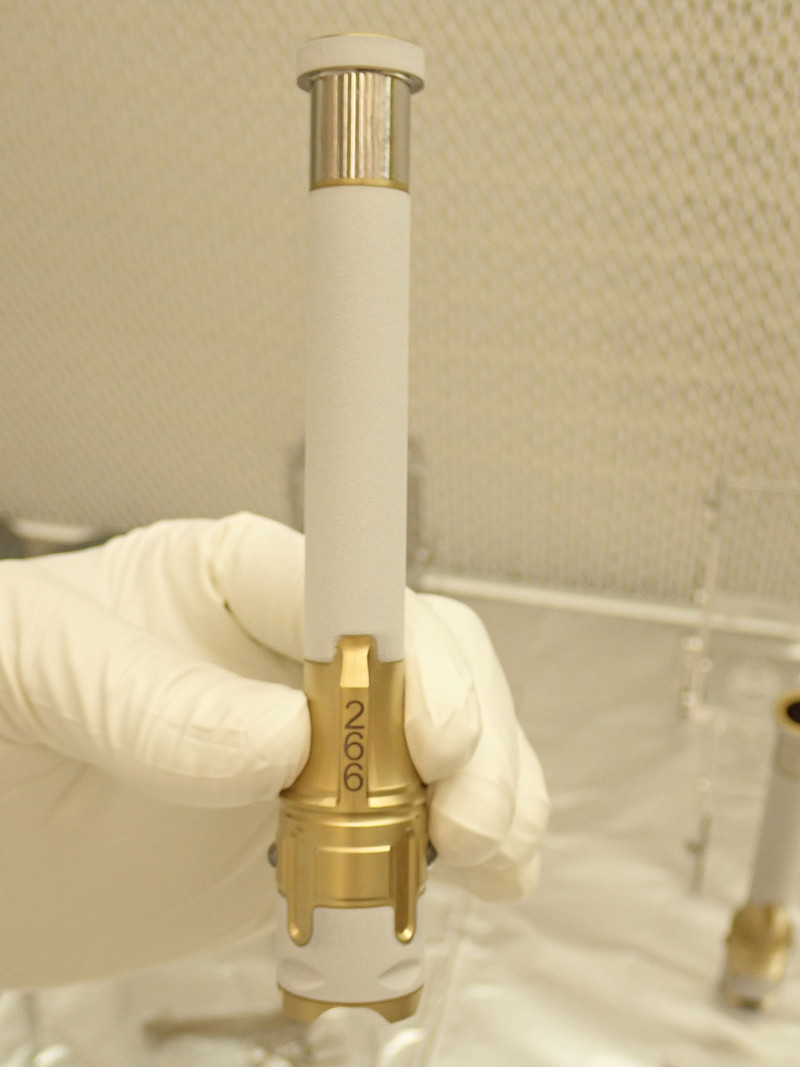
Mars sample return tube

Instead, NASA and their international partners have been working to distribute the cost and complexity of the mission among several different vehicles. In fact, the first phase of the program is well underway.

The Perseverance rover has been collecting samples and storing them in 15 cm (6 inch) titanium tubes since it landed on the Red Planet in February of 2021. Considerable progress has also been made on the Mars Ascent Vehicle (MAV) which will carry the samples from the surface and into orbit around the planet, where they will eventually be picked up by yet another vehicle which will ultimately return them to Earth.

But there’s still some large gaps in the overall plan. Chief among them is how the samples are to be transferred into the MAV. Previously, the European Space Agency (ESA) was to contribute a small “fetch rover” which would collect the sample tubes dropped by Perseverance and bring them to the MAV launch site.

But in a recent press release, NASA has announced that those plans have changed significantly, thanks at least in part to the incredible success of the agency’s current Mars missions.

Continue reading “Martian Successes Reshape Sample Return Plans”

Books You Should Read: The Hardware Hacker’s Handbook

Here on Hackaday, we routinely cover wonderful informative writeups on different areas of hardware hacking, and we even have our own university with courses that delve into topics one by one. I’ve had my own fair share of materials I’ve learned theory and practical aspects from over the years I’ve been hacking – as it stands, for over thirteen years. When such materials weren’t available on any particular topic, I’d go through hundreds of forum pages trawling for details on a specific topic, or spend hours fighting with an intricacy that everyone else considered obvious.

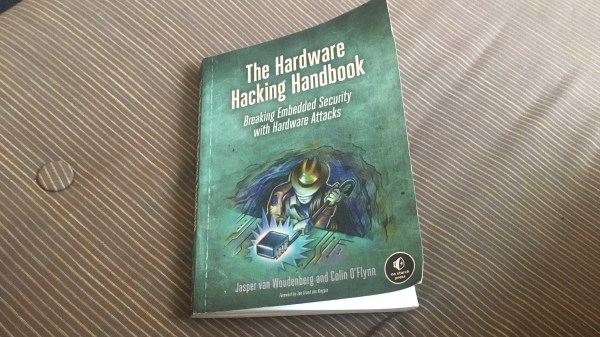
Today, I’d like to highlight one of the most complete introductions to hardware hacking I’ve seen so far – from overall principles to technical details, spanning all levels of complexity, uniting theory and practice. This is The Hardware Hacking Handbook, by Jasper van Woudenberg and Colin O’Flynn. Across four hundred pages, you will find as complete of an introduction to subverting hardware as there is. None of the nuances are considered to be self-evident; instead, this book works to fill any gaps you might have, finding words to explain every relevant concept on levels from high to low.

Apart from the overall hardware hacking principles and examples, this book focuses on the areas of fault injection and power analysis – underappreciated areas of hardware security that you’d stand to learn, given that these two practices give you superpowers when it comes to taking control of hardware. It makes sense, since these areas are the focus of [Colin]’s and [Jasper]’s research, and they’re able to provide you something you wouldn’t learn elsewhere. You’d do well with a ChipWhisperer in hand if you wanted to repeat some of the things this book shows, but it’s not a requirement. For a start, the book’s theory of hardware hacking is something you would benefit from either way. Continue reading “Books You Should Read: The Hardware Hacker’s Handbook”

Stentrodes: A Way To Insert Brain Electrodes Without Invasive Surgery

When we think of brain-computer interfaces (BCIs) that use electrodes, we usually think of Utah arrays that are placed directly on the brain during open brain surgery, or with thin electrodes spliced into the exposed brain as postulated by Neuralink. While Utah arrays and kin as a practical concept date back to the 1980s, a more recent concept called Stentrodes – for stent-electrode array – seeks to do away with the need for invasive brain surgery.

As the name suggests, this approach uses stents that are inserted via the blood vessels, where they are expanded and thus firmly placed inside a blood vessel inside the brain. Since each of these stents also features an electrode array, these can be used to record neural activity in nearby neural clusters, as well as induce activity through electrical stimulation.

Due to the fact that stents are already commonly used by themselves in the brain’s blood vessels, and the relatively benign nature of these electrode arrays, human trials have already been approved in 2018 by an ethics committee in Australia. Despite lingering concerns about the achievable resolution and performance of this approach, it may offer hope to millions of people suffering from paralysis and other conditions.

Continue reading “Stentrodes: A Way To Insert Brain Electrodes Without Invasive Surgery”

The Hackaday Summer Camp Survival Guide

It’s a feature of summer for us, the round of hacker camps in which members of our community gather in fields and spend a few days relaxing and doing what we do best. This summer I’ll have been to four of them by September, one of which was unexpected because a last-minute ticket came my way. For Hackaday they’re a chance to connect with our readers and maybe see come of the coolest stuff in person.

If you consult the wiki for your hacker camp of choice then you’ll usually find a page of tips about what to bring. Starting with a tent and a sleeping bag and probably going on to sunscreen, a hat, and maybe how to avoid dehydration. I’d probably add spare toilet paper and disinfectant spray in case the toilets are nightmarish. All very practical stuff, but expressed in a dry list format that doesn’t really tell you what to expect. A hacker camp can be overwhelming if you’ve not been to one before, so how do you get the best out of it? Here are a few tips based on our experience. Continue reading “The Hackaday Summer Camp Survival Guide”

Maximum Power Point Tracking: Optimizing Solar Panels

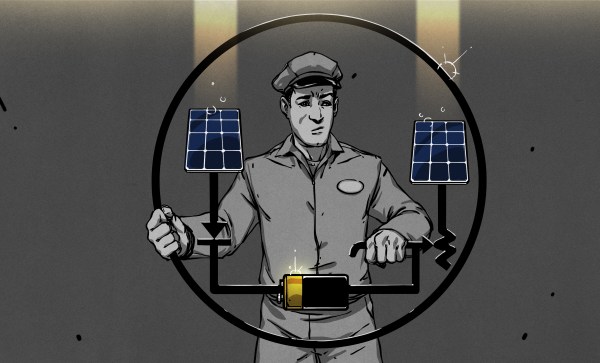
When looking at integrating a photovoltaic solar panel into a project, the naive assumption would be that you simply point the panel into the general direction of where the Sun is, and out comes gobs of clean DC power, ready to be used for charging a battery. To a certain extent this assumption is correct, but feeding a solar panel’s output into something like a regular old PWM buck or boost regulator is unlikely to get you anywhere close to the panel’s full specifications.

The keywords here are ‘maximum power point’ (MPP), which refers to the optimal point on the solar panel’s I-V curve. This is a property that’s important not only with photovoltaics, but also with wind turbines and other highly variable power sources. The tracking of this maximum power point is what is generally referred to as ‘MPPT‘, but within this one acronym many different algorithms are covered, each with its own advantages and disadvantages. In this article we’ll take a look at what these MPPT algorithms are, and when you would want to pick a particular one.

Continue reading “Maximum Power Point Tracking: Optimizing Solar Panels”

Toyota’s Cartridge Helps Make Hydrogen Portable

Hydrogen has long been touted as the solution to cleaning up road transport. When used in fuel cells, the only emissions from its use are water, and it eliminates the slow recharging problem of battery-electric vehicles. It’s also been put forth as a replacement for everything from natural gas supplies to laptop batteries.

Toyota has been pushing hard for hydrogen technology, and has worked to develop vehicles and infrastructure to this end. The company’s latest efforts involve a toteable hydrogen cartridge – letting you take hydrogen power on the go!

Continue reading “Toyota’s Cartridge Helps Make Hydrogen Portable”