Dawn Of The First Digital Camera

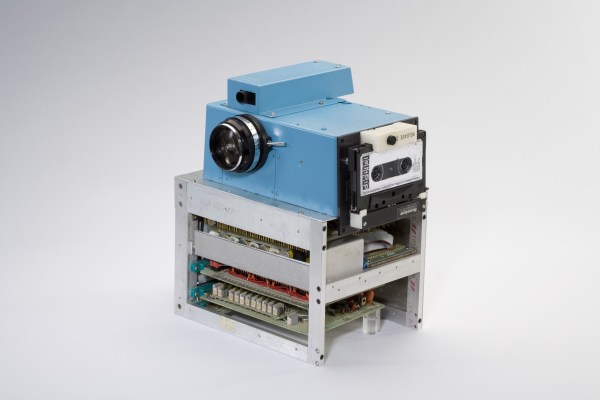
Technology vanishes. It either succeeds and becomes ubiquitous or fails. For example, there was a time when networking and multimedia were computer buzzwords. Now they are just how computers work. On the other hand, when was the last time you thought about using a CueCat barcode reader to scan an advertisement? Then there are the things that have their time and vanish, like pagers. It is hard to decide which category digital cameras fall into. They are being absorbed into our phones and disappearing as a separate category for most consumers. But have you ever wondered about the first digital camera? The story isn’t what you would probably guess.

The first digital camera I ever had was a Sony that took a floppy disk. Surely that was the first, right? Turns out, no. There were some very early attempts that didn’t really have the technology to make them work. The Jet Propulsion Laboratory was using analog electronic imaging as early as 1961 (they had been developing film on the moon but certainly need a better way). A TI engineer even patented the basic outline of an electronic camera in 1972, but it wasn’t strictly digital. None of these bore any practical fruit, especially relative to digital technology. It would take Eastman Kodak to create a portable digital camera, even though they were not the first to commercialize the technology.

Continue reading “Dawn Of The First Digital Camera”

Project Orion: Detonating Nuclear Bombs For Thrust

Rockets with nuclear bombs for propulsion sounds like a Wile E. Coyote cartoon, but it has been seriously considered as an option for the space program. Chemical rockets combust a fuel with an oxidizer within themselves and exhaust the result out the back, causing the rocket to move in the opposite direction. What if instead, you used the higher energy density of nuclear fission by detonating nuclear bombs?

Detonating the bombs within a combustion chamber would destroy the vehicle so instead you’d do so from outside and behind. Each bomb would include a little propellant which would be thrown as plasma against the back of the vehicle, giving it a brief, but powerful push.

That’s just what a group of top physicists and engineers at General Atomic worked on between 1958 and 1965 under the name, Project Orion. They came close to doing nuclear testing a few times and did have success with smaller tests, exploding a series of chemical bombs which pushed a 270-pound craft up 185 feet as you’ll see below.

Continue reading “Project Orion: Detonating Nuclear Bombs For Thrust”

Tariff Expansion Set To Hit 3D-Printing Right In The Filament

Mere weeks after tariffs were put into place raising the cost of many Chinese-sourced electronics components by 25%, a second round of tariffs is scheduled to begin that will deal yet another blow to hackers. And this time it hits right at the heart of our community: 3D-printing.

A quick scan down the final tariff list posted by the Office of the US Trade Representative doesn’t reveal an obvious cause for concern. In among the hundreds of specific items listed one will not spot “Filaments for additive manufacturing” or anything else that suggests that 3D-printing supplies are being targeted. But hidden in the second list of tariff items, wedged into what looks like a polymer chemist’s shopping list, are a few entries for “Monofilaments with cross-section dimension over 1 mm.” Uh-oh!

Continue reading “Tariff Expansion Set To Hit 3D-Printing Right In The Filament”

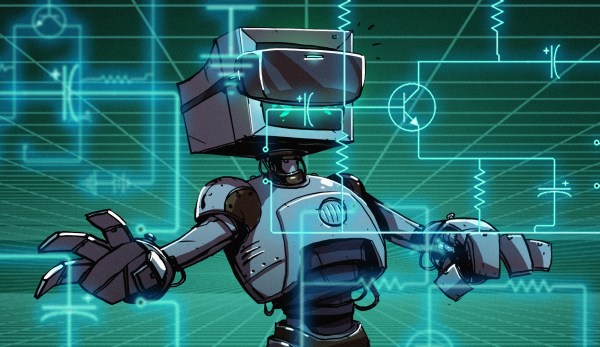
Circuit VR: Starting An Amplifier Design

Sometimes I wish FETs had become practical before bipolar transistors. A FET is a lot more like a tube and amplifies voltages. Bipolar transistors amplify current and that makes them a bit harder to use. Recently, [Jenny List] did a series on transistor amplifiers including the topic of this Circuit VR, the common emitter amplifier. [Jenny] talked about biasing. I’ll start with biasing too, but in the next installment, I want to talk about how to use capacitors in this design and how to blend two amplifiers together and why you’d want to do that.

But before you can dive into capacitors and cascades, we need a good feel for how to get the transistor biased to start with. As always, there’s good news and bad news. The bad news it that transistors vary quite a bit from device to device. The good news is that we’ll use some design tricks to keep that from being a problem and that will also give us a pretty wide tolerance on component values. The resulting amplifier won’t necessarily be precise, but it will be fine for most uses. As usual, you can find all the design files on GitHub, and we’ll be using the LT Spice simulator.

Continue reading “Circuit VR: Starting An Amplifier Design”

Rediffusion Television: Early Cable TV Delivered Like Telephone

Recently I spent an enjoyable weekend in Canterbury, staying in my friend’s flat with a superb view across the rooftops to the city’s mediaeval cathedral. Bleary-eyed and in search of a coffee on the Sunday morning, my attention was immediately drawn to one of her abode’s original built-in features. There on the wall in the corner of the room was a mysterious switch.

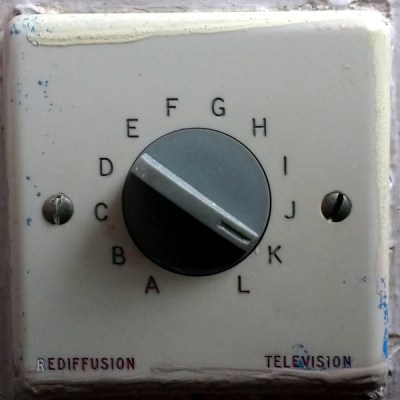
Housed on a standard-sized British electrical fascia was a 12-position rotary switch, marked with letters A through L. An unexpected thing to see in the 21st century and one probably unfamiliar to most people under about 40, I’d found something I’d not seen since my university days in the early 1990s: a Rediffusion selector switch.


If you have cable TV, there is probably a co-axial cable coming into your home. It is likely to carry a VHF signal, either a series of traditional analogue channels or a set of digital multiplexes. “Cable ready” analogue TVs had wideband VHF tuners to allow the channels to be viewed, and on encrypted systems there would have been a set-top box with its own analogue tuner and decoder circuitry.

Your digital cable TV set-top box will do a similar thing, giving you the channels you have subscribed to as it decodes the multiplex. At the dawn of television transmission though, none of this would have been possible. Co-axial cable was expensive and not particularly high quality, and transistorised wideband VHF tuners were still a very long way away. Engineers designing the earliest cable TV systems were left with the technology of the day derived from that of the telephone networks, and in Britain at least that manifested itself in the Rediffusion system whose relics I’d found.

Continue reading “Rediffusion Television: Early Cable TV Delivered Like Telephone”

The VU Meter And How It Got That Way

Given its appearance in one form or another in all but the cheapest audio gear produced in the last 70 years or so, you’d be forgiven for thinking that the ubiquitous VU meter is just one of those electronic add-ons that’s more a result of marketing than engineering. After all, the seemingly arbitrary scale and the vague “volume units” label makes it seem like something a manufacturer would slap on a device just to make it look good. And while that no doubt happens, it turns out that the concept of a VU meter and its execution has some serious engineering behind that belies the really simple question it seeks to answer: How loud is this audio signal?

Continue reading “The VU Meter And How It Got That Way”

Recorded Programming — Thanks To Bing Crosby

If you look up Bing Crosby in Wikipedia, the first thing you’ll notice is his real name was Harry. The second thing you’ll read, though, is that he is considered the first “multimedia star.” In 1948, half of the recorded music played on the air was by Bing Crosby. He also was a major motion picture star and a top-selling recording artist. However, while you might remember Bing for his songs like White Christmas, or for his orange juice commercials, or for accusations of poor treatment from his children, you probably don’t associate him with the use of magnetic tape.

In a way, Bing might have been akin to the Steve Jobs of the day. He didn’t power the technology for tape recording. But he did see the value of it, invested in it, and brought it to the market. Turns out Bing was quite the businessman. Want to know why he did all those Minute Maid commercials? He was a large shareholder in the company and was the west coast distributor for their products. He also owned part of the Pittsburgh Pirate baseball team and other businesses.

So how did Bing become instrumental in introducing magnetic tape recording? Because he was tired of doing live shows. You see, in 1936, Crosby became the host of a radio variety show, The Kraft Music Hall. This very popular program was live. That means you have to show up on time. If you go off on a tangent, you’ll run out of time. And if you make a mistake, there is no editing. Oh and one other thing. You have to do a nationwide live show twice: once for the east coast and another for the west. This was cutting into Bing’s “family time” which, as far as we can ascertain was a code phrase for golf.

Continue reading “Recorded Programming — Thanks To Bing Crosby”