Barbara McClintock: Against The Genetic Grain

The tale of much of Barbara McClintock’s life is that of the scientist working long hours with a microscope seeking to solve mysteries. The mystery she spent most of her career trying to solve was how all cells in an organism can contain the same DNA, and yet divide to produce cells serving different functions; basically how cells differentiate. And for that, she got a Nobel prize all to herself, which is no small feat either.

Becoming a Scientist
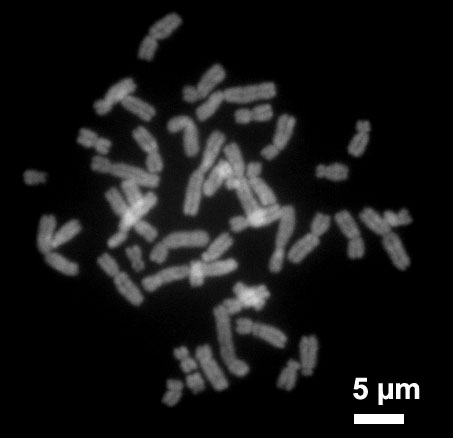
Human chromosomes, long strands of DNA
Human chromosomes, long strands of DNA by Steffen Dietzel CC BY-SA 3.0

McClintock was born on June 16, 1902, in Hartford, Connecticut, USA. From age three until beginning school, she lived with her aunt in Brooklyn, New York while her father strove financially to start up a medical practice. She was a solitary and independent-minded child, a trait she later called her “capacity to be alone”.

In 1919, she began her studies at Cornell’s College of Agriculture and took her first course in genetics in 1921. A year later, due to the interest she showed in genetics, she was invited to take the graduate genetics course at Cornell. It was here that she became interested in the new field of cytogenetics, specifically of maize or corn. Cytogenetics studies how the chromosomes relate to cell behavior, particularly during cell division. Chromosomes are the long strands of DNA within the nucleus of every cell and shown here in the photo at a time when they are condensed, or coiled up.

While still at Cornell she developed a number of methods for visualizing and characterizing maize which ended up in textbooks. She also became the first to describe the morphology of the ten maize chromosomes, basically their form and structural relationships, which then allowed her to discover more about the chromosomes. One of her colleagues observed that ten of the seventeen significant advances made in the field at Cornell between 1929 and 1935 were hers. This was only the first step in what would be the remarkable career of a very well respected scientist.

Continue reading “Barbara McClintock: Against The Genetic Grain”
Hunting Rogue Access Points With The ESP8266

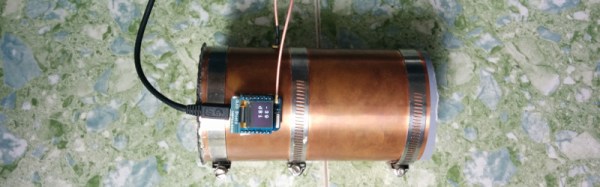
Cantennas outperform every consumer-grade Wi-Fi antenna I’ve had the bad luck of purchasing. Cantenna is a mashup of ‘can’ and ‘antenna’ creating the nickname for a directional waveguide antenna built from re-purposed steel cans. For anyone who has yet to build one, it makes an excellent afternoon project. Here are some build instructions and technical details. I went beyond that, and ended up catching a rogue WiFi access point in the process.

When I needed to extend the range of some ESP8266-based sensors, cantennas were right at the top of my list of things to try. It was easy enough to build one, attach it to a Wemos Mini D1 Pro, and call the job done… leaving me with plenty of time to over-engineer it, and I ended up down a bit of a rabbit hole.

The first thing I did was stop using cans. Canned goods are not only expensive in my corner of the world, but more importantly don’t lend themselves that well to making a standardized antenna in volume. I can also only eat so many beans! The latter reason alone is enough to consider an alternative design like a modular dish reflector.

Continue reading “Hunting Rogue Access Points With The ESP8266”

JST Is Not A Connector

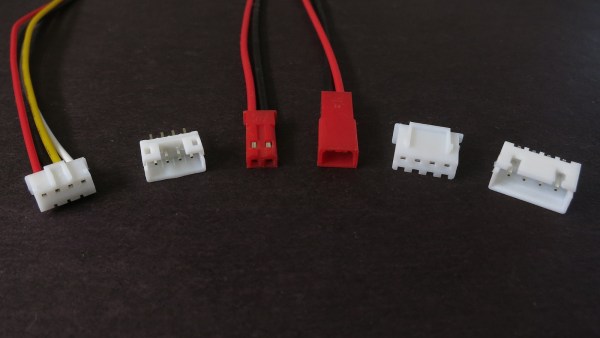
When reading about cool projects and products, it’s common to see wiring plugs labelled “JST connector.” This looks fine until we start getting hands-on and begin hacking things together. Inevitably we find the JST connector from one part fails to fit in the JST connector of another. This is the moment we learn “JST” is not a connector specification. It is short for Japan Solderless Terminals Manufacturing Company, Ltd. A company whose history goes back to 1957 and their website (styled in 1999) lists hundreds of different types.

We can simplify to “JST connector” when chit-chatting about projects. But when it comes to actual hardware specification, that’s not good enough. Which JST connector?

Continue reading “JST Is Not A Connector”

2017: As The Hardware World Turns

The year is almost over, and now it’s time to look back on the last fifty-odd weeks. What happened in this year in hacking? 2017 will go down as the beginning of another AI renaissance, although we’re not going to call it that; this year was all about neural nets and machine learning and advancements resulting from the development of self-driving cars and very beefy GPUs. Not since the 80s have we seen more work in ‘AI’ fields. What will it amount to this time around the hype cycle? Find out in a few years.

Biohacking was big this year, and not just because people are installing RFID tags and magnets in their hands. CRISPR is allowing for Star Trek-style genome hacking, and this year saw in vivo experiments to enable and disable individual genes in rat models. Eventually, someone is going to get a Nobel for CRISPR.

We’re going to Mars, and soon — very soon — a SpaceX Falcon Heavy is going to either lob a Tesla Roadster into solar orbit or the Atlantic Ocean. We learned about the BFR that will take dozens of people to Mars in a single launch. Boeing and Lockheed think they can compete with the Elon Musk PR powerhouse. The Bigelow Aerospace inflatable module passed its in-flight test on the ISS, giving the space station a new storage closet. Even in space, amazing stuff is happening this year.

Is that it? Not by a long shot. This year has seen some of the coolest hacks we’ve ever seen, and some of the dumbest security breaches ever. Hackaday is doing awesome. What else did 2017 have? Read on to find out.

Continue reading “2017: As The Hardware World Turns”

A Visit From Saint Rich

With apologies to Clement Clarke Moore, Richard Stallman, and the English-speaking world in general — ed.

‘Twas the night before Christmas
While up in my bed,
I stared at the ceiling
With feelings of dread.

I’d really no reason for portents of doom
Lying there, sleepless, in gathering gloom.
We’d wrapped all the presents, and decked out the tree,
But still, there was something niggling at me.

Continue reading “A Visit From Saint Rich”

Coin Cells: The Mythical Milliamp-Hour

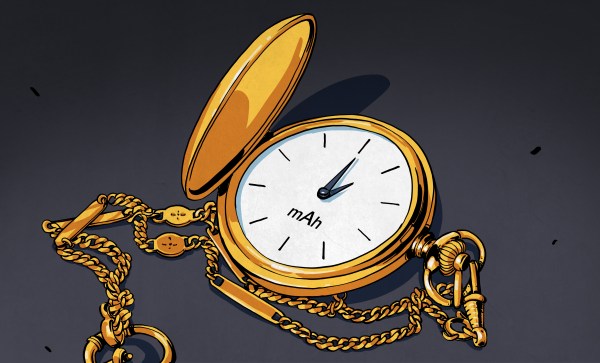
Just how much metaphorical juice is in a coin cell battery? It turns out that this seemingly simple question is impossible to answer — at least without a lot of additional information. The problem is that the total usable energy in a battery depends on how you try to get that energy out, and that is especially true of coin cells.

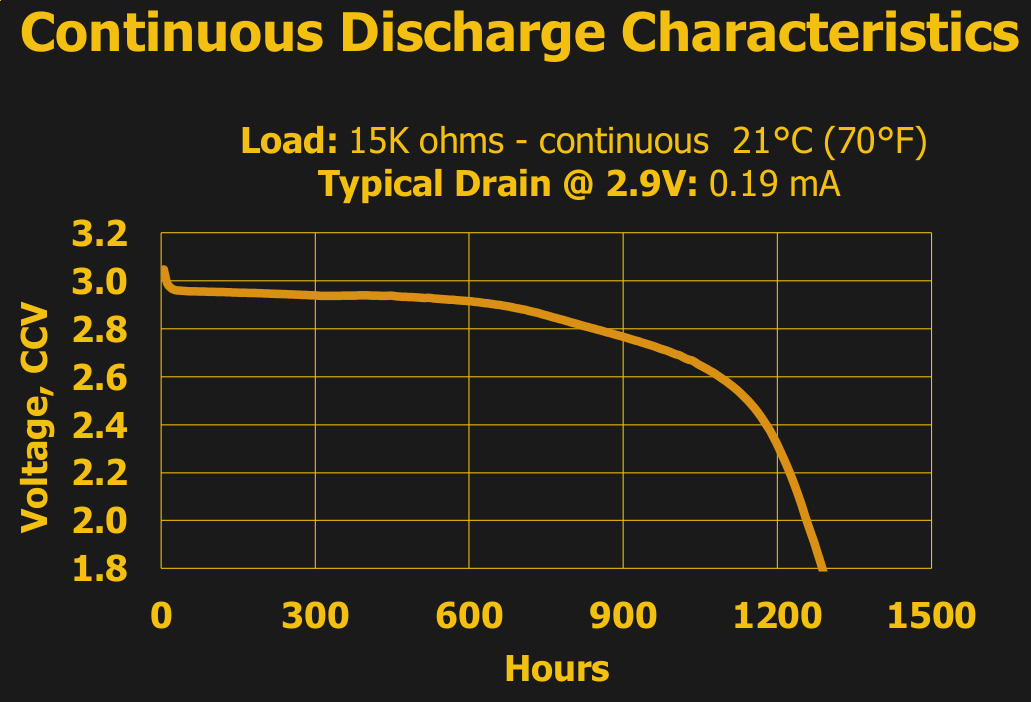
Energizer specs its 2032s at 0.2 mA

For instance, ask any manufacturer of the common 3 V lithium 2032 batteries, and they’ll tell you that it’s got 230 mAh. That figure is essentially constant across brands and across individual cells, and if you pull a constant 0.2 mA from the battery, at room temperature and pressure, you’ll get a bit more than the expected 1,150 hours before it dips below the arbitrary voltage threshold of 2.0 V. Just as it says on the tin.

What if you want to do anything else with a coin cell? Run an LED for a decade? Pull all the energy out right now and attempt to start a car? We had these sorts of extreme antics in mind when we created the Coin Cell Challenge, but even if you just want to do something mundane like run a low-power radio sensor node for more than a day, you’re going to need to learn something about the way coin cells behave in the real world. And to do that, you’re going to need to get beyond the milliamp hour rating. Let’s see how deep this rabbit hole goes.

Continue reading “Coin Cells: The Mythical Milliamp-Hour”

Ask Hackaday: Preserving Electronic Devices

Conventional wisdom holds that we no longer make things to last for the long haul, and that we live in a disposable world. It’s understandable — after all, most of us have a cell phone in our pocket that’s no more than a year or two old, and it’s often cheaper to buy a new printer than replace the ink cartridges. But most of that disposability is driven by market forces, like new software that makes a device obsolete long before it breaks down, or the razor and blades model that makes you pay through the nose for ink. It turns out that most electronic devices are actually pretty well engineered, and as long as they’re not abused can still be operating decades down the road.

But what happens when you want to put an electromechanical device away and preserve it for a rainy day? What can you do to make sure the device will operate again a few years down the road? Are there steps one can take beyond the typical “keep it in a cool, dry place” advice? In short, how do you preserve electronic devices?

Continue reading “Ask Hackaday: Preserving Electronic Devices”