Beyond Conway: Cellular Automata From All Walks Of Life

There’s a time in every geek’s development when they learn of Conway’s Game of Life. This is usually followed by an afternoon spent on discovering that the standard rule set has been chosen because most of the others just don’t do interesting things, and that every idea you have has already been implemented. Often enough this episode is then remembered as ‘having learned about cellular automata’ (CA). While important, the Game of Life is not the only CA out there and it’s not even the first. The story starts decades before Life’s publication in 1970 in a place where a lot of science happened at that time: the year is 1943, the place is Los Alamos in New Mexico and the name is John von Neumann.

Recap: What is a CA?

A cyclic CA making some waves

The ‘cellular’ part in the name comes from the fact that CAs represent a grid of cells that can be in a number of defined states. The grid can have any number of dimensions, but with three dimensions the visual representation starts to get into the way, and above that most human brains stop working, so two-dimensional grids are the most common — with the occasional one-dimensional surprise. The cells’ states are in most cases discrete but a subset of continuous CAs exists. During the operation of a CA the future state of every cell in the grid is determined from each cells state according to a set of rules which in most cases take into account the states of neighboring cells.

Continue reading “Beyond Conway: Cellular Automata From All Walks Of Life”

Rita Levi-Montalcini Had Nerves Of Steel

When we think of role models, it’s easy to categorize them narrowly on the basis of their skill set. We might say that he’s a great mathematician, or that she is an excellent chemist. Some role models are admirable on a deeper, human level. These are the kinds of heroes who obliterate all the obstacles dropped in front of them to tirelessly pursue their interests and devote their lives to doing the kind of stuff that makes the world better for everyone.

Italian Nobel Laureate Rita Levi-Montalcini is this kind of role model. Her scientific curiosity and unconventional thinking led her to discover nerve growth factor (NGF), a naturally occurring protein which we now know is responsible for nerve growth and regulation. Rita’s discovery provided great insight into the way the nervous system develops. The discoveries that she made underlie much of modern research into neurologically degenerative diseases like Alzheimer’s and cancer, and NGF is used experimentally the treatment of both.

Continue reading “Rita Levi-Montalcini Had Nerves Of Steel”

Review: IoT Data Logging Services With MQTT

For the last few months, I had been using Sparkfun’s Phant server as a data logger for a small science project. Unfortunately, they’ve had some serious technical issues and have discontinued the service. Phant was good while it lasted: it was easy to use, free, and allowed me to download the data in a CSV format. It shared data with analog.io, which at the time was a good solution for data visualization.

While I could continue using Phant since it is an open-source project and Sparkfun kindly releases the source code for the server on Github, I thought it might be better to do some research, see what’s out there. I decided to write a minimal implementation for each platform as an interesting way to get a feel for each. To that end, I connected a DHT11 temperature/humidity sensor to a NodeMCU board to act as a simple data source.

Continue reading “Review: IoT Data Logging Services With MQTT”

Coffee, Conspiracy, And Citizen Science: An Introduction To Iodometry

I take coffee very seriously. It’s probably the most important meal of the day, and apparently the largest overall dietary source of antioxidants in the United States of America. Regardless of whether you believe antioxidants have a health effect (I’m skeptical), that’s interesting!

Unfortunately, industrially roasted and ground coffee is sometimes adulterated with a variety of unwanted ‘other stuff’: corn, soybeans, wheat husks, etc. Across Southeast Asia, there’s a lot of concern over food adulteration and safety in general, as the cost-driven nature of the market pushes a minority of vendors to dishonest business practices. Here in Vietnam, one of the specific rumors is that coffee from street vendors is not actually coffee, but unsafe chemical flavoring agents mixed with corn silk, roasted coconut husks, and soy. Local news reported that 30% of street coffee doesn’t even contain caffeine.

While I’ve heard some pretty fanciful tales told at street side coffee shops, some of them turned out to be based on some grain (bean?) of truth, and local news has certainly featured it often enough. Then again, I’ve been buying coffee at the same friendly street vendors for years, and take some offense at unfounded accusations directed at them.

This sounds like a job for science, but what can we use to quantify the purity of many coffee samples without spending a fortune? As usual, the solution to the problem (pun intended) was already in the room:

Continue reading “Coffee, Conspiracy, And Citizen Science: An Introduction To Iodometry”

Surfboard Industry Wipes Out, Innovation Soon Follows

For decades, Gordon Clark and his company Clark Foam held an almost complete monopoly on the surfboard blank market. “Blanks” are pieces of foam with reinforcing wood strips (called “stringers”) in a rough surfboard shape that board manufacturers use to make a finished product, and Clark sold almost every single one of these board manufacturers their starting templates in the form of these blanks. Due to environmental costs, Clark suddenly shuttered his business in 2005 with virtually no warning. After a brief panic in the board shaping industry, and a temporary skyrocketing in price of the remaining blanks in existence, what followed next was rather surprising: a boom of innovation across the industry.

Continue reading “Surfboard Industry Wipes Out, Innovation Soon Follows”

Fail Of The Week — Accidental Demagnetization

There’s a trick in the world of plastic enclosures. The threaded insert is a small cylinder of metal with threads on the inside and a rough edge on the outside. To make a plastic part with a hole for securely connecting bolts that can be repeatedly screwed without destroying the plastic, you take the threaded insert and press it (usually with the help of a soldering iron to heat the insert)  into a hole that’s slightly smaller than the insert. The heat melts the plastic a little bit and allows for the insert to go inside. Then when it cools the insert is snugly inside the plastic, and you can attach circuit boards or other plastic parts using a bolt without stripping the screw or the insert. We’ve seen Hackaday’s [Joshua Vasquez] installing threaded inserts with an iron, as well as in a few other projects.

This trick is neat. And I’ve now proven that it does not work with neodymium magnets.

Continue reading “Fail Of The Week — Accidental Demagnetization”

This Power Strip Is A Fire Starter

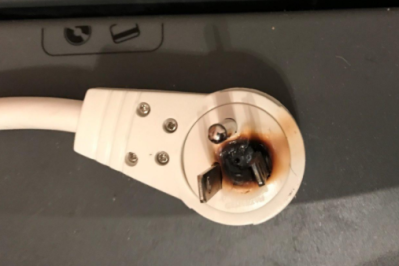
A few weeks ago I needed a power strip in my home office. The outlet in question is located behind a filing cabinet so it would need a low profile plug. I jumped on Amazon to buy a surge suppressor strip. That’s when I noticed strips with rotating plugs. I’ve always had some apprehensions about plugs like that, though I could never quite put my finger on why. Looking at the reviews on this particular plug, I found some scary issues. Photos of melted plugs, melted outlets, and cries of “fire hazard”. So I did what any crazy hacker would do – bought two power strips. One with a fixed right angle plug to use in my office, and one with a rotating plug to tear down.

Failed plug – from Amazon reviews

Surge suppressors, power strips, outlet strips, they have many names. Underwriter’s Laboratories (UL) calls them “Relocatable power taps”. They all have several outlets, most have a circuit breaker of some sort inside, and some have circuits for surge suppression. These are some of the most common devices to find in the modern home. Many of our houses were designed and built before surround sound, cable boxes, computers, modems, cell phone chargers, tablet chargers, and all our other modern conveniences. There weren’t as many electrical loads, so the houses didn’t have many outlets. Power strips solve this problem.

After a couple of days, I had my strips in hand. I expected the plug to rotate once – maybe 270 degrees. That would indicate there were wires connecting the rotating head to rest of the plug. Not so – this plug would spin round and round all day long.

Continue reading “This Power Strip Is A Fire Starter”