Automate The Freight: Front Line Deliveries By Drone

Gen. Robert H. Barrow, USMC, once said that “Amateurs talk about tactics, but professionals study logistics.” That’s true in many enterprises, but in warfare, the side that neglects logistics is likely to be the loser. Keeping soldiers fed, clothed, and armed is the very essence of effectively prosecuting a war, and the long logistical chain from rear supply depots to forward action is what makes that possible.

Armies have had millennia to optimize logistics, and they have always maximized use of new technologies to position supplies where they’re needed. Strong backs of men and beasts sufficed for centuries, supplemented by trains in the 19th century and supplanted by motor vehicles in the 20th. Later, aircraft made an incalculable impact on supply chains, allowing rapid mobilization of supplies and supporting the industrial scale death and destruction of the 20th-century’s wars.

Continue reading “Automate The Freight: Front Line Deliveries By Drone”
This Way To The Ingress: Keeping Stuff Dry And Clean With IP And NEMA

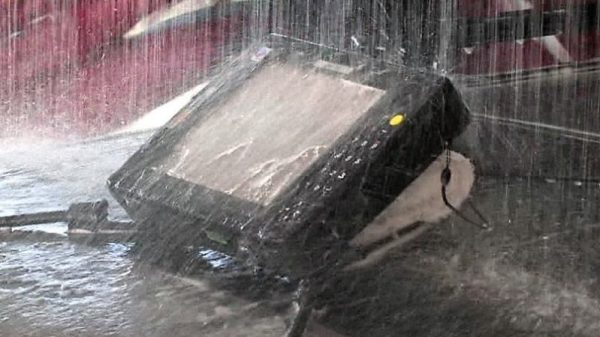
When designing a piece of hardware that has even the faintest chance of being exposed to the elements, it’s best to repeat this mantra: water finds a way. No matter how much you try to shield a project from rain, splashing, or even just humid air, if you haven’t taken precautions to seal your enclosure, I’ll bet you find evidence of water when you open it up. Water always wins, and while that might not be a death knell for your project, it’s probably not going to help. And water isn’t the only problem that outdoor or rough-service installations face. Particle intrusion can be a real killer too, especially in an environment where dust can be conductive.

There’s plenty you can do to prevent uninvited liquid or particulate guests to your outdoor party, but it tends to be easier to prevent the problem at design time than to fix it after the hardware is fielded. So to help you with your design, here’s a quick rundown of some standards for protection of enclosures from unwanted ingress.

Continue reading “This Way To The Ingress: Keeping Stuff Dry And Clean With IP And NEMA”

Hacking On Mars In “The Martian”

It’s been 6 years since the hacker’s treat of a book, “The Martian” by Andy Weir, was self-published, and 2 years since the movie came out. We’ve talked about it briefly before, but enough time has passed that we can now write-up the book’s juicier hacks while being careful to not give away any plot spoilers. The book has more hacks than the movie so we’re using the book as the source.

For anyone unfamiliar with the story, Mark Watney is an astronaut who’s left for dead, by himself, on Mars. To survive, he has a habitat designed for six, called the Hab, two rovers, the Mars Descent Vehicle (MDV) they arrived in, and the bottom portion of the Mars Ascent Vehicle (MAV), the top portion of which was the rocket that his five crewmates departed in when they left him alone on the inhospitable desert planet. If you haven’t read it yet, it’s easy to finish over a long weekend. Do yourself a favor and pick it up after work today.

Making Water

Watney’s major concern is food. They sent up some potatoes with the mission which will sprout roots from their eyes. To grow potatoes he needs water.

One component of the precious H2O molecule is of course the O, oxygen. The bottom portion of the MAV doesn’t produce oxygen, but it does collect CO2 from the Martian atmosphere and stores it in liquid form. It does this as one step in producing rocket fuel used later to blast off from the surface.

Continue reading “Hacking On Mars In “The Martian””

Something To Think About While You’re Mowing The Lawn

Well here we are, we’ve reached that time of year again at which our yearly ritual of resuscitating small internal combustion engines from their winter-induced morbidity is well under way. It’s lawn mowing season again, and a lot of us are spending our Saturday afternoons going up and down our little patches of grass courtesy of messers Briggs and Stratton. Where this is being written, the trusty Honda mower’s deck has unexpectedly failed, so an agricultural field topper is performing stand-in duty for a while, and leaving us with more of the rough shag pile of a steeplechaser’s course than the smooth velvet of a cricket ground. Tea on the lawn will be a mite springier this year.

When you think about it, there’s something ever so slightly odd about going to such effort over a patch of grass. Why do we do it? Because we like it? Because everyone else has one? Or simply because it’s less effort to fill the space with grass than it is to put something else there? It’s as if our little pockets of grassland have become one of those facets of our consumer culture that we never really think about, we just do. Continue reading “Something To Think About While You’re Mowing The Lawn”

Will It Sell?

Many of us develop things for one of two purposes: to hack something cool, or to sell something cool. When hacking something cool, your target market is yourself, and you already know you’ve made the sale. If your goal is to sell the thing you are making, then a lot more thought and effort is required. You could develop the coolest product in the world, but if your target market is too small, your price is too high, your lead time is too long, or any of a dozen other factors is not quite right, you’ll be spending a lot of time and effort on what will amount to a huge disappointment. The Hackaday Prize Best Product has many great examples which let us study some of these success factors, so let’s take a look. Continue reading “Will It Sell?”

Mechanical Image Acquisition With A Nipkow Disc

If you mis-spent your teenage years fishing broken televisions from dumpsters and either robbing them for parts or fixing them for the ability to watch The A Team upstairs rather than in the living room as I did, then it’s possible that you too will have developed a keen interest in analogue television technology. You’ll know your front porch from your blanking interval and your colour burst, you might say.

An illustration of a simple Nipkow disk. Hzeller (CC BY-SA 3.0).

There was one piece of television technology that evaded a 1980s dumpster-diver, no 625-line PAL set from the 1970s was ever going to come close to the fascination of the earliest TV sets. Because instead of a CRT and its associated electronics, they featured a spinning disk with a spiral pattern of holes. These mechanical TV systems were quickly superseded in the 1930s by all-electronic systems, so of the very few sets manufactured only a fraction have survived the intervening decades.

The spinning disk in a mechanical TV is referred to as a Nipkow disk, after its inventor, [Paul Gottlieb Nipkow]. [Nipkow] conceived and patented the idea of a spinning disk with a spiral of holes to dissect an image sequentially into a series of lines in the 1880s, but without the benefit of the electronic amplification that would come a few decades later was unable to produce a viable system to demonstrate it. It would be in the 1920s before [John Logie Baird] would develop the first working television system using [Nipkow]’s invention.

Continue reading “Mechanical Image Acquisition With A Nipkow Disc”

A Crash Course In Thingiverse Customizer

OpenSCAD is a great way to create objects for 3D printing (or other purposes), especially if you are already used to programming. For things like front panels, it is great because you can easily make modifications and — if you wrote your code correctly–everything will just adjust itself to new positions.

However, what if you have a general-purpose piece of code, and you want people to have the ability to customize it? For example, consider this code:



$fn=100;
difference()
{
  cube([25,25,5]);
  translate([4,4,-1]) cylinder(h=7,r=2);
  translate([25-4,4,-1]) cylinder(h=7,r=2);
  translate([4,25-4,-1]) cylinder(h=7,r=2);
  translate([25-4,25-4,-1]) cylinder(h=7,r=2);
}

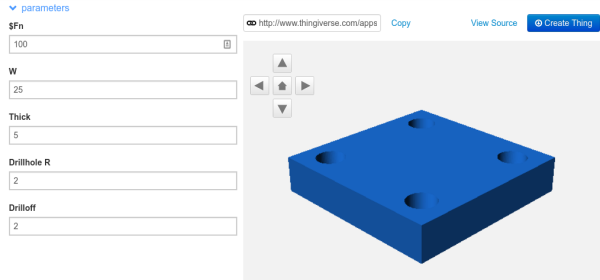
That creates the plate with four drill holes you see on the right.

Continue reading “A Crash Course In Thingiverse Customizer”