Diodes: The Switch You Never Knew You Had

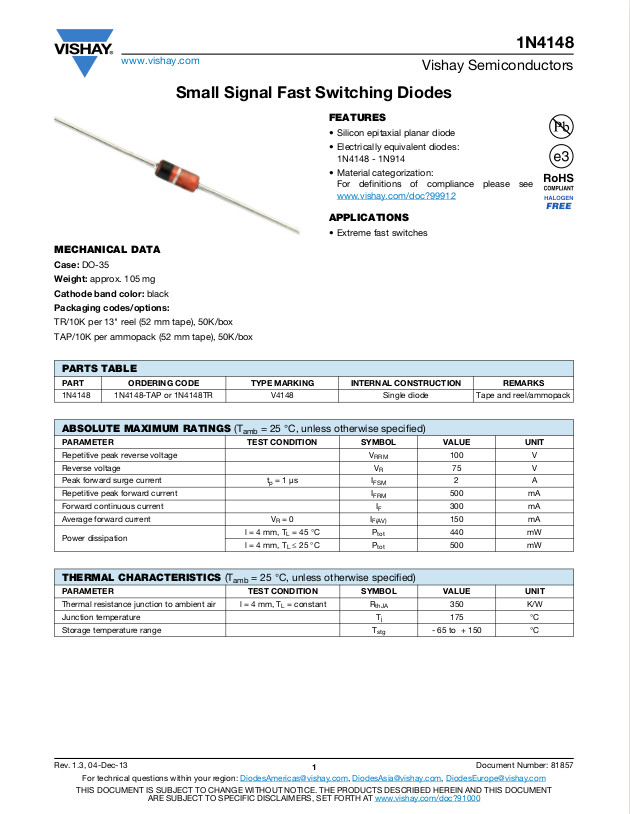
Vishay's take on the 1N4148 data sheet (PDF), describing it as a switching diode.
Vishay’s take on the 1N4148 data sheet (PDF), describing it as a switching diode.

When looking across the discrete components in your electronic armory, it is easy to overlook the humble diode. After all, one can be forgiven for the conclusion that the everyday version of this component doesn’t do much. They have none of the special skills you’d find in tunnel, Gunn, varicap, Zener, and avalanche diodes, or even LEDs, instead they are simply a one-way valve for electrical current. Connect them one way round and current flows, the other and it doesn’t. They rectify AC to DC, power supplies are full of them. Perhaps you’ve also used them to generate a stable voltage drop because they have a pretty constant voltage across them when current is flowing, but that’s it. Diodes: the shortest Hackaday article ever.

Not so fast with dismissing the diode though. There is another trick they have hiding up their sleeves, they can also act as a switch. It shouldn’t come as too much of a shock, after all a quick look at many datasheets for general purpose diodes should reveal their description as switching diodes.

So how does a diode switch work? The key lies in that one-way valve we mentioned earlier. When the diode is forward biased and conducting electricity it will pass through any variations in the voltage being put into them, but when it is reverse biased and not conducting any electricity it will not. Thus a signal can be switched on by passing it through a diode in forward bias, and then turned off by putting the diode into reverse bias.

Continue reading “Diodes: The Switch You Never Knew You Had”
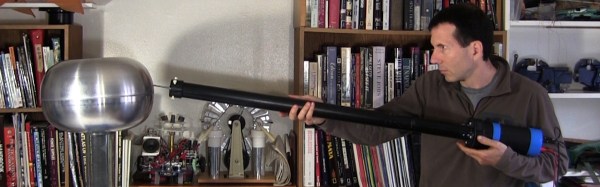
Probing high voltage

Measuring High Voltage In Millimeters (and Other HV Probe Tricks)

I work a lot with high voltages and others frequently replicate my projects, so I often get asked “What voltage is needed?”. That means I need to be able to measure high voltages. Here’s how I do it using a Fluke high voltage probe as well as my own homemade probe. And what if you don’t have a probe? I have a solution for that too.

How Long Is Your Spark?

The simplest way to measure high voltage is by spark length. If your circuit has a spark gap then when a spark occurs, that’s a short-circuit, dumping all your built up charge. When your spark gap is at the maximum distance at which you get a spark then just before the spark happens is when you have your maximum voltage. During the spark the voltage rapidly goes to zero and depending on your circuit it may start building up again. The voltage before the spark occurred is related to the spark length, which is also the spark gap width.

The oscilloscope photo below shows this changing voltage. This method is good for a rough estimate. I’ll talk about doing more precise measurements when I talk about high voltage probes further down.

Continue reading “Measuring High Voltage In Millimeters (and Other HV Probe Tricks)”

You Can Have My LM386s When You Pry Them From My Cold Dead Hands

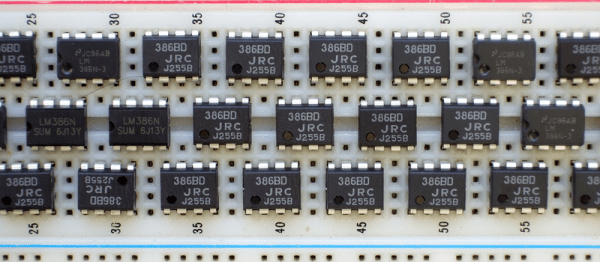
Everyone has a chip-of-shame: it’s the part that you know is suboptimal but you keep using it anyway because it just works well enough. Maybe it’s not what you would put into a design that you’re building more than a couple of, but for a quick and dirty lashup, it’s just the ticket. For Hackaday’s [Adam Fabio], that chip is the TIP120 transistor. Truth be told, we have more than one chip of shame, but for audio amplification purposes, it’s the LM386.

The LM386 is an old design, and requires a few supporting passive components to get its best performance, but it’s fundamentally solid. It’s not noise-free and doesn’t run on 3.3 V, but if you can fit a 9 V battery into your project and you need to push a moderate amount of sound out of a speaker, we’ll show you how to get the job done with an LM386.

Continue reading “You Can Have My LM386s When You Pry Them From My Cold Dead Hands”

Hack Safely: Fire Safety In The Home Shop

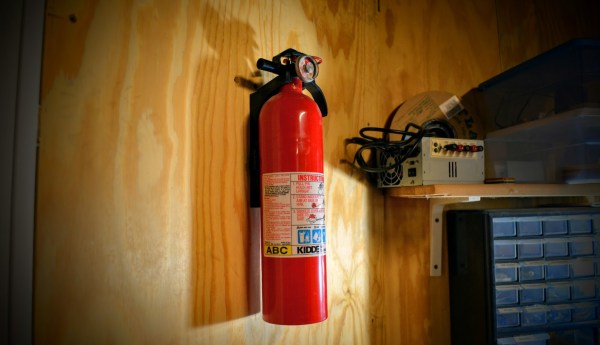
Within the past two months we’ve covered two separate incidents of 3D printing-related fires. One was caused by an ill-advised attempt to smooth a print with acetone heated over an open flame, while the other was investigated by fire officials and found to have been caused by overuse of hairspray to stick prints to the printer bed. The former was potentially lethal but ended with no more than a good scare and a winning clip for “Hacking’s Funniest Home Videos”; the latter tragically claimed the life of a 17-year old lad with a lot of promise.

In light of these incidents, we here at Hackaday thought it would be a good idea to review some of the basics of fire safety as they relate to the home shop. Nowhere was this need made clearer than in the comments section on the post covering the fatal fire. There was fierce debate about the cause of the fire and the potential negative effect it might have on the 3D-printing community, with comments ranging from measured and thoughtful to appallingly callous. But it was a comment by a user named [Scuffles] that sealed the deal:

“My moment of reflection is that it’s well past time I invest in a fire extinguisher for my workstation. Cause right now my fire plan pretty much consists of shouting obscenities at the blaze and hoping it goes out on its own.”

Let’s try to come up with a better plan for [Scuffles] and for everyone else. We’ll cover the basics: avoidance, detection, control, and escape.

Continue reading “Hack Safely: Fire Safety In The Home Shop”

The Demise Of Pebble As A Platform

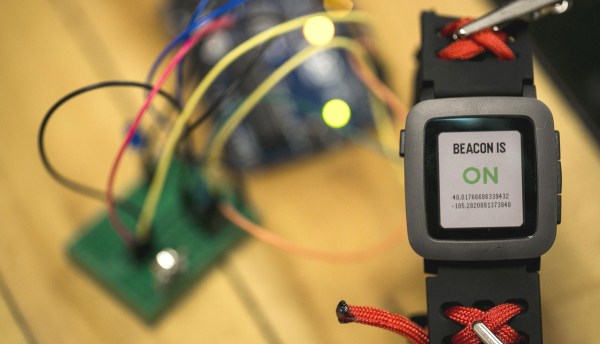
Despite owning five, including the original Pebble, I’ve always been somewhat skeptical about smart watches. Even so, the leaked news that Fitbit is buying Pebble for “a small amount” has me sort of depressed about the state of the wearables market. Because Pebble could have been a contender, although perhaps not for the reason you might guess.

Pebble is a pioneer of the wearables market, and launched its first smartwatch back in 2012, two years before the Apple Watch was announced. But after turning down an offer of $740 million by Citizen back in 2015, and despite cash injections from financing rounds and a recent $12.8 million Kickstarter, the company has struggled financially.

An offer of just $70 million earlier this year by Intel reflected Pebble’s reduced prospects, and the rumoured $30 to $40 million price being paid by Fitbit must be a disappointing outcome for a company that was riding high such a short time ago.

Continue reading “The Demise Of Pebble As A Platform”

Taking It To Another Level: Making 3.3V Speak With 5V

If your introduction to digital electronics came more years ago than you’d care to mention, the chances are you did so with 5V TTL logic. Above 2V but usually pretty close to 5V is a logic 1, below 0.8V is a logic 0. If you were a keen reader of electronic text books you might have read about different voltage levels tolerated by 4000 series CMOS gates, but the chances are even with them you’d have still used the familiar 5 volts.

This happy state of never encountering anything but 5V logic as a hobbyist has not persisted. In recent decades the demands of higher speed and lower power have given us successive families of lower voltage devices, and we will now commonly also encounter 3.3V or even sometimes lower voltage devices. When these different families need to coexist as for example when interfacing to the current crop of microcontroller boards, care has to be taken to avoid damage to your silicon. Some means of managing the transition between voltages is required, so we’re going to take a look at the world of level shifters, the circuits we use when interfacing these different voltage logic families.

Continue reading “Taking It To Another Level: Making 3.3V Speak With 5V”

Self-Driving Cars Are Not (Yet) Safe

Three things have happened in the last month that have made me think about the safety of self-driving cars a lot more. The US Department of Transportation (DOT) has issued its guidance on the safety of semi-autonomous and autonomous cars. At the same time, [Geohot]’s hacker self-driving car company bailed out of the business, citing regulatory hassles. And finally, Tesla’s Autopilot has killed its second passenger, this time in China.

At a time when [Elon Musk], [President Obama], and Google are all touting self-driving cars to be the solution to human error behind the wheel, it’s more than a little bold to be arguing the opposite case in public, but the numbers just don’t add up. Self-driving cars are probably not as safe as a good sober driver yet, but there just isn’t the required amount of data available to say this with much confidence. However, one certainly cannot say that they’re demonstrably safer.

Continue reading “Self-Driving Cars Are Not (Yet) Safe”