An SD card is surely not an enterprise grade storage solution, but single board computers also aren’t just toys anymore. You find them in applications far beyond the educational purpose they have emerged from, and the line between non-critical and critical applications keeps getting blurred.
Laundry notification hacks and arcade machines fail without causing harm. But how about electronic access control, or an automatic pet feeder? Would you rely on the data integrity of a plain micro SD card stuffed into a single board computer to keep your pet fed when you’re on vacation and you back in afterward? After all, SD card corruption is a well-discussed topic in the Raspberry Pi community. What can we do to keep our favorite single board computers from failing at random, and is there a better solution to the problem of storage than a stack of SD cards?
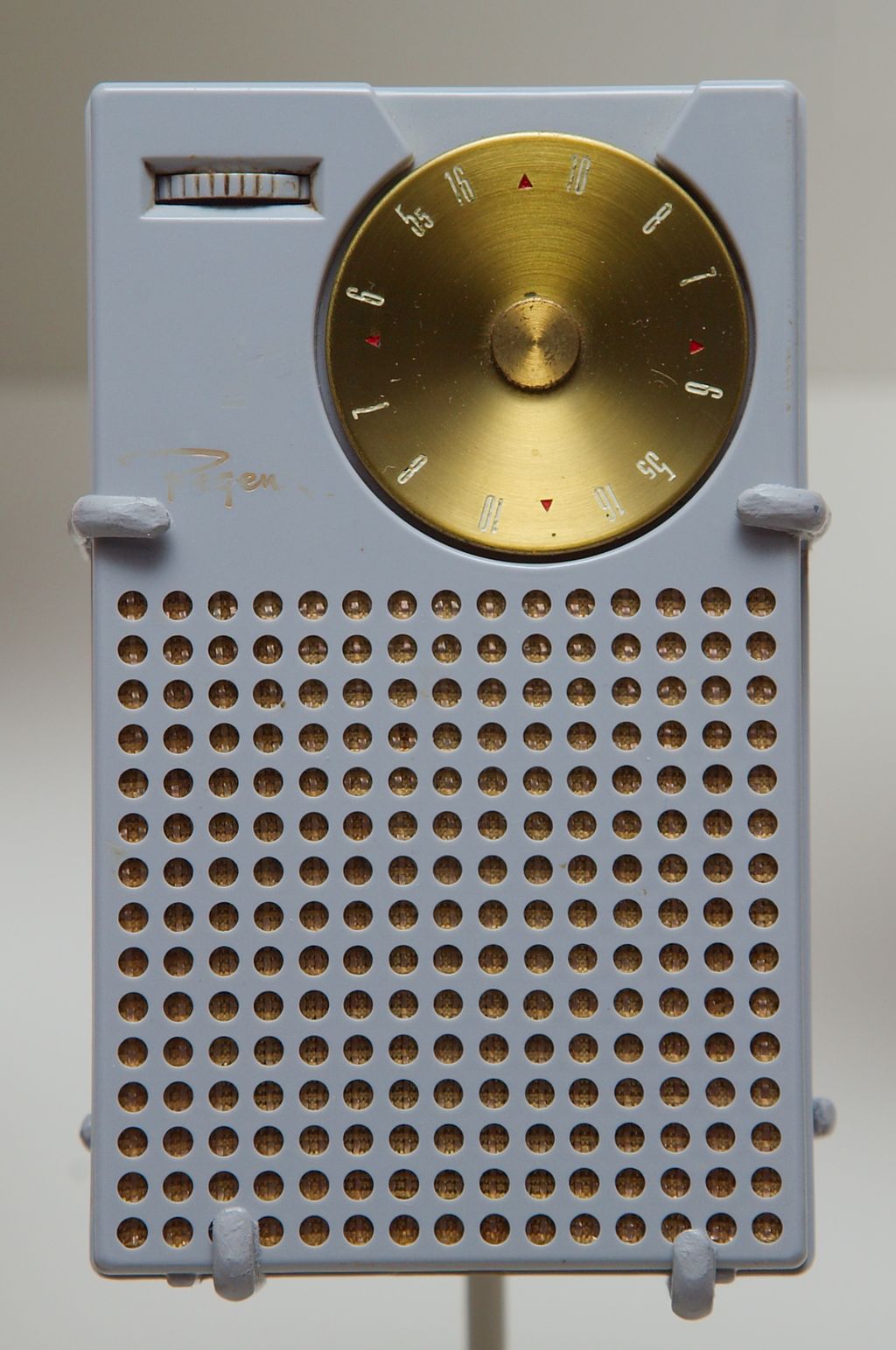
Transistors have come a long way. Like everything else electronic, they’ve become both better and cheaper. According to a recent IEEE article, a transistor cost about $8 in today’s money back in the 1960’s. Consider the Regency TR-1, the first transistor radio from TI and IDEA. In late 1954, the four-transistor device went on sale for $49.95. That doesn’t sound like much until you realize that in 1954, this was equivalent to about $441 (a new car cost about $1,700 and a copy of life magazine cost 20 cents). Even at that price, they sold about 150,000 radios.
Part of the reason the transistors cost so much was that production costs were high. But another reason is that yields were poor. In some cases, 4 out of 5 of the devices were not usable. The transistors were not that good even when they did work. The first transistors were germanium which has high leakage and worse thermal properties than silicon.
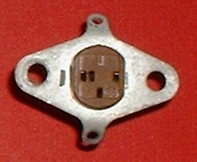
Early transistors were subject to damage from soldering, so it was common to use an alligator clip or a specific heat sink clip to prevent heat from reaching the transistor during construction. Some gear even used sockets which also allowed the quick substitution of devices, just like the tubes they replaced.
When the economics of transistors changed, it made a lot of things practical. For example, a common piece of gear used to be a transistor tester, like the Heathkit IT-121 in the video below. If you pulled an $8 part out of a socket, you’d want to test it before you spent more money on a replacement. Of course, if you had a curve tracer, that was even better because you could measure the device parameters which were probably more subject to change than a modern device.
Of course, germanium to silicon is only one improvement made over the years. The FET is a fundamentally different kind of transistor that has many desirable properties and, of course, integrating hundreds or even thousands of transistors on one integrated circuit revolutionized electronics of all types. Transistors got better. Parameters become less variable and yields increased. Maximum frequency rises and power handling capacity increases. Devices just keep getting better. And cheaper.
A Brief History of Transistors
The path from vacuum tube to the Regency TR-1 was a twisted one. Everyone knew the disadvantages of tubes: fragile, power hungry, and physically large, although smaller and lower-power tubes would start to appear towards the end of their reign. In 1925 a Canadian physicist patented a FET but failed to publicize it. Beyond that, mass production of semiconductor material was unknown at the time. A German inventor patented a similar device in 1934 that didn’t take off, either.
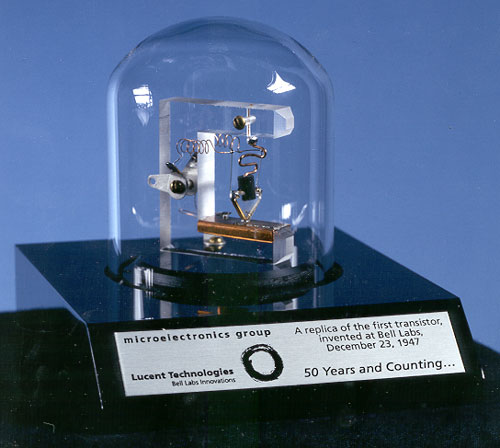
Replica of the First Transistor
Bell labs researchers worked with germanium and actually understood how to make “point contact” transistors and FETs in 1947. However, Bell’s lawyers found the earlier patents and elected to pursue the conventional transistor patent that would lead to the inventors (John Bardeen, Walter Brattain, and William Shockley) winning the Nobel prize in 1956.
Two Germans working for a Westinghouse subsidiary in Paris independently developed a point contact transistor in 1948. It would be 1954 before silicon transistors became practical. The MOSFET didn’t appear until 1959.
Of course, even these major milestones are subject to incremental improvements. The V channel for MOSFETs, for example, opened the door for FETs to be true power devices, able to switch currents required for motors and other high current devices.
I’ll admit. When I saw the Othermill for the first time I thought it was just another mill with cheap Chinese hardware inside sold as a premium. I’m ashamed to say that I even trash talked it a little bit. It gave me another chance to relearn that I should always do my research before being a jerk, check my assumptions thoroughly, and even then it’s not recommended. Other Machine Company was kind enough to let me swing by the office in Berkeley California. [Danielle], the CEO, led me through the design of the mill as well as the challenges in running the operation.
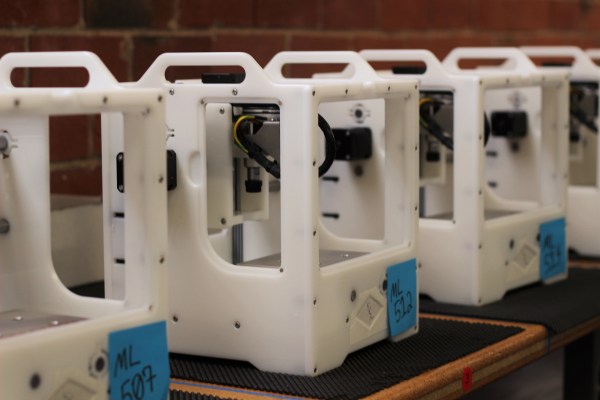
The Othermill is a serious machine, and with the recent release of the Othermill Pro, it’s only getting better. The components are not bargain basement. This is something that could be more obvious, but it’s almost entirely made from US sourced parts, including the custom stepper motors. There aren’t any ball bearings that will start to make strange noises in a year. It can now cut 6mil traces in a PCB all day long. To put it into perspective. The Othermill Pro costs a third of the price of an equivalent machine from LPKF and has the same capabilities.
VCF West is happening this Saturday and Sunday at the Computer History Museum in Mountain View, CA. This on of our favorite events; a celebration of the hardware that paved the way for our modern world. VCF attracts an impressive amount of rare and interesting computers and other technology items. That hardware doesn’t make it to the festival on its own. The people at VCF — exhibitors, speakers, attendees, etc — are themselves an incredible collection of stories from salvage and restoration to the inside story on the teams that made the computers in the first place. Check out some of Brian Benchoff’s coverage of VCF East earlier this year.
I ran into Vintage Computer Federation President Evan Koblentz ten days ago and he shared an interesting anecdote I think you’ll enjoy. Bil Herd was a featured speaker at VCF East a few years back. He was the Senior Design Engineer behind the Commodore C128 — obviously a fascinating person to headline the event. The year after Bil spoke at the festival, Evan as surprised to run into him wandering around the event again. Bil didn’t just want to speak, he wanted to see all the cool stuff and has attended, spoken, and conducted workshops at several of the festivals since.
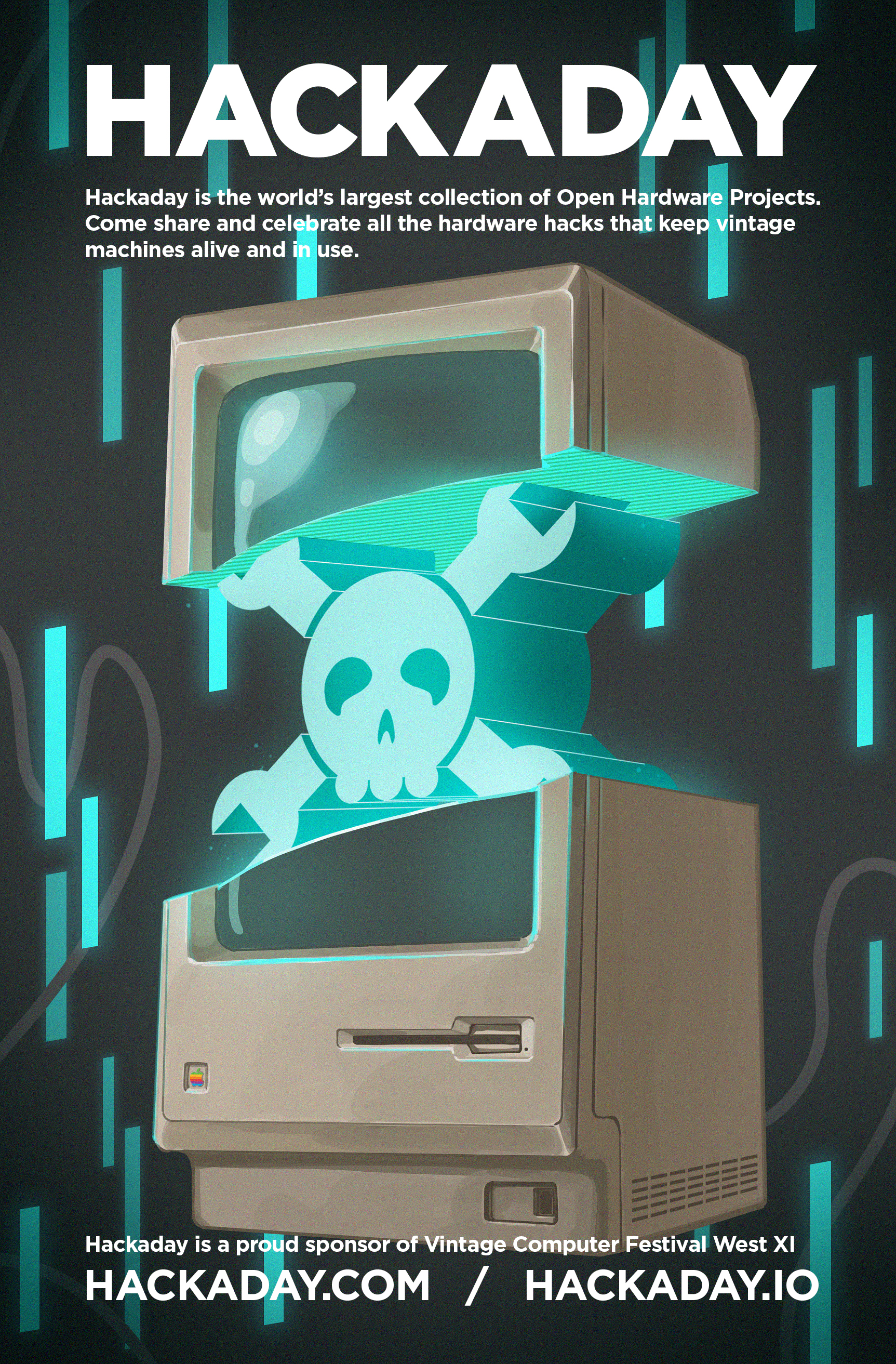
Who will show up this year is anyone’s guess. But we know this event is incredible and you will be amazed at who you run into. It is important to recognize where our technology comes from, to celebrate those who made it happen, and to encourage young people to start on the path to becoming a computer engineering wizard. For all of these reasons we are happy to be sponsoring VCF West. On the inside cover of every festival program you’ll find this epic art by our Illustrator, Joe Kim. You can also click the image on the right to embiggen.
Joshua Vasquez will on hand for Hackaday at VCF West. He’s looking for the best bits to feature on our front page. If you want get a hold of him to show off your wares, or to grab some excellent Hackaday stickers, hit him up on Hackaday.io.
At frustratingly regular intervals, the debate around gun control crops up, and every time there is a discussion about smart guns. The general idea is to have a gun that will not fire unless authenticated and authorized. There’s usually a story about a young person who invents a smart controller and another company that is struggling because they just can’t get “Big Guns” to buy into the idea. We aren’t going to focus on the politics; we’re going to look at whether the technology is realistic, and why a lot of the news stories about new tech never pan out.
Let’s start with an example of modern technology creeping into established machines: the car. These are giant hunks of metal with nearly constant explosions, controlled by sophisticated electronics that are getting smarter and more connected every day. Industry is adopting it with alacrity, and the vehicles are getting more efficient and powerful because of it. So why can’t firearms?
Many of us have enjoyed building electronic projects that come not from our own inspiration or ingenuity but from a ready-made kit. It makes sense, after all in buying a kit you should receive a tried-and-tested design that you can assemble without some of the heartache associated with getting a self-designed project right. And though in recent years the barriers to entry into the professional PCB market for small projects have lowered significantly, there is still an attraction to a kit that comes with a decent PCB and case.
The kit version of the Sinclair ZX81 microcomputer. By Smaddison (Own work) [CC BY-SA 3.0], via Wikimedia Commons.If you start your electronic odyssey through kit-building, you gain more than a set of electronic projects. You learn about the circuits you build, and you gain a feel for how a well-designed project should go together. Eventually this feeds into your own projects, and in time you are producing builds that equal or surpass those you can buy as kits.
From the point of having a nicely executed project to that of wondering whether it too could be sold as a kit is not a huge step. This is the first of a series of articles that will examine the kit manufacturing process from project to customer, and will with luck deliver some insight to those of you who have always wondered whether you could make it as a kit vendor.
Wood. Humans have burned it for to heat their homes for thousands of years. It’s truly a renewable source of energy. While it may not be the most efficient or green method to warm a space, it definitely gets the job done. Many homes still have a fireplace or wood burning stove for supplemental heat. For those in colder climates, wood is more than just supplemental, it’s needed simply for survival.
Splitting maul by Chmee2 via Wikipedia
The problem with firewood is that it doesn’t come ready to burn. Perfect fireplace sized chunks don’t grow on trees after all. The trees have to be cut up into logs. The logs must be split. The split wood then needs to dry for 6 months or so.
Anyone who’s spent time manually splitting wood can tell you it’s back breaking work. Swinging an 8 pound maul for a few hours will leave your hands numb and your shoulders aching. It’s the kind of work that leaves the mind free to wander a bit. The hacker’s mind will always wander toward a better way to get the job done. Curiously we haven’t seen too many log splitting hacks here on the blog. [KH4] built an incredible cross bladed axe back in 2015, but that’s about it.






![The kit version of the Sinclair ZX81 microcomputer. By Smaddison (Own work) [CC BY-SA 3.0], via Wikimedia Commons.](https://hackaday.com/wp-content/uploads/2016/07/636px-zx81_kit.jpg)