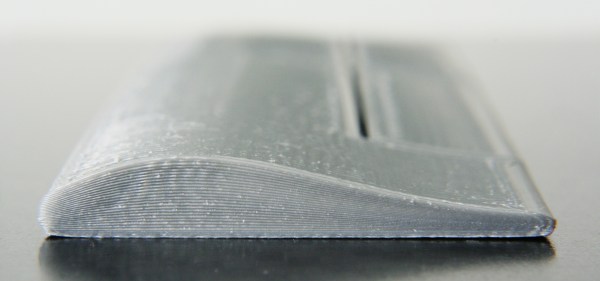
Non-planar layer Fused Deposition Modeling (FDM) is any form of fused deposition modeling where the 3D printed layers aren’t flat or of uniform thickness. For example, if you’re using mesh bed leveling on your 3D printer, you are already using non-planar layer FDM. But why stop at compensating for curved build plates? Non-planar layer FDM has more applications and there are quite a few projects out there exploring the possibilities. In this article, we are going to have a look at what the trick yields for us.
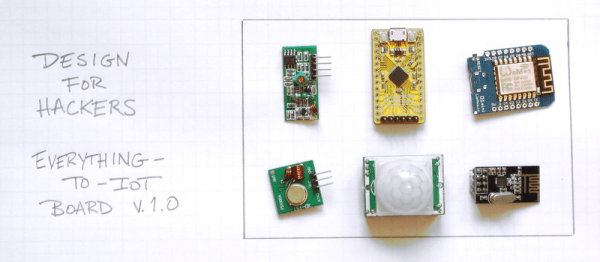
Near the end of the lifecycle of mass-market commercial product development, an engineering team may come in and make a design for manufacturability (DFM) pass. The goal is to make the device easy, cheap, and reliable to build and actually improve reliability at the same time. We hackers don’t usually take this last step, because when you’re producing just a couple of any given device, it hardly makes sense. But when you release an open-source hardware design to the world, if a lot of people re-build your widget, it might be worth it to consider DFM, or at least a hardware hacker’s version of DFM.
If you want people to make their own versions of your project, make it easy and cheap for them to do so and don’t forget to also make it hackable. This isn’t the same as industrial DFM: rather than designing for 100,000s of boards to be put together by robot assembly machines, you are designing for an audience of penny-pinching hackers, each building your project only once. But thinking about how buildable your design is will still be worthwhile.
In this article, I’m going to touch on a couple of Design for Hackers (DFH) best practices. I really want to hear your experience and desires in the comments. What would you like to see in someone else’s open designs? What drives you nuts when replicating a project? What tricks do you know to make a project easily and cheaply buildable by the average hacker?
As a rule, I try hard not to get sucked into religious wars. You know, Coke vs Pepsi. C++ vs Java. Chrome vs Firefox. There are two I can’t help but jump into: PC vs Mac (although, now that Mac has turned into Unix, that’s almost more habit than anything else) and–the big one–Emacs vs vi.
If you use Linux, Unix, or anything similar, you are probably at least aware of the violence surrounding this argument. Windows users aren’t immune, although fewer of them know the details. If you aren’t familiar with these two programs, they are–in a way–text editors. However, that’s like calling a shopping mall “a store.” Technically, that’s correct, but the connotation is all wrong.
Like most religious wars, this one is partly based on history that might not be as relevant as it used to be. Full disclosure: I’m firmly in the Emacs camp. Many of my friends are fans of vi–I try not to hold it against them. I’ll try to be balanced and fair in my discussion, unless I’m talking about my preference. I don’t have to be fair when it comes to my opinions. Just to be clear: I know how to use vi. My preference isn’t based out of not wanting to learn something new.
The pioneering years in the history of capacitors was a time when capacitors were used primarily for gaining an early understanding of electricity, predating the discovery even of the electron. It was also a time for doing parlor demonstrations, such as having a line of people holding hands and discharging a capacitor through them. The modern era of capacitors begins in the late 1800s with the dawning of the age of the practical application of electricity, requiring reliable capacitors with specific properties.
Leyden Jars
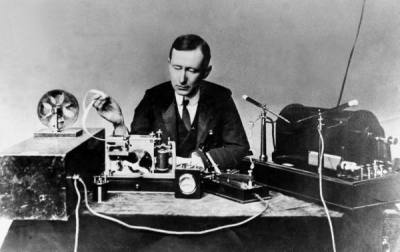
Marconi with transmitting apparatus, Published on LIFE [Public domain], via Wikimedia CommonsOne such practical use was in Marconi’s wireless spark-gap transmitters starting just before 1900 and into the first and second decade. The transmitters built up a high voltage for discharging across a spark gap and so used porcelain capacitors to withstand that voltage. High frequency was also required. These were basically Leyden jars and to get the required capacitances took a lot of space.
Mica
In 1909, William Dubilier invented smaller mica capacitors which were then used on the receiving side for the resonant circuits in wireless hardware.
Early mica capacitors were basically layers of mica and copper foils clamped together as what were called “clamped mica capacitors”. These capacitors weren’t very reliable though. Being just mica sheets pressed against metal foils, there were air gaps between the mica and foils. Those gap allowed for oxidation and corrosion, and meant that the distance between plates was subject to change, altering the capacitance.
In the 1920s silver mica capacitors were developed, ones where the mica is coated on both sides with the metal, eliminating the air gaps. With a thin metal coating instead of thicker foils, the capacitors could also be made smaller. These were very reliable. Of course we didn’t stop there. The modern era of capacitors has been marked by one breakthrough after another for a fascinating story. Let’s take a look.
Some of our more dedicated readers may remember me as that promising and talented new writer who disappeared after only a couple of months last fall. Or, alternatively, that moronic new writer who had no idea what he was talking about. But, I’m just going to go ahead and assume it was the former in order to protect my ego. In either case, if you remember me at all, you may have wondered why I left. Was it cholera? Was I drafted into a top-secret CIA program? Did I join a circus as a fledgling trapeze artist?
No, it was none of that. That would be absurd. What would make you think I had any trapeze skills at all, much less circus-worthy ones? The truth is a lot more straightforward, but was also a lot scarier (and more exciting) for me — I started a business. The astute readers among you have probably already put the dots together and figured out that I failed. The title was a pretty strong hint, right? This isn’t a story of bootstraps-pulling success, or a heartwarming underdog tale. This is an opportunity for me to talk about the lessons I learned as I failed, and to give the entrepreneurs out there something to consider when they start their businesses. We’ll laugh together, we’ll cry together, and maybe we’ll even learn something together. Ready? Alright, let’s dive right into the heart of it, starting when I was seven years old…
In our last installment of Tools of the Trade, we had just finished doing the inspection of the surface mount part of the PCB. Next in the process is the through hole components. Depending on the PCB, the order may change slightly, but generally it makes more sense to get all the SMT work done before moving to the through hole work.
Through hole used to be the standard, but as the need for size reduction and automation increased, SMT gained favor. However, there are still a lot of reasons to use through hole components, so they aren’t going away entirely (at least not any time soon). One of the biggest advantages of THT is mechanical strength, which makes it better suited for connectors than SMT. If you’ve ever popped a microusb connector off a PCB by breathing on it heavily, you’ll understand. So, how do we most efficiently get through hole components on a PCB, and how do the big boys do it?
Psst… Wanna make a canning jar diode? A tennis ball triode? How about a semiconductor transistor? Or do you just enjoy sitting back and following along an interesting narrative of something being made, while picking up a wealth of background, tips and sparking all sorts of ideas? In my case I wanted to make a cuprous oxide semiconductor diode and that lead me to H.P. Friedrichs’ wonderful book Instruments of Amplification. It includes such a huge collection of amplifier knowledge and is a delight to read thanks to a narrative style and frequent hands-on experiments.
My well worn copy of Instruments of Amplifications
DIY point-contact semiconductor transistor
Friedrichs first authored another very popular book, The Voice of the Crystal, about making crystal radios, and wanted to write a second one. For those not familiar with crystal radios, they’re fun to make radios that are powered solely by the incoming radio waves; there are no batteries. But that also means the volume is low.
Readers of that book suggested a good follow-up would be one about amplifier circuits, to amplify the crystal radio’s volume. However, there were already an abundance of such books. Friedrichs realized the best follow-up would be one on how to make the amplifying components from scratch, the “instruments of amplification”. It would be unique and in the made-from-scratch spirit of crystal radios. The book, Instruments of Amplification was born.
The book includes just the right amount of a history, giving background on what an amplifier is and how they first came in the electrical world. Telegraph operators wanted to send signals over greater and greater distances and the solution was to use the mix of electronics and mechanics found in the telegraph relay. This is the springboard for his first project and narrative: the microphonic relay.
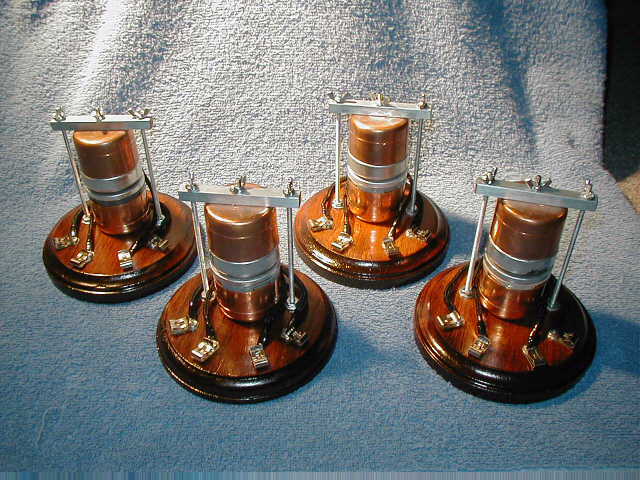
The microphonic relay example shown on the right places a speaker facing a microphone; the speaker is the input with the microphone amplifying the output. He uses a carbon microphone salvaged from an old telephone headset, housing everything in an enclosure of copper pipe caps, steel bar stock, nuts and bolts mounted on an elegant looking wood base. All the projects are made with simple parts, with care, and they end up looking great.