In July 1940 the German airforce began bombing Britain. This was met with polite disagreement on the British side — and with high technology, ingenuity, and improvisation. The defeat of the Germans is associated with anti-aircraft guns and fighter planes, but a significant amount of potential damage had been averted by the use of radio.
Night bombing was a relatively new idea at that time and everybody agreed that it was hard. Navigating a plane in the dark while travelling at two hundred miles per hour and possibly being shot at just wasn’t effective with traditional means. So the Germans invented non-traditional means. This was the start of a technological competition where each side worked to implement new and novel radio technology to guide bombing runs, and to disrupt those guidance systems.
When they need to add temperature control to a project, many hackers reach for a K-type thermocouple for their high-temperature needs, or an integrated temperature-sensing IC when it doesn’t get that hot. The thermocouple relies on very small currents and extremely high gain, and you pretty much need a dedicated IC to read it, which can be expensive. The ICs aren’t as expensive, but they’re basically limited to boiling water. What do you do if you want to control a reflow oven?
There’s a cheaper way that spans a range between Antarctic winter and molten solder, and you’ve probably already got the parts on your shelf. Even if you don’t, it’s only going to run you an extra two cents, assuming that you’ve already got a microcontroller with an ADC in your project. The BOM: a plain-vanilla diode and a resistor.
I’ve been using diodes as temperature sensors in three projects over the last year: one is a coffee roaster that brings the beans up to 220 °C in hot air, another is a reflow hotplate that tops out around 210 °C, and the third is a toner-transfer iron that holds a very stable 130 °C. In all of these cases, I don’t really care about the actual numerical value of the temperature — all that matters is reproducibility — so I never bothered to calibrate anything. I thought I’d do it right for Hackaday, and try to push the humble diode to its limits for science.
What resulted was a PCB fire, test circuits desoldering themselves above 190 °C, temperature probes coming loose, and finally a broken ramekin and 200 °C peanut oil all over my desk. Fun times! On the other hand, I managed to get out enough data to calibrate some diodes, and the results are fantastic. The circuits under test included both best practices and the easiest thing that could possibly work, and the results are pretty close. This is definitely a technique that you want to have under your belt for most temperature ranges. The devil is in the details, of course, so read on!
Morse code — that series of dots and dashes — can be useful in the strangest situations. As a kid I remember an original Star Trek episode where an injured [Christopher Pike] could only blink a light once for yes and twice for no. Even as a kid, I remember thinking, “Too bad they didn’t think to teach him Morse code.” Of course odd uses of Morse aren’t just for TV and Movies. Perhaps the strangest real-life use was the case of the Colombian government hiding code in pop music to send messages to hostages.
In 2010, [Jose Espejo] was close to retirement from the Colombian army. But he was bothered by the fact that some of his comrades were hostages of FARC (the Revolutionary Armed Forces of Colombia; the anti-government guerrillas), some for as many as ten years. There was a massive effort to free hostages underway, and they wanted them to know both to boost morale and so they’d be ready to escape. But how do you send a message to people in captivity without alerting their captors?
A reasonable selection of the Hackaday readership will have had their first experiences of computing on an 8-bit machine in a black case, with the word “Sinclair” on it. Even if you haven’t work with one of these machines you probably know that the man behind them was the sometimes colourful inventor Clive (now Sir Clive) Sinclair.
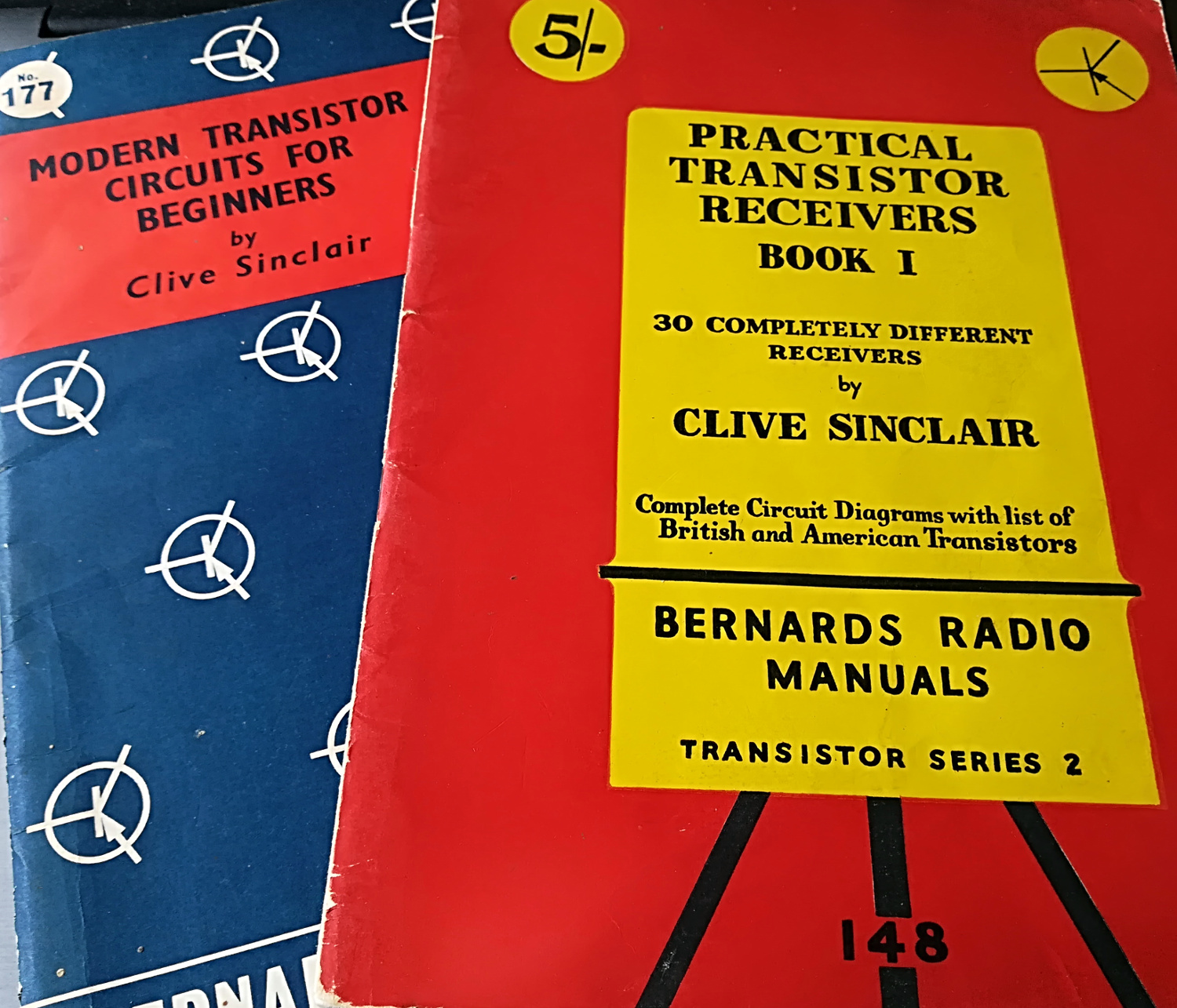
The finest in 1950s graphic design, applied to electronics books.
He was the founder of an electronics company that promised big results from its relatively inexpensive electronic products. Radio receivers that could fit in a matchbox, transistorised component stereo systems, miniature televisions, and affordable calculators had all received the Sinclair treatment from the early-1960s onwards. But it was towards the end of the 1970s that one of his companies produced its first microcomputer.
At the end of the 1950s, when the teenage Sinclair was already a prolific producer of electronics and in the early stages of starting his own electronics business, he took the entirely understandable route for a cash-strapped engineer and entrepreneur and began writing for a living. He wrote for electronics and radio magazines, later becoming assistant editor of the trade magazine Instrument Practice, and wrote electronic project books for Bernard’s Radio Manuals, and Bernard Babani Publishing. It is this period of his career that has caught our eye today, not simply for the famous association of the Sinclair name, but for the fascinating window his work gives us into the state of electronics at the time.
On Saturday, the Hackaday Community from across Ireland and other parts of Europe poured into the performance hall at Dublin’s Project Arts Centre for a massive collection of talks. From rediscovering century’s old technology, to cutting edge research projects, we heard talks from dozens of attendees on the technology that is interesting them most right now.
Choosing what to share about last weekend’s Uncon has been a particularly taxing process. So many and varied were the projects presented, and such was their high standard, that a writer faces a significant challenge to fit them into a single report. But we’ll give it a try. Read on for highlights of what was a weekend we will remember forever.
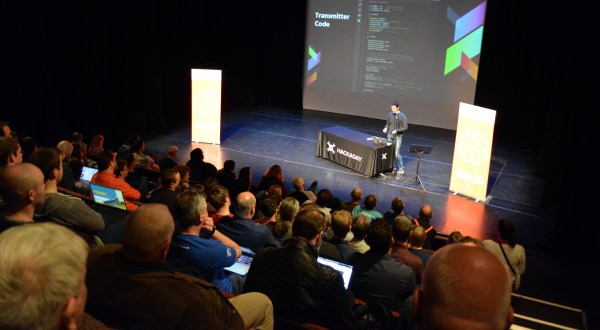
[Rachel]’s about to lull us into a false sense of security with talk of fashion, then go for the eyeballs!
From Wearables to Lab-Grown Eyeballs
Dublin by early April has lost some of winter’s chill, but the sun hadn’t regained control enough for the populace to have shed their coats and boots. It was in a slightly damp Temple Bar then that the Hackaday faithful convened at the Project Arts Centre, temporarily forsaking for us its role as one of Ireland’s most cutting-edge contemporary performing arts venues. We’d spent the previous day rounding up what seemed like Ireland’s entire stock of snack food to keep everyone happy, so it was into the upstairs performance hall for the day’s festivities. After putting in a talk topic and stopping by the swag table for goodies from our sponsor, DesignSpark, we all packed into the hall and began the Uncon.
First to brave the floor was [Rachel “Konichiwakitty” Wong], who started by talking about her interest in and flair for wearable electronics applied to fashion. This is not however what she does for a living, and she soon switched from the kawaii to the everyday work of a stem cell research scientist. This section of her talk was entitled “The Future Of Medicine, stem cells, tissue engineering, off-the-shelf pick-n-mix organs”. Because of the work being done by people like her our hospitals may one day be able to prescribe custom 3D-printed organs for their patients, and her talk was a fascinating overview of that field for those of us who can not grow eyeball tissue on our benches.
There followed the exciting Unconference format, in which attendees were scheduled on-the-fly in four talk sessions throughout the day. Each deliver a seven-minute presentation and although it’s not compulsory to give an Unconference talk, there were definitely more than enough people wanting to give it a go. It’s impossible to mention them all in a single Hackaday piece, but here follows a selection of the many that caught our eye.
The image of the crackpot inventor, disheveled, disorganized, and surrounded by the remains of his failures, is an enduring Hollywood trope. While a simple look around one’s shop will probably reveal how such stereotypes get started, the image is largely not a fair characterization of the creative mind and how it works, and does not properly respect those who struggle daily to push the state of the art into uncharted territory.
That said, there are plenty of wacky ideas that have come down the pike, most of which mercifully fade away before attracting undue attention. In times of war, though, the need for new and better ways to blow each other up tends to bring out the really nutty ideas and lower the barrier to revealing them publically, or at least to military officials.
Of all the zany plans that came from the fertile minds on each side of World War II, few seem as out there as a plan to use birds to pilot bombs to their targets. And yet such a plan was not only actively developed, it came from the fertile mind of one of the 20th century’s most brilliant psychologists, and very nearly resulted in a fieldable weapon that would let fly the birds of war.
On April 2nd, 2018 a Falcon 9 rocketed skywards towards the International Space Station. The launch itself went off without a hitch, and the Dragon spacecraft delivered its payload of supplies and spare parts. But alongside the usual deliveries, CRS-14 brought a particularly interesting experiment to the International Space Station.
Developed by the University of Surrey, RemoveDEBRIS is a demonstration mission that aims to test a number of techniques for tackling the increasingly serious problem of “space junk”. Earth orbit is filled with old spacecraft and bits of various man-made hardware that have turned some areas of space into a literal minefield. While there have been plenty of ideas floated as to how to handle this growing issue, RemoveDEBRIS will be testing some of these methods under real-world conditions.
The RemoveDEBRIS spacecraft will do this by launching two CubeSats as test targets, which it will then (hopefully) eliminate in a practical demonstration of what’s known as Active Debris Removal (ADR) technology. If successful, these techniques could eventually become standard operating procedure on future missions.






![[Rachel]'s about to lull us into a false sense of security with talk of fashion, then go for the eyeballs!](https://hackaday.com/wp-content/uploads/2018/04/rachel-konichiwakitty.jpg)