Software Update Destroys $286 Million Japanese Satellite

The Japanese X-ray telescope Hitomi has been declared lost after it disintegrated in orbit, torn apart when spinning out of control. The cause is still under investigation but early analysis points to bad data in a software package pushed shortly after an instrument probe was extended from the rear of the satellite. JAXA, the Japanese space agency, lost $286 million, three years of planned observations, and a possible additional 10 years of science research.

Hitomi, also known as ASTRO-H, successfully launched on February 17, 2016 but on March 26th catastrophe struck, leaving only pieces floating in space. JAXA, desperately worked to recover the satellite not knowing the extent of the failure. On April 28th they discontinued their efforts and are now working to determine the reasons for the failure, although a few weeks ago they did provide an analysis of the failure sequence at a press conference.

Continue reading “Software Update Destroys $286 Million Japanese Satellite” →

Has Mankind Gone Too Far With Drone Fishing?

Previously man was limited in his ability to fish the waters of this world by the power of his arm or his ability to procure the services of a boat. Now, as long as man is willing to risk a thousand dollar drone set-up, he can descend upon unsuspecting fish with robotic precision. It is very unfair, and awesome.

The concept is simple. Buy one of those drones every upper middle class teenager seems to get for Christmas. Attach a streaming camera set-up to it. Next, rig it up so that it can fly the fishing line from the rod out, but when the fish bites the line can easily detach. Finally, attach a friend to the controls of the fishing rod.

After that it’s like shooting fish in an ocean. Fly the drone around, pulling the line behind you, until you see a school of fish. Next, dangle the bait in the center of the school. Inevitably one will strike, the line will detach, and it’s up to your friend to reel in your catch. Either that or a bunch of tuna will wreck your drone and you’ll get to watch a livestream of a thousand dollars sink to the ocean floor. Video after the break.

Continue reading “Has Mankind Gone Too Far With Drone Fishing?” →

Megaprocessor Is A Macro Microprocessor

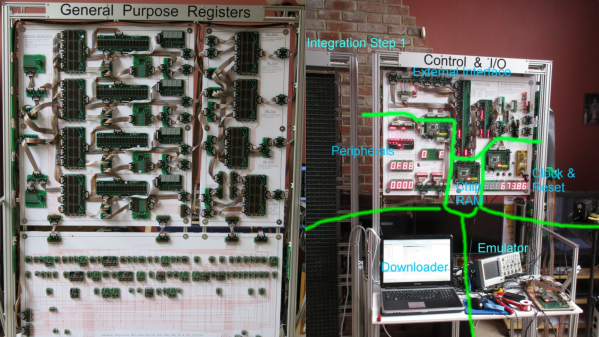
If we have to make a list of Projects that are insane and awesome at the same time, this would probably be among the top three right up there. For the past few years, [James Newman] has been busy building Megaprocessor – a huge micro-processor made out of transistors and LED’s, thousands of ’em. “I started by wanting to learn about transistors. Things got out of hand.” And quite appropriately, he’s based out of Cambridge – the “City of perspiring dreams“. The Why part is pretty simple – because he can. We posted about his build as recently as 10 months back, but he’s made a ton of progress since then and an update seemed in order.
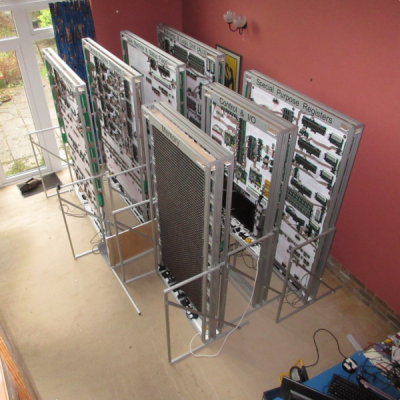
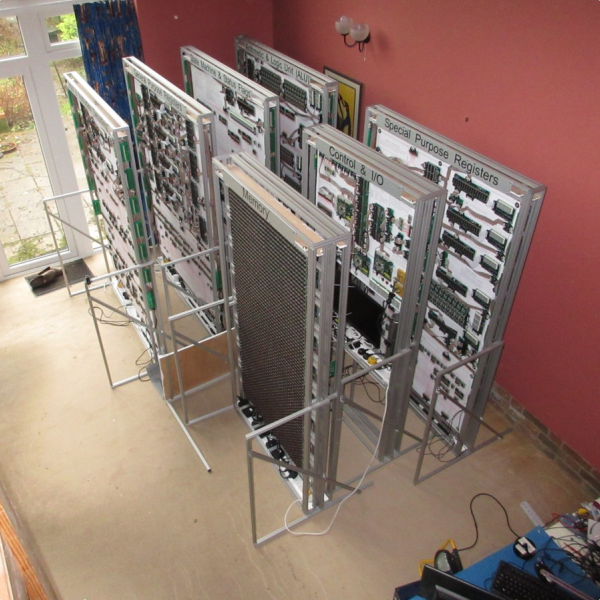
megaprocessor_04How big is it ? For starters, the 8-bit adder module is about 300mm (a foot) long – and he’s using five of them. When fully complete, it will stretch 14m wide and stand 2m tall, filling a 30 sq.m room, consisting of seven individual frames that form the parts of the Megaprocessor.

The original plan was for nine frames but he’s managed to squeeze all parts in to seven, building three last year and adding the other four since then. Assembling the individual boards (gates), putting them together to form modules, then fitting it all on to the frames and putting in almost 10kms of cabling is a slow, painstaking job, but he’s been on fire last few months. He has managed to test and integrate the racks shown here and even run some code.

The Megaprocessor has a 16-bit architecture, seven registers, 256bytes of RAM and a questionable amount of PROM (depending on his soldering endurance, he says). It sips 500W, most of it going to light up all the LED’s. He guesses it weighs about half a ton. The processor uses up 15,300 transistors and 8,500 LED’s, while the RAM has 27,000 transistors and 2,048 LED’s. That puts it somewhere between the 8086 and the 68000 microprocessors in terms of number of transistors. He recently got around to calculating the money he’s spent on this to date, and it is notching up over 40,000 Quid (almost $60,000 USD)!  You can read a lot of other interesting statistics on the Cost and Materials page.

Continue reading “Megaprocessor Is A Macro Microprocessor” →

Centennial Birthday Of Claude E. Shannon The Math And EE Pioneer

Dr. Claude E. Shannon was born 100 years ago tomorrow. He contributed greatly to the fields of engineering, communications, and computer science but is not a well known figure, even to those in the field. However, his work touches us all many times each day. The network which delivered this article to your computer or smartphone was designed upon important theories developed by Dr. Shannon.

Shannon was born and raised in Michigan. He graduated from the University of Michigan with degrees in Mathematics and Electrical Engineering. He continued his graduate studies at Massachusetts Institute of Technology (MIT) where he obtained his MS and PhD. He worked for Bell Laboratories on fire-control systems and cryptography during World War II and in 1956 he returned to MIT as a professor.

shannon-0Shannon’s first impactful contribution was his masters thesis which took the Boolean Algebra work of George Boole and applied it to switching circuits (then made up of relays). Before his work there was no formal basis for the analysis of switching systems, like telephone networks or elevator control systems. Shannon’s thesis developed the use of symbolic notation to represent networks and applied simplifying rules to optimize the system. These same rules later translated to vacuum tube and transistor logic aiding in the development of today’s computer systems. The thesis — A Symbolic Analysis of Relay and Switching Circuits — was completed in 1937 and subsequently published in 1938 in the Transactions of the American Institute of Electrical Engineers.

Shannon’s doctoral work continued in the same vein of applying mathematics someplace new, this time to genetics. Vannevar Bush, his advisor, commented, “It occurred to me that, just as a special algebra had worked well in his hands on the theory of relays, another special algebra might conceivably handle some of the aspects of Mendelian heredity”. Shannon’s work again is revolutionary, providing a mathematical basis for population genetics. Unfortunately, it was a step further than geneticists of time could take. His work languished, although interest increased over time.

Continue reading “Centennial Birthday Of Claude E. Shannon The Math And EE Pioneer” →

Colin Furze Flies The Dangerous Skies

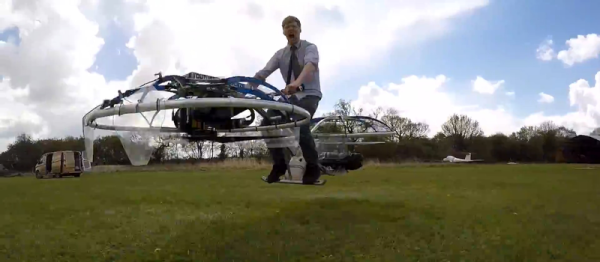
To quote our tipster: “Furze is my hero … You just need to know how to weld and have zero consideration for your personal well-being.” We’re not exactly sure that he has no consideration, but [Colin Furze] definitely pulls off some dangerous hacks. This time? Two-engine hoverbike. We don’t have to tell you to watch the video, do we? Continue reading “Colin Furze Flies The Dangerous Skies” →

Up-Close And Personal With Laser Cuts

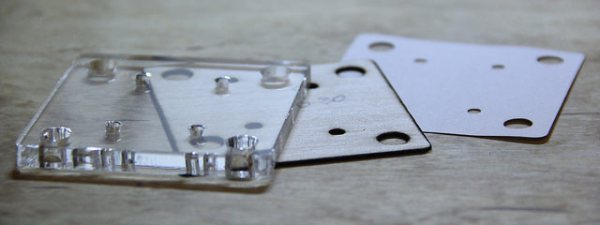
Plenty of materials take the heated edge of a laser beam quite well, but many others don’t. Some release toxic fumes; others catch fire easily. For all the materials that don’t cut well (PVC and FR4, we’re looking at you!) and for those that do (hello, acrylic and Delrin) they’re each reacting to the heat of the laser beam in different ways. Lucky for us, these ways are well-characterized. So let’s take a look at how a laser cutter actually cuts through materials.

Continue reading “Up-Close And Personal With Laser Cuts” →

The MakerBot Obituary

MakerBot is not dead, but it is connected to life support waiting for a merciful soul to pull the plug.

This week, MakerBot announced it would lay off its entire manufacturing force, outsourcing the manufacturing of all MakerBot printers to China. A few weeks ago, Stratasys, MakerBot’s parent company, released their 2015 financial reports, noting MakerBot sales revenues have fallen precipitously. The MakerBot brand is now worth far less than the $400 Million Stratasys spent to acquire it. MakerBot is a dead company walking, and it is very doubtful MakerBot will ever be held in the same regard as the heady days of 2010.

How did this happen? The most common explanation of MakerBot’s fall from grace is that Stratasys gutted the engineering and goodwill of the company after acquiring it. While it is true MakerBot saw its biggest problems after the acquisition from Stratasys, the problems started much earlier.

Continue reading “The MakerBot Obituary” →