A White Hat Virus For The Internet Of Things

The Internet of Things is going gangbusters, despite no one knowing exactly what it will be used for. There’s more marketing money being thrown at IoT paraphernalia than a new soda from Pepsi. It’s a new technology, and with that comes a few problems: these devices are incredibly insecure, and you only need to look at a few CCTV camera streams available online for proof of that.

The obvious solution to vulnerable Internet of Things things would be to get people to change the login credentials on their devices, but that has proven to be too difficult for most of the population. A better solution, if questionable in its intentions, would be a virus that would close all those open ports on routers, killing Telnet, and reminding users to change their passwords. Symantec has found such a virus. It’s called Wifatch, and it bends the concept of malware into a force for good.

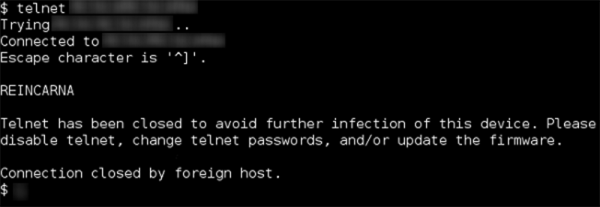
Wifatch is a bit of code that slips through the back door of routers and other IoT devices, closes off Telnet to prevent further infection, and leaves a message telling the owner to change the password and update the device firmware. Wifatch isn’t keeping any secrets, either: most of the code is written in unobfuscated Perl, and there are debug messages that enable easy analysis of the code. This is code that’s meant to be taken apart, and code that includes a comment directed at NSA and FBI agents:

To any NSA and FBI agents reading this: please consider whether defending
the US Constitution against all enemies, foreign or domestic, requires you
to follow Snowden's example.

Although the designer of Wifatch left all the code out in the open, and is arguably doing good, there is a possible dark side to this white hat virus. Wifatch connects to a peer-to-peer network that is used to distribute threat updates. With backdoors in the code, the author of Wifatch could conceivably turn the entire network of Wifatch-infected devices into a personal botnet.

While Wifatch is easily removed from a router with a simple restart, and re-infection can be prevented by changing the default passwords, this is an interesting case of virtual vigilantism. It may not be the best way to tell people they need to change the password on their router, but it’s hard to argue with results.

[Image source: header, thumb]

Ask Hackaday: I Love The Smell Of Burnt Hair In The Morning

At the end of the 19th century, [King Camp Gillette] had the idea of creating a disposable razor blade that didn’t need sharpening. There was one problem with this idea: metallurgy was not yet advanced enough to produce paper-thin carbon steel blades and sharpen them for a close shave. In 1901, [William Nickerson] solved this problem, and the age of disposable razors began.

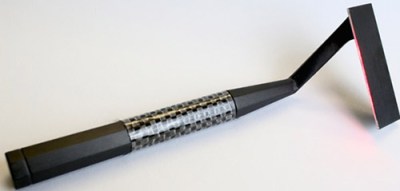
The Skarp laser razor. Source
The Skarp laser razor

This Kickstarter would have you believe there is a new era of beard technology dawning. It’s a laser razor called Skarp, and it’s on track to become one of the most funded Kickstarters of all time. The only problem? Even with relatively good documentation on the Kickstarter campaign, a demo video, a patent, and an expert in the field of cosmetic lasers, only the creators can figure out how it works.

Instead of using technology that has been tried and tested for thousands of years, the Skarp uses a laser to shave hairs off, right at the surface of the skin. You need only look at a billboard for laser hair removal to realize this is possible, but building a laser razor is something that has eluded us for decades. This patent from 1986 at the very least demonstrates the beginnings of the idea – put a laser beam in a handheld package and plunge it into a beard. This patent from 2005 uses fiber optics to send a laser beam to a handheld razor. Like anything out of the sci-fi genre, a laser razor is a well-tread idea in the world of invention.

But Skarp thinks it has solved all of the problems which previously block lasers from finding a place in your medicine cabinet.

Continue reading “Ask Hackaday: I Love The Smell Of Burnt Hair In The Morning” →

New Part Day: Tiny, Tiny Bluetooth Chips

The future of tiny electronics is wearables, it seems, with companies coming out with tiny devices that are able to check your pulse, blood pressure, and temperature while relaying this data back to your phone over a Bluetooth connection. Intel has the Curie module, a small System on Chip (SoC) meant for wearables, and the STM32 inside the Fitbit is one of the smallest ARM microcontrollers you’ll ever find. Now there’s a new part available that’s smaller than anything else and has an integrated Bluetooth radio; just what you need when you need an Internet of Motes of Dust.

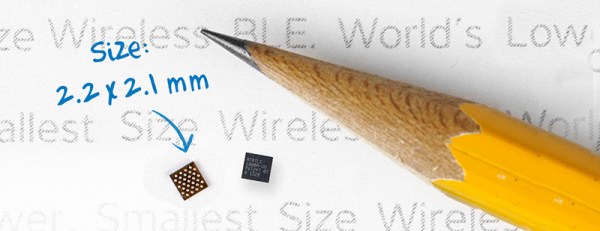
The Atmel BTLC1000 is a tiny SoC designed for wearables. The internals aren’t exceptional in and of themselves – it’s an ARM Cortex M0 running at 26 MHz. There’s a Bluetooth 4.1 radio inside this chip, and enough I/O, RAM, and ROM to connect to a few sensors and do a few interesting things. What makes this chip so exceptional is its size – a mere 2.262mm by 2.142mm. It’s a chip that can fit along the thickness of some PCBs.

To provide some perspective: the smallest ATtiny, the ‘tiny4/5/9/10 in an SOT23-6 package, is 2.90mm long. The smallest PICs are similarly sized, and both have a tiny amount of RAM and Flash space. The BTLC1000 is surprisingly capable, with 128kB each of RAM and ROM.

The future of wearable devices is smaller, faster and more capable devices, and with a tiny chip that can fit on the head of a pin, this is certainly an interesting chip for applications where performance can be traded for package size. If you’re ready to dive in with this chip the preliminary datasheets are now available.

Teeny Tiny Very Small – Atomic Resolution And The Home Hobbyist

Atoms are small. Really small. You just won’t believe how minusculely microscopically mindbogglingly small they are. I mean you may think it’s a short way down the road to the chemist’s, but that’s just peanuts to atoms.

Atoms really are small. The atomic radius of a carbon atom is on the order of 0.1 nanometers, that’s 0.0000001 millimeters. It’s hard to grasp how fantastically small this is compared to objects we generally encounter, but as a starting point I’d recommend looking at the “Powers of Ten” video found below whose ability to convey the concept has been unrivaled since it was published in 1977.

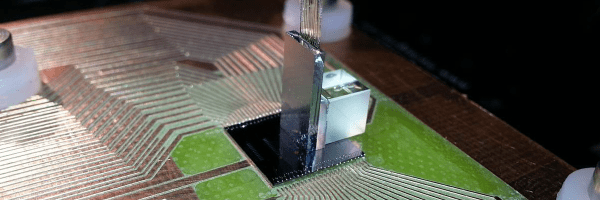
The term nanometer might be most familiar from the semiconductor industry, and its seemingly unstoppable march to smaller feature sizes. Feature sizes currently hover somewhere around the 10 nanometer mark. So while these multi-billion dollar facilities can achieve 10nm precision it’s somewhat surprising that sub-nanometer feature size positioning, and fabrication techniques are available at relatively low cost to the hacker hobbyist.

In this article we’re going to review some of the amazing work demonstrated by hobbyists in the area of the very very small through use of cutting edge, but low cost techniques.

Continue reading “Teeny Tiny Very Small – Atomic Resolution And The Home Hobbyist” →

Concrete With A Drinking Problem Could Reduce Flooding

Concrete – it’s all around you. You probably walk on it, drive on it, and maybe even sit on it! From a civil engineering standpoint, concrete really is a miracle material. But, it does have its downsides, especially in heavily developed urban areas. One of the most glaring of those downsides is the tendency for water to pool and flood on concrete. However, a new concrete formula could dramatically improve that by allowing water to drain quickly through the concrete itself.

While all unsealed concrete technically absorbs water, it does so very inefficiently and quickly becomes saturated. Once that happens, water will pool on the surface. This causes obvious problems for cars, as they become susceptible to hydroplaning. It also creates the potential for flooding in heavily paved areas.

This new concrete formula, called Topmix Permeable, is designed to reduce pooling by letting the water flow through at the rate of 600 liters per minute per square meter! It does this by using larger gravel pieces in the mix, which leaves bigger gaps for the water to drain down into. From there, it can be absorbed by the underlying soil, or routed safely away from roadways and parking lots.

Of course, this formula isn’t perfect. Its ability to pass through water also makes it likely to crack and quickly deteriorate in cold climates, as the water freezing and thawing inside the concrete will easily damage it. But, in warmer climates that receive a lot of rainfall in bursts, it could significantly improve safety.

Continue reading “Concrete With A Drinking Problem Could Reduce Flooding” →

Quantum Computing Kills Encryption

Imagine a world where the most widely-used cryptographic methods turn out to be broken: quantum computers allow encrypted Internet data transactions to become readable by anyone who happened to be listening. No more HTTPS, no more PGP. It sounds a little bit sci-fi, but that’s exactly the scenario that cryptographers interested in post-quantum crypto are working to save us from. And although the (potential) threat of quantum computing to cryptography is already well-known, this summer has seen a flurry of activity in the field, so we felt it was time for a recap.

How Bad Is It?

If you take the development of serious quantum computing power as a given, all of the encryption methods based on factoring primes or doing modular exponentials, most notably RSA, elliptic curve cryptography, and Diffie-Hellman are all in trouble. Specifically, Shor’s algorithm, when applied on a quantum computer, will render the previously difficult math problems that underlie these methods trivially easy almost irrespective of chosen key length. That covers most currently used public-key crypto and the key exchange that’s used in negotiating an SSL connection. That is (or will be) bad news as those are what’s used for nearly every important encrypted transaction that touches your daily life.

Continue reading “Quantum Computing Kills Encryption” →

Navigating The Oceans Is Deadly Without A Clock

I came across an interesting question this weekend: how do you establish your East/West location on the globe without modern technology? The answer depends on what you mean by “modern”, it turns out you only have to go back about three centuries to find there was no reliable way. The technology that changed that was a clock; a very special one that kept accurate time despite changing atmospheric conditions and motion. The invention of the Harrison H1 revolutionized maritime travel.

We can thank Andy Weir for getting me onto this topic. I just finished his amazing novel The Martian and I can confirm that George Graves’ opinion of the high quality of that novel is spot on. For the most part, Andy lines up challenges that Mark Watney faces and then engineers a solution around them. But when it came to plotting location on the surface of Mars he made just a passing reference to the need to have accurate clocks to determine longitude. I had always assumed that a sextant was all you needed. But unless you have a known landmark to sight from this will only establish your latitude (North/South position).

Continue reading “Navigating The Oceans Is Deadly Without A Clock” →