Universal Chip Analyzer: Test Old CPUs In Seconds

Collecting old CPUs and firing them up again is all the rage these days, but how do you know if they will work? For many of these ICs, which ceased production decades ago, sorting the good stuff from the defective and counterfeit is a minefield.

Testing old chips is a challenge in itself. Even if you can find the right motherboard, the slim chances of escaping the effect of time on the components (in particular, capacitor and EEPROM degradation) make a reliable test setup hard to come by.

Enter [Samuel], and the Universal Chip Analyzer (UCA). Using an FPGA to emulate the motherboard, it means the experience of testing an IC takes just a matter of seconds. Why an FPGA? Microcontrollers are simply too slow to get a full speed interface to the CPU, even one from the ’80s.
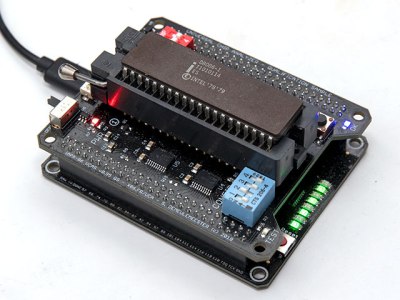
So, how does it actually test? Synthesized inside the FPGA is everything the CPU needs from the motherboard to make it tick, including ROM, RAM, bus controllers, clock generation and interrupt handling. Many testing frequencies are supported (which is helpful for spotting fakes), and if connected to a computer via USB, the UCA can check power consumption, and even benchmark the chip. We can’t begin to detail the amount of thought that’s gone into the design here, from auto-detecting data bus width to the sheer amount of models supported, but you can read more technical details here.

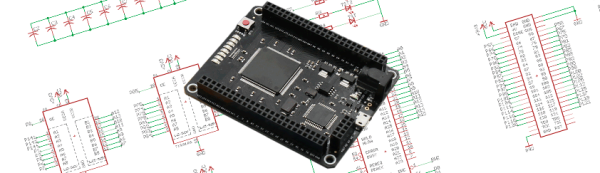
The Mojo v3 FPGA development board was chosen as the heart of the project, featuring an ATmega32U4 and Xilinx Spartan 6 FPGA. The wily among you will have already spotted a problem – the voltage levels used by early CPUs vary greatly (as high as 15V for an Intel 4004). [Samuel]’s ingenious solution to keep the cost down is a shield for each IC family – each with its own voltage converter.

Continue reading “Universal Chip Analyzer: Test Old CPUs In Seconds”
Apple One, On FPGA

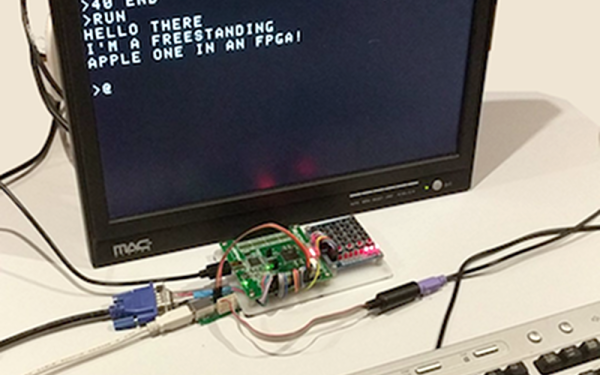
Today, Apple is known for iPhones, iPads, and a commitment to graphical user interfaces. But that wasn’t how it all started. The original Apple was a single board computer built around a 6502. In 1976, you could snag one for $666.66, but you needed to supply your own TV, power supply, and keyboard. [Alangarf] didn’t have an Apple 1, but he did have a 6502 CPU core for FPGAs from [Andrew Holme] that he fleshed out to an Apple I clone with a VGA output and PS/2 keyboard port. The project works with either an iCE40 board or a Terasic DE0 board. You could probably port it to other similar FPGAs.

This is much more practical than trying to find an original, as Apple bought a lot of the old boards back and destroyed them. According to the Apple-1 Registry there are only about 71 of the boards still in existence, and that’s with the annotation that 4 of those may be lost and 8 might be duplicates. We’ve heard that of those there are only six that actually still work.

Continue reading “Apple One, On FPGA”

A DIY Nine Channel Digital Scope

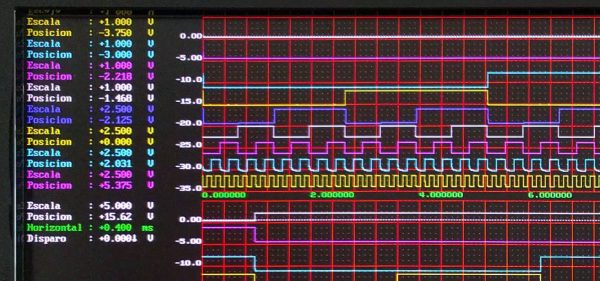
Have you ever found yourself in the need of a nine channel scope, when all you had was an FPGA evaluation board? Do not despair, [Miguel Angel] has you covered. While trying to make sense of the inner workings of a RAM controller core, he realized that he needed to capture a lot of signals in parallel and whipped up this 9-channel digital oscilloscope.

The scope is remote-controlled via a JavaScript application, and over Ethernet. Graphical output is provided as a VGA signal at full HD, so it is easy to see what is going on. Downloading sampled data to the controlling computer for analysis is in the works. [Miguel] runs his implementation on an Arty A7 development board which is currently available for around a hundred dollars, but the design is transferable to other platforms. The code and some documentation is available on GitHub and there is a demo video after the break.

Continue reading “A DIY Nine Channel Digital Scope”

Icoboard Software Defined Radio Platform

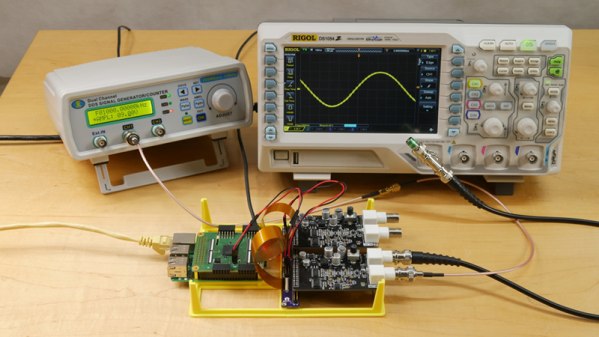
The Icoboard is a plug-in for the Raspberry Pi with a Lattice iCE FPGA onboard. Combined with a cheap A/D converter, [OpenTechLab] build a software-defined radio using all open source tools. He found some inexpensive converters that cost about $25 and were fast enough (32 MHz) for the purpose at hand. The boards also had a digital to analog converter and he was able to find the data sheets. You can see a video with the whole project covered, below.

The video, by the way, is pretty extensive (about an hour’s worth) and covers the creation of a PC board to connect from the Icoboard to the converters. There’s also a 3D printed frame, and that’s explained in detail as well.

Continue reading “Icoboard Software Defined Radio Platform”

Reverse Engineer An X-Ray Image Sensor

If you think of a medical x-ray, it is likely that you are imagining a photographic plate as its imaging device. Clipped to your tooth by your dentist perhaps, or one of the infamous pictures of the hands of [Thomas Edison]’s assistant [Clarence Madison Dally].

As with the rest of photography, the science of x-ray imaging has benefited from digital technology, and it is now well established that your hospital x-ray is likely to be captured by an electronic imaging device. Indeed these have now been in use for so long that their first generation can even be bought by an experimenter for an affordable sum, and that is what the ever-resourceful [Lucy Fauth] with the assistance of [Jana Marie Hemsing], has done. Their Trophy DigiPan digital x-ray image sensor was theirs for around a hundred Euros, and though it’s outdated in medical terms it still has huge potential for the x-ray experimenter.

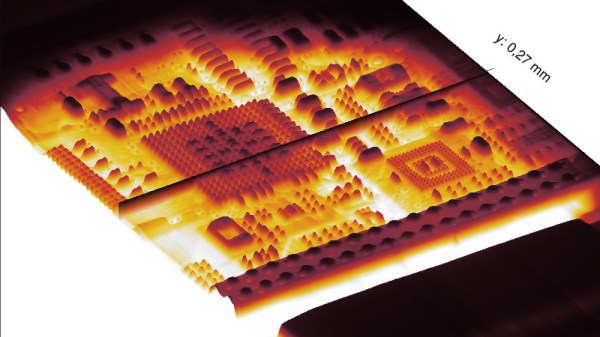
The write-up is a fascinating journey into the mechanics of an x-ray sensor, with the explanation of how earlier devices such as this one are in fact linear CCD sensors which track across the exposed area behind a scintillator layer in a similar fashion to the optical sensor in a flatbed scanner. The interface is revealed as an RS422 serial port, and the device is discovered to be a standalone unit that does not require any commands to start scanning. On power-up it sends a greyscale image, and a bit of Sigrok examination of the non-standard serial stream was able to reveal it as 12-bit data direct from the sensor. From those beginnings they progressed to an FPGA-based data processor and topped it all off with a very tidy power supply in a laser-cut box.

It’s appreciated that x-rays are a particularly hazardous medium to experiment with, and we note from their videos that they are using some form of shielding. The source is a handheld fluoroscope of the type used in sports medicine that produces a narrow beam. If you remember the discovery of an unexpected GameBoy you will be aware that medical electronics seems to be something of a speciality in those quarters, as do autonomous box carriers.

Continue reading “Reverse Engineer An X-Ray Image Sensor”

FPGA Magic Puts Little Embedded Screens Up On The Big Screen

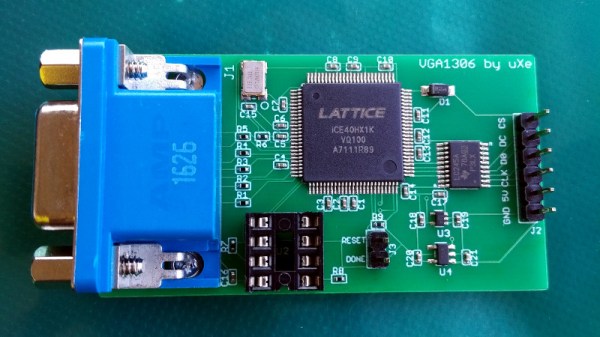
Old-school handheld gaming platforms have a certain charm, but it’s fair to say that their relatively tiny screens don’t lend themselves to wider viewing. This presented a problem to [uXe] who wanted to display Arduboy games on the big screen, so he took a MyStorm BlackIce FPGA board and created a converter that emulates a SSD1306 OLED display and has a VGA output.

Having proved the viability of the idea, it was ported to a dedicated PCB with onboard ancillaries such as a level shifter for a 5 volt input. In an exciting twist, with a few modifications it’s also emulated a GameBoy screen, allowing full-sized playable games from that platform too. But the power of this hack isn’t relegated to gaming. SSD1306 is just one of a few different common standards for embedded displays. The FPGA work in this project is the blueprint for building a VGA adapter for any number of display replacements. We’d love to see an HD44780 mod of this!

The result as you can see in the video below the break is very much more in the spirit of the OLED than an HD immersive experience. But it does have a very pleasing air of an older arcade machine about it.

Several projects starting on a MyStorm BlackIce board have made it here in the past. Pretty memorable is the BBC Micro clone using one.

Continue reading “FPGA Magic Puts Little Embedded Screens Up On The Big Screen”

FPGA Makes ASCII Video

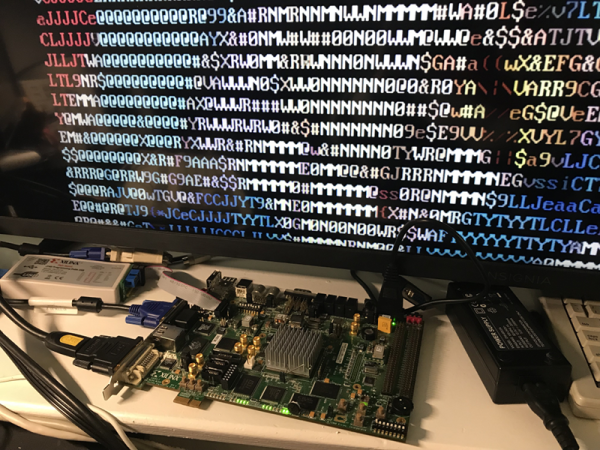
Human beings like pictures which is probably why there’s the old adage “A picture’s worth a thousand words.” We take computer graphic output for granted now, but even in the earliest days for Teletypes and line printers, there was artwork made from characters ranging from Snoopy to Spock. [Wenting Z] continues the tradition by creating an FPGA that converts VGA video to ASCII art and outputs it via DVI.

The device uses a Xilinx Virtex device and uses about 500 LUT (look up tables) which is not much at all. You can see a video (that includes an overlay of the source video) of the device in action below.

In fact, we think of art like this as a computer phenomenon, but [Flora Stacey] created a butterfly on a typewriter in 1898 and ham radio operators were doing art using paper tape for the last half of the twentieth century. Even before that, In 1865, Alice in Wonderland had a certain passage that was typeset to suggest a mouse’s tail. Perhaps the pinnacle is the famous ASCII version of Star Wars.

This is decidedly less mechanical than some of the other ASCII art projects we’ve seen. If you have a taste for more text art, have a look at some other examples, including a very old advertisement that uses character art.

Continue reading “FPGA Makes ASCII Video”