Clean Water Technologies Hack Chat

Join us on Wednesday, September 4th at noon Pacific for the Clean Water Technologies Hack Chat with Ryan Beltrán!

Access to clean water is something that’s all too easy to take for granted. When the tap is turned, delivering water that won’t sicken or kill you when you drink it, we generally stop worrying. But for millions around the world, getting clean water is a daily struggle, with disease and death often being the penalty for drinking from a compromised source. Thankfully, a wide range of water technologies is available to help secure access to clean water. Most are expensive, though, especially at the scale needed to supply even a small village.

Seeing a need to think smaller, Ryan started MakeWater.org, a non-profit program that seeks to give anyone the power to make clean water through electrocoagulation, or the use of electric charge to precipitate contaminants from water. There’s more to MakeWater than electrocoagulation kits, though. By partnering with STEM students and their teachers, MakeWater seeks to crowdsource improvements to the technology, incorporating student design changes into the next version of the kit. They also hope to inspire students to develop the skills they need to tackle real-world problems and make a difference in the lives of millions.

join-hack-chatOur Hack Chats are live community events in the Hackaday.io Hack Chat group messaging. This week we’ll be sitting down on Wednesday, September 4 at 12:00 PM Pacific time. If time zones have got you down, we have a handy time zone converter.

Click that speech bubble to the right, and you’ll be taken directly to the Hack Chat group on Hackaday.io. You don’t have to wait until Wednesday; join whenever you want and you can see what the community is talking about.

Hackaday Links Column Banner

Hackaday Links: September 1, 2019

The sun may be spotless, but that doesn’t mean it isn’t doing interesting things. A geomagnetic storm is predicted for this weekend, potentially giving those at latitudes where the Northern Lights are not common a chance to see a cosmic light show. According to SpaceWeather.com, a coronal hole, a gap in the sun’s atmosphere that can let the solar wind escape, is about to line up with Earth. The last time this hole was on the Earth-facing side of the sun, the resultant storm gave aurora as far south as Colorado. So if you’re in any of the northern tier states, you might want to find somewhere with dark skies and a good view to the north this weekend.

It’s not only space weather that’s in the news, but weather-weather too. Hurricane Dorian will probably make landfall as a Category 4 storm, probably along Florida’s Atlantic coast, and probably in the middle of the night on Monday. That’s a lot of uncertainty, but one thing’s for sure: amateur radio operators will be getting into the action. The Hurricane Watch Net will activate their net for Dorian on Saturday afternoon at 5:00 PM Eastern time, ready to take reports from stations in the affected area. Not a ham? You can still listen to the live feed once the net activates.

Hams aren’t the only ones getting geared up for Dorian, though. Weather satellite enthusiasts are pointing their SDRs at the sky and grabbing some terrifyingly beautiful pictures of Dorian as it winds up. Some of the downloaded images are spectacular, and if you’ve got an SDR dongle and a couple of pieces of coat hanger wire, you too can spy on Dorian from any number of satellites.

Speaking of which, over on r/RTLSDR, someone has done a little data mining and shown that NOAA 15 is still very much alive. u/amdorj plotted the scan motor current draw and found that it steadily decreased over time, possibly indicating that the bearings aren’t as worn as previously thought. We recently covered the story of the plucky satellite that’s almost two decades past its best-by date; here’s hoping our report on its death was greatly exaggerated.

In one of the weirder bits of marketing we’ve seen lately, NASA decided to name a rock on Mars after septuagenarian rockers The Rolling Stones. The golf ball size rock was blasted about a meter across the Martian landscape when the Mars InSight lander touched down in 2018, leaving a small scar in the dust. The stone had obviously rolled, so phone calls were made and one thing led to another, and before you know it, Robert Downey Jr. is making the announcement before a Stones concert at the Rose Bowl, right in JPL’s backyard. There’s even a cute animation to go along with it. It’s a nice piece of marketing, but it’s not the first time the Stones have been somewhat awkwardly linked to the technology world. We dare you not to cringe.

We’ll finish up today with something not related to space. As Al Williams recently covered, for about fifty bucks you can now score a vector network analyzer (VNA) that will do all sorts of neat RF tricks. The NanoVNA sounds like a great buy for anyone doing RF work, but its low price point and open-source nature mean people are finding all kinds of nifty uses for it. One is measuring the length of coax cables with time-domain reflectometry, or TDR. Phasing antenna arrays? the NanoVNA sounds like the perfect tool for the job.

Hackaday Podcast 033: Decompressing From Camp, Nuclear Stirling Engines, Carphone Or Phonecar, And ArduMower

Hackaday Editors Mike Szczys and Elliot Williams are back from Chaos Communication Camp, and obviously had way too much fun. We cover all there was to see and do, and dig into the best hacks from the past week. NASA has a cute little nuclear reactor they want to send to the moon, you’ve never seen a car phone quite like this little robot, and Ardupilot (Ardurover?) is going to be the lawn mowing solution of the future. Plus you need to get serious about debugging embedded projects, and brush up on your knowledge of the data being used to train facial recognition neural networks.

Take a look at the links below if you want to follow along, and as always tell us what you think about this episode in the comments!

Take a look at the links below if you want to follow along, and as always, tell us what you think about this episode in the comments!

Direct download (60 MB or so.)

Continue reading “Hackaday Podcast 033: Decompressing From Camp, Nuclear Stirling Engines, Carphone Or Phonecar, And ArduMower”

This Week In Security: VPN Gateways, Attacks In The Wild, VLC, And An IP Address Caper

We’ll start with more Black Hat/DEFCON news. [Meh Chang] and [Orange Tsai] from Devcore took a look at Fortinet and Pulse Secure devices, and found multiple vulnerabilities. (PDF Slides) They are publishing summaries for that research, and the summary of the Fortinet research is now available.

It’s… not great. There are multiple pre-authentication vulnerabilities, as well as what appears to be an intentional backdoor.

CVE-2018-13379 abuses an snprintf call made when requesting a different language for the device login page. Snprintf is an alternative to sprintf, but intended to prevent buffer overflows by including the maximum string length to write to the target buffer, which sounds like a good idea but can lead to malicious truncation.

The code in question looks like snprintf(s, 0x40, "/migadmin/lang/%s.json", lang);.
When loading the login page, a request is made for a language file, and the file is sent to the user. At first look, it seems that this would indeed limit the file returned to a .json file from the specified folder. Unfortunately, there is no further input validation on the request, so a language of ../../arbitrary is considered perfectly legitimate, escaping the intended folder.  This would leak arbitrary json files, but sincesnprintf doesn’t fail if it exceeds the specified length, sending a request for a lang that’s long enough results in the “.json” extension not being appended to the request either.

A metasploit module has been written to test for this vulnerability, and it requests a lang of /../../../..//////////dev/cmdb/sslvpn_websession. That’s just long enough to force the json extension to fall off the end of the string, and it is Unix convention is to ignore the extra slashes in a path. Just like that, the Fortigate is serving up any file on its filesystem just for asking nice.

More worrying than the snprintf bug is the magic value that appears to be an intentional backdoor. A simple 14 character string sent as an http query string bypasses authentication and allows changing any user’s password — without any authentication. This story is still young, it’s possible this was intended to have a benign purpose. If it’s an honest mistake, it’s a sign of incompetence. If it’s an intentional backdoor, it’s time to retire any and all Fortinet equipment you have.

Pulse Secure VPNs have a similar pre-auth arbitrary file read vulnerability. Once the full report is released, we’ll cover that as well.

Exploitation in the Wild

But wait, there’s more. Hide your kids, hide your wife. Webmin, Pulse Secure, and Fortigate are already being exploited actively in the wild, according to ZDNet. Based on reports from Bad Packets, the Webmin backdoor was being targeted in scans within a day of announcement, and exploited within three days of the announcement. There is already a botnet spreading via this backdoor. It’s estimated that there are around 29,000 vulnerable Internet-facing servers.

Both Pulse Secure and Fortinet’s Fortigate VPN appliances are also being actively targeted. Even though the vulnerabilities were reported first to the vendors, and patched well in advance of the public disclosure, thousands of vulnerable devices remain. Apparently routers and other network appliance hardware are fire-and-forget solutions, and often go without important security updates.

VLC is Actually Vulnerable This Time

The VLC media player has released a new update, fixing 11 CVEs. These CVEs are all cases of mishandling malformed media files, and are only exploitable by opening a malicious file with VLC. Be sure to go update VLC if you have it installed. Even though no arbitrary code execution has been demonstrated for any of these issues, it’s likely that it will eventually happen.

Gray Market IP Addresses

With the exhaustion of IPv4 addresses, many have begun using alternative methods to acquire address space, including the criminal element. Krebs on Security details his investigation into one such story: Residential Networking Solutions LLC (Resnet). It all started with an uptick in fraudulent transactions originating from Resnet residential IP addresses. Was this a real company, actually providing internet connectivity, or a criminal enterprise?


Following Pigs: Building An Injectable Livestock Tracking System

I’m often asked to design customer and employee tracking systems. There are quite a few ways to do it, and it’s an interesting intersection of engineering and ethics – what information is reasonable to collect in different contexts, anonymizing and securely storing it, and at a fundamental level whether the entire system should exist at all.

On one end of the spectrum, a system that simply counts the number of people that are in your restaurant at different times of day is pretty innocuous and allows you to offer better service. On the other end, when you don’t pay for a mobile app, generally that means your private data is the product being bought and sold. Personally, I find that the whole ‘move fast and break things’ attitude, along with a general disregard for the privacy of user data, has created a pretty toxic tech scene. So until a short while ago, I refused to build invasive tracking systems – then I got a request that I simply couldn’t put aside…

Continue reading “Following Pigs: Building An Injectable Livestock Tracking System”

The Amazon Dash Button: A Retrospective

The Internet of Things will revolutionize everything! Manufacturing? Dog walking? Coffee bean refilling? Car driving? Food eating? Put a sensor in it! The marketing makes it pretty clear that there’s no part of our lives which isn’t enhanced with The Internet of Things. Why? Because with a simple sensor and a symphony of corporate hand waving about machine learning an iPhone-style revolution is just around the corner! Enter: Amazon Dash, circa 2014.

The first product in the Dash family was actually a barcode scanning wand which was freely given to Amazon Fresh customers and designed to hang in the kitchen or magnet to the fridge. When the Fresh customer ran out of milk they could scan the carton as it was being thrown away to add it to their cart for reorder. I suspect these devices were fairly expensive, and somewhat too complex to be as frequently used as Amazon wanted (thus the extremely limited launch). Amazon’s goal here was to allow potential customers to order with an absolute minimum of friction so they can buy as much as possible. Remember the “Buy now with 1-Click” button?

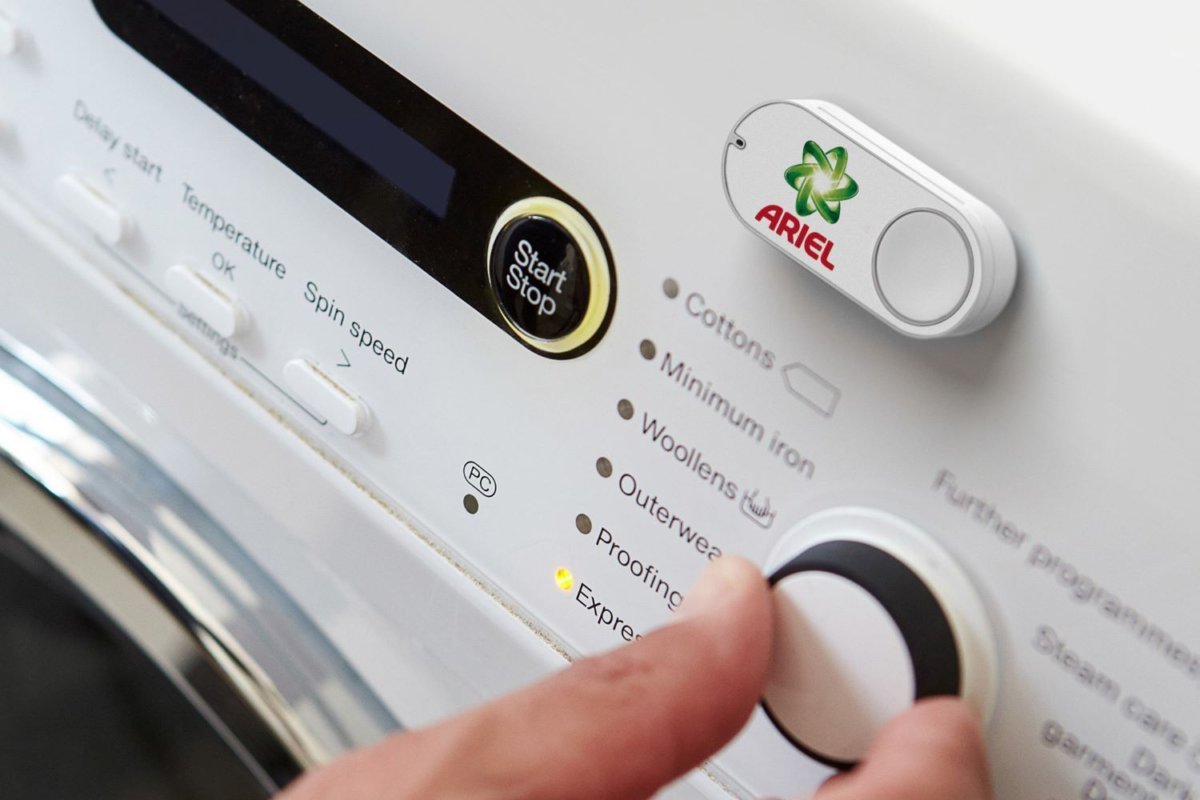
That original Dash Wand was eventually upgraded to include a push button activated Alexa (barcode scanner and fridge magnet intact) and is generally available. But Amazon had pinned its hopes on a new beau. Mid 2015 Amazon introduced the Dash Replenishment Service along with a product to be it’s exemplar – the Dash Button. The Dash Button was to be the 1-Click button of the physical world. The barcode-scanning Wands require the user to remember the Wand was nearby, find a barcode, scan it, then remember to go to their cart and order the product. Too many steps, too many places to get off Mr. Bezos’ Wild Ride of Commerce. The Dash Buttons were simple! Press the button, get the labeled product shipped to a preconfigured address. Each button was purchased (for $5, with a $5 coupon) with a particular brand affinity, then configured online to purchase a specific product when pressed. In the marketing materials, happy families put them on washing machines to buy Tide, or in a kitchen cabinet to buy paper towels. Pretty clever, it really is a Buy now with 1-Click button for the physical world.

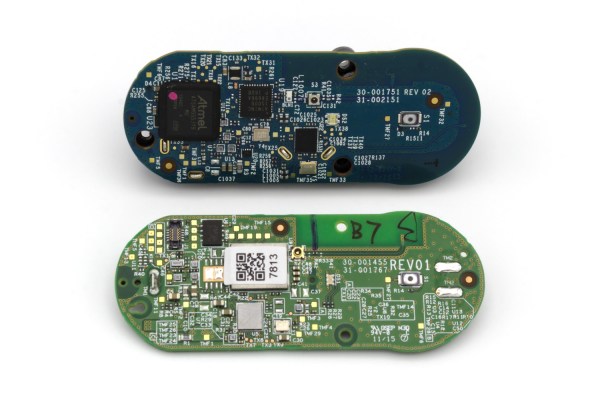
There were two versions of the Dash button. Both have the same user interface and work in fundamentally the same way. They have a single button (the software can recognize a few click patterns), a single RGB LED (‘natch), and a microphone (no, it didn’t listen to you, but we’ll come back to this). They also had a WiFi radio. Version two (silently released in 2016) added Bluetooth and completely changed the electrical innards, though to no user facing effect.

In February 2019, Amazon stopped selling the Dash Buttons. Continue reading “The Amazon Dash Button: A Retrospective”

Linux Fu: It’s A Trap!

It is easy to think that a Linux shell like Bash is just a way to enter commands at a terminal. But, in fact, it is also a powerful programming language as we’ve seen from projects ranging from web servers to simple utilities to make dangerous commands safer. Like most programming languages, though, there are multiple layers of complexity. You can spend a little time and get by or you can invest more time and learn about the language and, hopefully, write more robust programs.

Continue reading “Linux Fu: It’s A Trap!”