Linux Fu: Share Terminal In Browser

The title of this post says it all: GoTTY is a program that lets you share Linux terminal applications into a web browser. It is a simple web server written in Go that runs a non-GUI program and can push it out a socket in such a way that a browser can display it and, optionally, let the user interact with it.

With the emphasis on security these days, that ought to alarm you. After all, why would you want a shell running in a browser? Hang on, though. While that is possible — and not always undesirable — the real value to this technique is to run a specific command line program in a browser window. Here’s a use case: You want users to remotely monitor a system using top (or htop, if you are fancy). But you don’t want users logging into the system nor do you want to require them to have ssh clients. You don’t want to install monitoring tools, just use what you already have.

If you could get the output from top to show up in a browser window — even if the users had no ability to input — that would be an easy solution. Granted, you could just run top in batch mode, collect the output, and write it somewhere that a web server could find it. Assuming you have a web server installed, of course. But then what if you did want some other features like taking command line options or having the option for (hopefully) authenticated users to interact with the software? Now that would be more complicated. With GoTTY, it is easy.

Continue reading “Linux Fu: Share Terminal In Browser”

Kitty Yeung On Tech-Fashion Designs And The Wearables Industry

If there is a field which has promise verging on a true breakout, it is that of wearable electronics. We regularly see 3D printing, retrocomputing, robotics, lasers, and electric vehicle projects whose advances are immediately obvious. These are all exciting fields in which the Hackaday community continually push the boundaries, and from which come the astounding pieces of work you read on these pages daily. Of course the projects that merge textiles and electronics are pushing boundaries in the same way, except for that it’s often not obvious at first glance. Why is that?

Wearables are a field in which hard work and ingenuity abound, but pulling off the projects that stand out and go beyond mere ordinary garments adorned with a few twinkly LEDs or EL wire is hard. Wearables have a sense of either still seeking its killer application or its technological enabler, and it was this topic that physicist, textilist, and artist Kitty Yeung touched upon in her talk at the recent Hackaday Superconference.

Continue reading “Kitty Yeung On Tech-Fashion Designs And The Wearables Industry”

Seeing Like Bees With Ultraviolet Photography

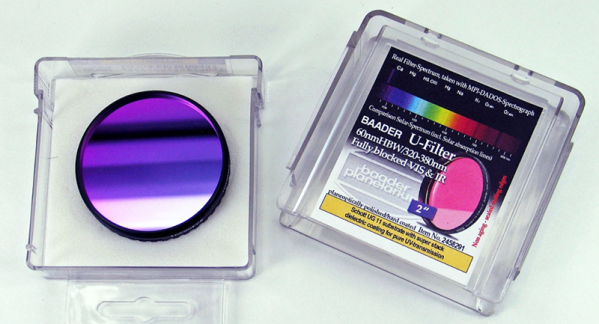
When it comes to seeing in strange spectrums, David Prutchi is the guy you want to talk to. He’s taken pictures of rocks under long, medium and short UV light, he’s added thermal imaging to consumer cameras, and he’s made cameras see polarization. There’s a lot more to the world than what the rods and cones on your retina can see, and David is one of the best at revealing it. For this year’s talk at the Hackaday Superconference, David is talking about DIY Ultraviolet Photography. It’s how bees see, and it’s the bees knees.

Continue reading “Seeing Like Bees With Ultraviolet Photography”

Scott Swaaley On High Voltage

If you were to invent a time machine and transport a typical hardware hacker of the 1970s into 2018 and sit them at a bench alongside their modern counterpart, you’d expect them to be faced with a pile of new things, novel experiences, and exciting possibilities. The Internet for all, desktop computing fulfilling its potential, cheap single-board computers, even ubiquitous surface-mount components.

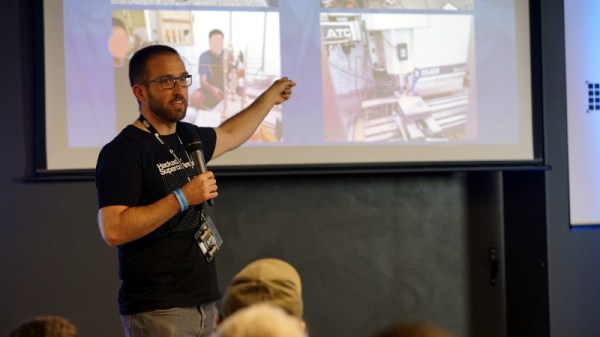
What you might not expect though is that the 2018 hacker might discover a whole field of equivalent unfamiliarity while being very relevant from their grizzled guest. It’s something Scott Swaaley touches upon in his Superconference talk:  “Lessons Learned in Designing High Power Line Voltage Circuits” in which he describes his quest for an electronic motor brake, and how his experiences had left him with a gap in his knowledge when it came to working with AC mains voltage.

When Did You Last Handle AC Line voltages?

If you think about it, the AC supply has become something we rarely encounter for several reasons. Our 1970s hacker would have been used to wiring in mains transformers, to repairing tube-driven equipment or CRT televisions with live chassis’,  and to working with lighting that was almost exclusively provided by mains-driven incandescent bulbs. A common project of the day would have been a lighting dimmer with a triac, by contrast we work in a world of microcontroller-PWM-driven LEDs and off-the-shelf switch-mode power supplies in which we have no need to see the high voltages. It may be no bad thing that we are rarely exposed to high-voltage risk, but along the way we may have lost a part of our collective skillset.

Scott’s path to gaining his mains voltage experience started in a school workshop, with a bandsaw. Inertia in the saw kept the blade moving after the power had been withdrawn, and while that might be something many of us are used to it was inappropriate in that setting as kids are better remaining attached to their fingers. He looked at brakes and electrical loads as the solution to stopping the motor, but finally settled on something far simpler. An induction motor can be stopped very quickly indeed by applying a DC voltage to it, and his quest to achieve this led along the path of working with the AC supply. Eventually he had a working prototype, which he further developed to become the MakeSafe power tool brake.

Get Your AC Switching Right First Time

The full talk is embedded below the break, and gives a very good introduction to the topic of switching AC power. If you’ve never encountered a thryristor, a triac, or even a diac, these once-ubiquitous components make an entrance. We learn about relays and contactors, and how back EMF can destroy them, and about the different strategies to protect them. Our 1970s hacker would recognise some of these, but even here there are components that have reached the market since their time that they would probably give anything to have. We see the genesis of the MakeSafe brake as a panel with a bunch of relays and an electronic fan controller with a rectifier to produce the DC, and we hear about adequate safety precautions. This is music to our ears, as it’s a subject we’ve touched on before both in terms of handling mains on your bench and inside live equipment.

So if you’ve never dealt with AC line voltages, give this talk a look. The days of wiring up transformers to power projects might be largely behind us, but the skills and principles contained within it are still valid.

Continue reading “Scott Swaaley On High Voltage”

Retrotechtacular: Remembering Radio Shack P-Box Kits

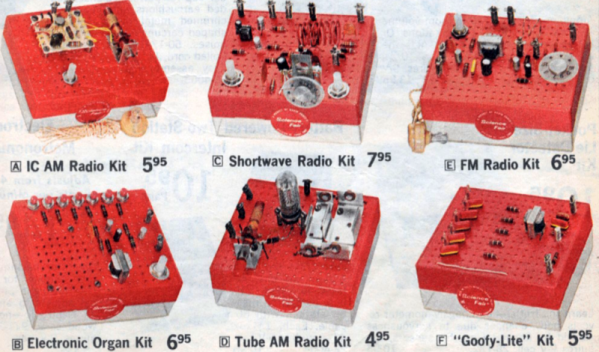
If you are under a certain age, you probably associate Radio Shack with cellphones. While Radio Shack never gave us access to the variety and economy of parts we have today, they did have one thing that I wish we could get again: P-Box kits. The obvious questions are: What’s a P-Box and why do I want one? But the kit wasn’t to make a P-Box. P-Box was the kind of box the kit came in. It was like a piece of perfboard, but made of plastic, built into a plastic box. So you bought the kit — which might be a radio or a metal detector — opened the box and then built the kit using the box as the chassis.

The perfboard was pretty coarse, too, because the components were all big discrete components. There was at least one that had an IC, but that came premounted on a PC board that you treated like a big component. One of my favorites was a three-transistor regenerative shortwave receiver. In those days, you could pick up a lot of stations on shortwave and it was one of the best ways at the time to learn more about the world.

On the left, you can see a picture of the radio from the 1975 catalog. You might think $7.95 is crazy cheap, but that was at least a tank full of gas or four movie tickets in those days, and most of us didn’t have a lot of money as kids, so you probably saved your allowance for a few weeks, did chores, or delivered papers to make $8.

Continue reading “Retrotechtacular: Remembering Radio Shack P-Box Kits”

Jeremy Hong: Weaponizing The Radio Spectrum

Jeremy Hong knows a secret or two about things you shouldn’t do with radio frequency (RF), but he’s not sharing.

That seems an odd foundation upon which to build one’s 2018 Hackaday Superconference talk, but it’s for good reason. Jeremy knows how to do things like build GPS and radar jammers, which are federal crimes. Even he hasn’t put his knowledge to practical use, having built only devices that never actually emitted any RF.

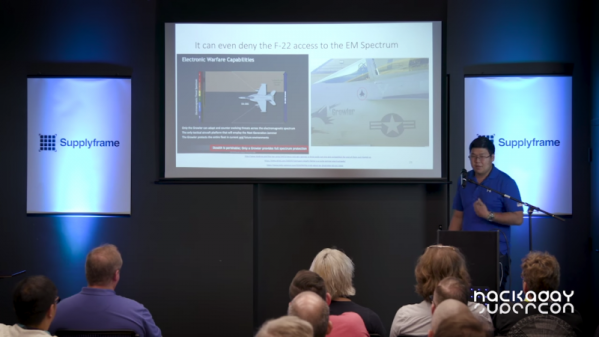
So what does one talk about when circumspection is the order of the day? As it turns out, quite a lot. Jeremy focused on how the military leverages the power of radio frequency jamming to turn the tables on enemies, and how civilian police forces are fielding electronic countermeasures as well. It’s interesting stuff, and Jeremy proved to be an engaging guide on a whirlwind tour into the world of electronic warfare.
Continue reading “Jeremy Hong: Weaponizing The Radio Spectrum”

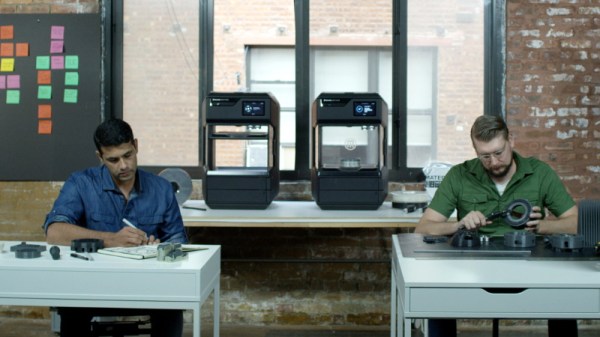
MakerBot Moves Away From Makers With New Printer

If you’ve been following the desktop 3D printing market for the last couple years, you’re probably aware of the major players right now. Chinese companies like Creality are dominating the entry level market with machines that are priced low enough to border on impulse buys, Prusa Research is iterating on their i3 design and bringing many exciting new features to the mid-range price point, and Ultimaker remains a solid choice for a high-end workhorse if you’ve got the cash. But one name that is conspicuously absent from a “Who’s Who” of 3D printing manufacturers is MakerBot; despite effectively creating the desktop 3D printing market, today they’ve largely slipped into obscurity.

So when a banner popped up on Thingiverse (MakerBot’s 3D print repository) advertising the imminent announcement of a new printer, there was a general feeling of surprise in the community. It had been assumed for some time that MakerBot was being maintained as a zombie company after being bought by industrial 3D printer manufacturer Stratasys in 2013; essentially using the name as a cheap way to maintain a foothold in the consumer 3D printer market. The idea that they would actually release a new consumer 3D printer in a market that’s already saturated with well-known, agile companies seemed difficult to believe.

But now that MakerBot has officially taken the wraps off a printer model they call Method, it all makes sense. Put simply, this isn’t a printer for us. With Method, MakerBot has officially stepped away from the maker community from which it got its name. While it could be argued that their later model Replicator printers were already edging out of the consumer market based on price alone, the Method makes the transition clear not only from its eye watering $6,500 USD price tag, but with its feature set and design.

That said, it’s still an interesting piece of equipment worth taking a closer look at. It borrows concepts from a number of other companies and printers while introducing a few legitimately compelling features of its own. While the Method might not be on any Hackaday reader’s holiday wish list, we can’t help but be intrigued about the machine’s future.

Continue reading “MakerBot Moves Away From Makers With New Printer”