Fail Of The Week — Accidental Demagnetization

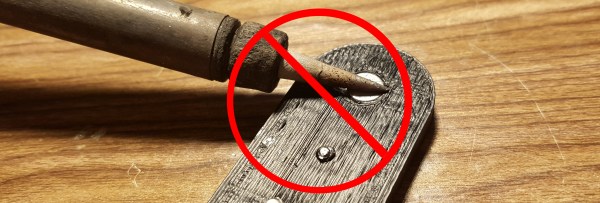
There’s a trick in the world of plastic enclosures. The threaded insert is a small cylinder of metal with threads on the inside and a rough edge on the outside. To make a plastic part with a hole for securely connecting bolts that can be repeatedly screwed without destroying the plastic, you take the threaded insert and press it (usually with the help of a soldering iron to heat the insert)  into a hole that’s slightly smaller than the insert. The heat melts the plastic a little bit and allows for the insert to go inside. Then when it cools the insert is snugly inside the plastic, and you can attach circuit boards or other plastic parts using a bolt without stripping the screw or the insert. We’ve seen Hackaday’s [Joshua Vasquez] installing threaded inserts with an iron, as well as in a few other projects.

This trick is neat. And I’ve now proven that it does not work with neodymium magnets.

Continue reading “Fail Of The Week — Accidental Demagnetization”

The Most Useless Tools You Can’t Seem To Part With

I’m a tool person. No matter how hard I try, I eventually end up with a bunch of tools that I just can’t bear to banish from my workshop. Why? I’m gonna keep it 100%: it’s the same emotion behind hoarding — fearing that you might need a thing later and not be able to have it.

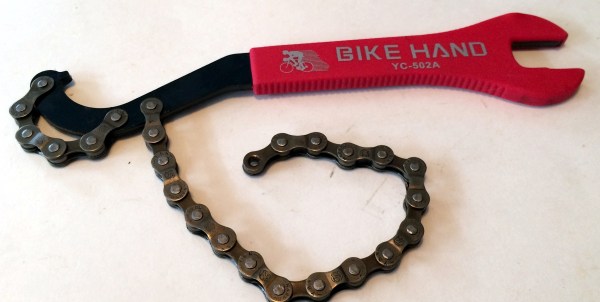
The stuff costs money, and if you have to script to buy a bunch of tools pertaining to Project X, you expect to still have and probably need those very same tools — even if they have to sit in a box on my shelf for 20 years, taunting me every time I have to move it to one side.  “Heat-bending element” the box’s label describes at tool I haven’t used in at least 5 years. I have a bunch of these white elephants. I’ll probably need to heat-bend acrylic real soon… yeah.

I’ve found that pretty much everyone in our crowd can relate. You buy a special tool for one project and it was expensive and tremendously helpful, and since then it’s been sitting around uselessly. You certainly couldn’t part with it, what if you needed it again? So you store it in your house for 20 years, occasionally coming across it when looking for something else, but it never actually gets used.

Join me now in a walk down our memory lane of useless tools.

Continue reading “The Most Useless Tools You Can’t Seem To Part With”

Friday Hack Chat: DMX512 Gon’ Give It To Ya

DMX512 is the standard for theatrical lighting, and it’s best described as, ‘MIDI for lights’. It’s been around since the 80s, and in the decades since it’s been used, abused, and shoved into just about everything imaginable.

For this week’s Hack Chat, we’re talking all about DMX512. What is DMX512? How does it work? What can you control with DMX512? What Open Source projects use it? There’s a wealth of information out there, and a lot of very cool tricks you can pull with this ubiquitous lighting protocol.

Our guest for this week’s Hack Chat is [Martin Searancke], owner of Dream Solutions Ltd. [Martin] was contacted early on in the development of Coca-Cola’s impressive 3D Times Square advertisement to see if Dream Solution’s LightFactory software could be used to drive this 3D screen. This software has pixel mapping and media playback capabilities and was used for the prototypes for the project. A subset of this product made it into the final installation, and is now driving a gargantuan display above Times Square in New York City.

This is a community Hack Chat, and of course we’re taking questions from the community. If you have a question you’d like to ask [Martin], add it to the discussion sheet.

join-hack-chatOur Hack Chats are live community events on the Hackaday.io Hack Chat group messaging. Our Hack Chats usually take place at noon, Pacific time on Friday, but this week is different. [Martin] is in New Zealand, so this Hack Chat is happening at 2pm Pacific, Friday, October 27th. Is that too hard for you? Here’s a time zone converter!

Click that speech bubble to the right, and you’ll be taken directly to the Hack Chat group on Hackaday.io.

You don’t have to wait until Friday; join whenever you want and you can see what the community is talking about.

We’re also looking for new Hack Chat hosts! If you’ve built something cool, you’re working on an interesting project, or you’re about to introduce a really cool product, hit us up! Email our wonderful community managers, and we’ll see if we can slot you in.

A Passive Mixer’s Adventure Through Product Development

The year was 2014, and KORG’s volca line of pint-sized synthesizers were the latest craze in the music world. Cheap synths and drum machines were suddenly a reality, all in a backpack-friendly form factor. Now practically anyone could become an electronic music sensation!

I attended a jam with friends from my record label, and as was the style at the time, we all showed up with our latest and greatest gear. There was the microKORG, a MiniNova, and a couple of guitars, but all attention was on the volcas, which were just so much fun to pick up and play with.

There was just one problem. Like any game-changing low-cost hardware, sacrifices had been made. The volcas used 3.5mm jacks for audio and sync pulses, and the initial lineup came with a bassline, lead, and drum synth. Syncing was easy, by daisy chaining cables between the boxes, but if you wanted to record or mix, you’d generally need to stack adapters to get your signals in a more typical 6.5mm TS format used by other music hardware.

After mucking around, I did some research on what other people were doing. Most were suffering just like we were, trying to patch these little machines into full-sized mixing desks. It seemed like overkill — when you just want to muck around, it’s a bit much to drag out a 24 channel powered mixer. I wanted a way to hook up 3 of these machines to a single set of headphones and just groove out.

To solve this problem, we needed a mixer to match the philosophy of the volcas; simple, accessible, and compact. It didn’t need to be gold-plated or capable of amazing sonic feats, it just had to take a few 3.5mm audio sources, and mix them down for a pair of headphones.

I’d heard of people using headphone splitters with mixed results, and it got me thinking about passive mixing. Suddenly it all seemed so clear — I could probably get away with a bunch of potentiometers and some passives and call it a day! With a friend desperate to get their hands on a solution, I decided to mock up a prototype and took it round to the studio to try out.

Continue reading “A Passive Mixer’s Adventure Through Product Development”

Reverse Polish Notation And Its Mildly Confusing Elegance

The best rummage sale purchase I ever made was a piece of hardware that used Reverse Polish Notation. I know what you’re thinking… RPN sounds like a sales gimmick and I got taken for a fool. But I assure you it’s not only real, but a true gem in the evolution of computing.

Best rummage sale find ever!

Sometime in the 1980s when I was a spotty teen, I picked up a calculator at a rummage sale. Protected by a smart plastic case, it was a pretty good condition Sinclair Scientific that turned out when I got it home to have 1975 date codes on its chips, and since anything with a Sinclair badge was worth having it became mine for a trifling amount of money. It had a set of corroded batteries that had damaged one of its terminals, but with the application of a bit of copper strip I had a working calculator.

And what a calculator! It didn’t have many buttons at a time when you judged how cool a scientific calculator was by the prolific nature of its keyboard. This one looked more akin to a run-of-the-mill arithmetic calculator, but had button modes for trigonometric functions and oddly an enter key rather than an equals sign. The handy sticker inside the case explained the mystery, this machine used so-called Reverse Polish Notation, or RPN. It spent several years on my bench before being reverently placed in a storage box of Sinclair curios which I’ve spent half a day turning the house over to find as I write this article.

Continue reading “Reverse Polish Notation And Its Mildly Confusing Elegance”

Hackaday Superconference Kicks Off With A Party

Begin the Hackaday Superconference a day early this year. Supercon is far more than a conference, it’s a Hacker Village that forms when we all get together and that’s happening on Friday, November 10th with early badge hacking, dinner, and a party all included with your Supercon ticket!

In the last year, Supplyframe (Hackaday’s parent company) moved into a new office. It’s a beautiful space with enough square footage to host a conference itself. This year we’ll be capitalizing on that by hosting some of the larger Superconference workshops there. They’ve also opened their doors and are pulling out all the stops for the meet-and-greet pregame on Friday. Just let us know you’ll be there.

Badge pick up and hacking will begin at noon. If you’re itching to get your hands on the amazing Supercon badge, this is where you want to be. As we move into the five o’clock hour we’ll bring in the catering and the bartenders for a bash that welcomes back your extended family of hackers, designers, and engineers. This an amazing community and you’re a part of it so make your plans to get to town early.

Is a day early not good enough for you? You’re in luck! We’ve opened up a chat room on Hackaday.io. Talk to one another about what to bring, how to get there, what to do, and who exactly already has the Gerbers for the Superconference badge. It’s going to be a fantastic conference, and we can’t wait to see you there!

Rosalind Franklin Saw DNA First

It’s a standard science trivia question: Who discovered the structure of DNA? With the basic concepts of molecular biology now taught at a fairly detailed level in grade school, and with DNA being so easy to isolate that it makes a good demonstration project for school or home, everyone knows the names of Watson and Crick. But not many people know the story behind one of the greatest scientific achievements of the 20th century, or the name of the scientist without whose data Watson and Crick were working blind: Rosalind Franklin.

Continue reading “Rosalind Franklin Saw DNA First”