Fake Ram: Identifying A Counterfeit Chip

[Robert Baruch‏] had something strange on his hands. He had carefully decapped 74LS189 16×4 static RAM, only to find that it wasn’t a RAM at all. The silicon die inside the plastic package even had analog elements, which is not what one would expect to find in an SRAM. But what was it? A quick tweet brought in the cavalry, in the form of chip analysis expert [Ken Shirriff].

[Ken] immediately realized the part [Robert] had uncovered wasn’t a 74 series chip at all. The power and ground pins were in the wrong places. Even the transistors were small CMOS devices, where a 74 series part would use larger bipolar transistors. The most glaring difference between the mystery device and a real LS819 was the analog elements. The mystery chip had a resistor network, arranged as an R-2R ladder. This configuration is often used as a simple Digital to Analog Converter (DAC).

Further analysis of the part revealed that the DAC was driven by a mask ROM that was itself indexed using a linear feedback shift register. [Ken] used all this information to plot out the analog signal the chip would generate. It turned out to be a rather sorry looking sine wave.

The mystery part didn’t look like any function generator or audio chip of the era. [Ken] had to think about what sort of commodity part would use lookup tables to generate an audio waveform. The answer was as close as his telephone — a DTMF “touch tone” generator, specifically a knockoff of a Mostek MK5085.

Most investigators would have stopped there. Not [Ken] though. He delved into the construction and function of the DTMF generator. You can find the full analysis on his site. This isn’t [Ken’s] first rodeo with decapped chips. He’s previously examined the Intel 8008 and presented a talk on silicon reverse engineering at the 2016 Hackaday Superconference. [Robert] has also shown us how to pop the top of classic ceramic integrated circuits.


Horizontal Magnetic Levitation Experiments

Levitating chairs from the Jetsons still have a few years of becoming a commercial product though they are fun to think about. One such curious inventor, [Conor Patrick], took a deep dive into the world of maglev and came up with a plan to create a clock with levitating hands. He shares the first part of his journey to horizontal levitational control.

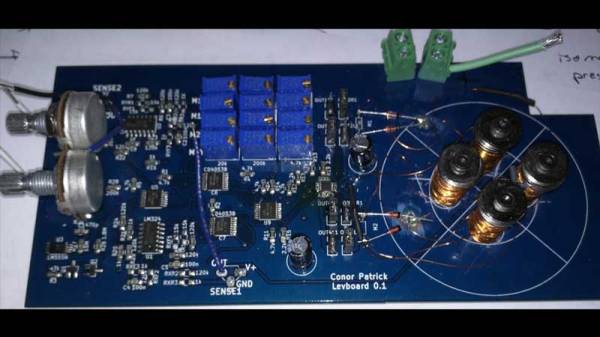
[Conor Patrick] bought an off-the-shelf levitation product that was capable of horizontal levitation. Upon dissecting it he found a large magnet, four electromagnet coils, and a hall effect sensor. These parts collectively form a closed-loop control to hold an object at a specific distance. He soon discovered that in fact, there were just two coils energized by H-bridges. His first attempt at replicating the circuit, he employed a breadboard which worked fine for a single axis model. Unfortunately, it did not work as expected with multiple coils.

After a few iteration and experiments with the PID control loop, he was able to remove unwanted sensor feedback as well as overshoot in control current. He finally moved to a Teensy with a digital PD loop. The system works, but only marginally. [Conor Patrick] is seeking help from the control loop experts out there and that is the essence of the OSHW world. The best part of this project is that it is a journey that involves solving one problem at a time. We hope to see some unique results in the future.

We have covered Acoustic Levitation in the past and the Levitating Clock on a similar beat. We’re certain a more refined approach is on the horizon since many of us are now looking at making one to experiment with on our workbench.

Hackaday Prize Entry: MappyDot, A Micro Smart LiDAR Sensor

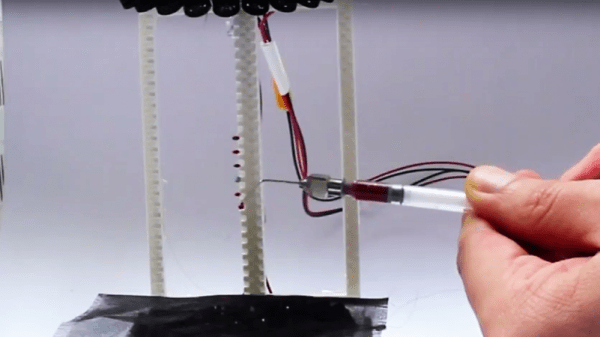
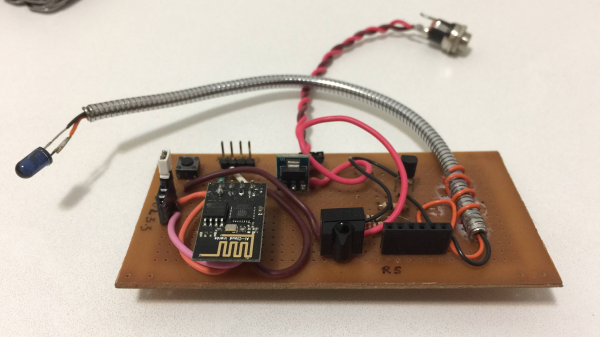
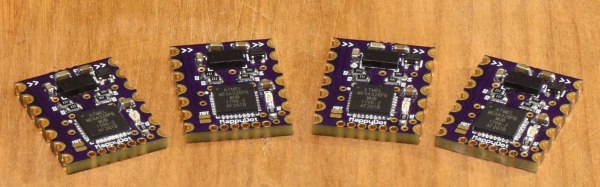
[Blecky]’s entry to the Hackaday Prize is MappyDot, a tiny board less than a square inch in size that holds a VL53L0X time-of-flight distance sensor and can measure distances of up to 2 meters.

MappyDot is more than just a breakout board; the ATMega328PB microcontroller on each PCB provides filtering, an easy to use  I2C interface, and automatically handles up to 112 boards connected in a bus. The idea is that one or a few MappyDots can be used by themselves, but managing a large number is just as easy. By dotting a device with multiple MappyDots pointing in different directions, a device could combine the readings to gain a LiDAR-like understanding of its physical environment. Its big numbers of MappyDots [Blecky] is going for, too: he just received a few panels of bare PCBs that he’ll soon be laboriously populating. The good news is, there aren’t that many components on each board.

It’s great to see open sourced projects and tools in which it is clear some thought has gone into making them flexible and easy to use. This means they are easier to incorporate into other work and helps make them a great contestant for the Hackaday Prize.

Reamer Regrinding Using A Toolpost Spindle

How often have you wished you could reduce the size of a drillbit? [Ben Katz] has a bunch of projects in mind that use a tight-tolerance 22mm bore–but he didn’t have a 22mm reamer handy. Rather than buy one, he thought, why not regrind a larger one to the right size?

He first ground down the shank to fit in the lathe’s drill chuck. Once it was loaded into the chuck,  he reground the edge of a 7/8″ (22.225mm) reamer, reducing its diameter down to 22mm by spinning it on his lathe in conjunction with a toolpost spindle with a grinding wheel attached. The final diameter was 21.995mm—off by 5 microns!

[Ben]’s homebuilt spindle is a cool project in itself, and we publish a lot of posts about those handy tools. Check out our pieces on a brushless DC motor used as a CNC spindle, and this 3D printer outfitted with a spindle. Also check out [Ben]’s electric tricycle build we featured a few years ago.

Continue reading “Reamer Regrinding Using A Toolpost Spindle”

New Method For Measuring Lots Of Resistors Using Very Few Wires

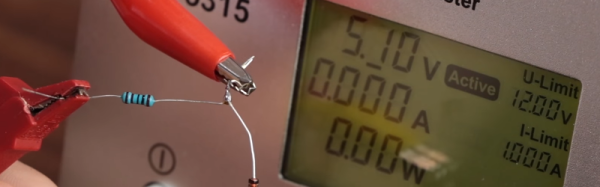
[Daqq] is back at it again with the linear algebra, and he’s now come up with a method for determining the resistance of lots of resistors using little of wires and loads of math.

Like any reasonable person, [daqq] decided it would be fun to “solve one of those nasty [electrical engineering] puzzles/exercises where you start out with a horrible mess of wires and resistors and you are supposed to calculate the resistance between two nodes.” You know, just an average Saturday night. At the time, he was also fascinated by Charlieplexing – an awesome technique that either allows one to control multiple polarized components, such as LEDs, simply by connecting them in a specific way. After toying with the idea for a while, [daqq] found that using just Charlieplexing would be“a horrible mess” but he didn’t stop there. Drawing inspiration from Charlieplexing, he came up with the idea to connect things in such a way that every node is connected by one connection to every other node – a complete graph from a topological view point (this makes so much more sense visually). From here, he was able to set pins to HIGH, LOW, or INPUT and gather all the data needed to solve his linear system of equations.

Now, there is a balance to everything, and while this system can determine the resistance of .5*N(N-1) resistors using just N wires, it also a memory and computation hungry method. Oh well, can’t have it all. But, while it’s computationally hungry, [daqq] got it working on an ATMega32, so it’s not an unmanageable feat. And, let’s not forget to mention [daqq’s] wonderful writing. Even if you don’t know linear algebra (or would rather forget), it’s a good read from a theory perspective. So good, in fact, that [daqq] is getting published in Circuit Cellar!

We love to see theory in the hacker world, so keep it coming! But, while we wait (wink wink), there’s always time to review the basic Hacker Calculus and check out our past math-related articles.

Fridge Compressor To 2-Stroke Engine: JB Weld For The Win

We like this one because it has a real Junkyard Wars feel to it: turning a cast-off fridge compressor into a two-stroke internal combustion engine. [Makerj101] is doing this with tooling no more complicated than a hacksaw and a hand drill. And JB Weld — lots and lots of JB Weld.

[Makerj101]’s video series takes us through his entire conversion process. Despite the outward similarity between compressors and engines, there are enough crucial differences to make the conversion challenging. A scheme for controlling intake and exhaust had to be implemented, the crankcase needed to be sealed, and a cylinder head with a spark plug needed to be fabricated. All of these steps would have been trivial in a machine shop with mill and lathe, but [Makerj101] chose the hard way. An old CPU heat sink serves as a cylinder head, copper wire forms a head gasket and spacer to decrease the compression ratio, and the old motor rotor serves as a flywheel. JB Weld is slathered everywhere, and to good effect as the test run in the video below shows.

Think you recognize [Makerj101]? You probably do, since we featured his previous machine shop-less engine build. This guy sure gets his money’s worth out of a tube of JB Weld.

Continue reading “Fridge Compressor To 2-Stroke Engine: JB Weld For The Win”

Use A Drill To Power Your Flipbooks

[WolfCat] of Wolfcatworkshop is creating a hand-animated split-flap animation. But what do you use to test your animation once it’s on the split-flaps? Well, to test it out, [WolfCat] used a drill to give it motion. DoodlersAnonymous has some pics and an interview with [WolfCat] about his animation and there are some pictures on his Instagram page.

Technically, what [WolfCat] wanted to make is a “mutoscope,” a hand-cranked precursor to the movie projector that had its heyday in the late 19th and early 20th century. Originally installed in penny arcades and the like, mutoscopes were single-viewer apparatus. The viewer cranks the handle and the animated cards inside rotate around, stopped briefly by a bit of metal at the top in order to show a frame. The basic idea is similar to the way split-flap clocks or signs work.

[WolfCat] hand drew the animation for his movie and then scanned and printed out each frame. The frames were then transferred to a pair of flaps. [WolfCat] wanted to see how it would look when animated, but didn’t have any plans at the time for a case or a hand crank, so he found the closest tool that would do the job – a cordless drill. Attaching the drill and using a bit of card or wood as a stopper, [WolfCat] could see how the end result would look and could then start work on the case and crank.

The drill is a quick and easy way to see what the finished product would look like. Once he’s got it working, [WolfCat] could check out this 3D printed mutoscope case, or this flip dot animated display.

Continue reading “Use A Drill To Power Your Flipbooks”