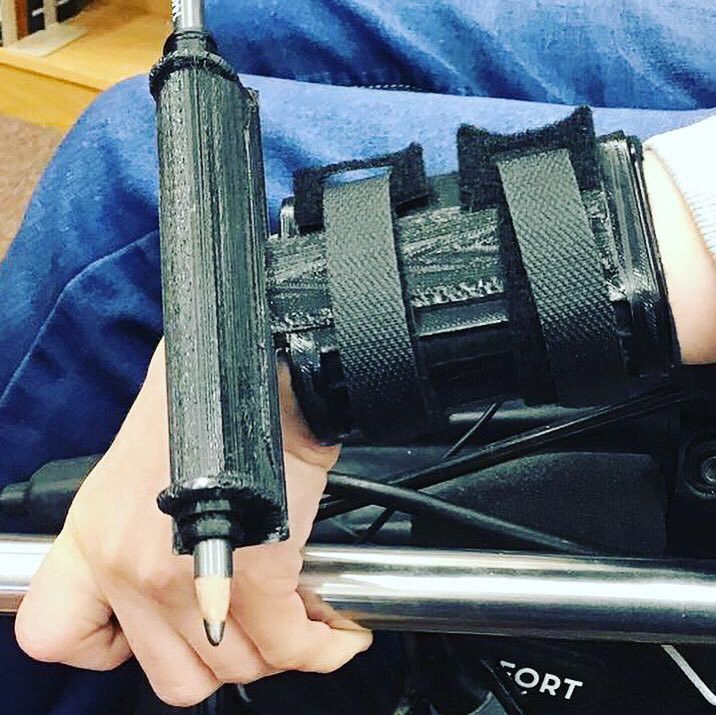
Cerebral Palsy Tool Assistant

We all deserve to create. Some people seem to have the muses hidden in their pocket, but everyone benefits when they express themselves in their chose art form. Each of us has tools, from Dremels to paintbrushes, and many folks here build their own implements. Even if we don’t have our macro-enabled mechanical keyboard or a dual-extrusion printer, we can make due. But what if you couldn’t operate your drill, or mouse, or even a pencil? To us, that would be excruciating and is the reality for some. [Laura Roth] and [Christopher Sweeney] are art teachers designing a tool holder for their students with cerebral palsy so that they can express themselves independently.

On either side of this banner image, you can see pencil drawings from [Sara], who has spastic cerebral palsy. She made these drawings while wearing the tool holder modeled after her hand. Now, that design serves other students and is part of the 2020 Hackaday Prize. The tool holder wraps around the wrist like a wide bracelet. Ribbing keeps its shape, and a tube accepts cylindrical objects, like pencils, styluses, and paintbrushes.The result is that the tip of the pencil is not far from where it would have been if held in the hand, but this sidesteps issues with grip and fine control in hands and fingers.

The print is available as an STL and should be printed with flexible filament to ensure it’s comfortable to wear. Be mindful of digital styluses which may need something conductive between the barrel and user.

Hackers are familiar with the challenges of cerebral palsy, and we’ve enjoyed seeing a variety of solutions over the years like door openers, camera gimbals, and just being altogether supportive.

Fog-Free Mask Hack Solves Mask Versus Glasses Conundrum With Superb Seal

If you have worn a mask and glasses together for more than a quarter of a second, you are probably annoyed that we don’t have a magical solution for foggy lenses. Moisture-laden air is also a good indicator of where unfiltered air is escaping. Most masks have some flexible metal across the nose bridge that is supposed to seal the top, but it is woefully inadequate. The Badger Seal by [David Rothamer] and [Scott Sanders] from the University of Wisconsin-Madison College of Engineering is free to copy during the COVID-19 pandemic, even commercially. It works by running an elastic cord below the jaw and a formable wire over the nose to encourage contact all around both mouth and nose.

You can build your own in three ways. Each configuration is uniquely suited to a different situation. The first design is the easiest to make and should work for most people. The second is best for folks who need a better seal on the lower half of their face, like someone sporting a beard. It can also have ear loops, and that means your 3D printed ear savers have another use. The Madison campus of the University of Wisconsin also has fun with lock cracking and graphene experiments.
Continue reading “Fog-Free Mask Hack Solves Mask Versus Glasses Conundrum With Superb Seal”

Karting Hands-Free

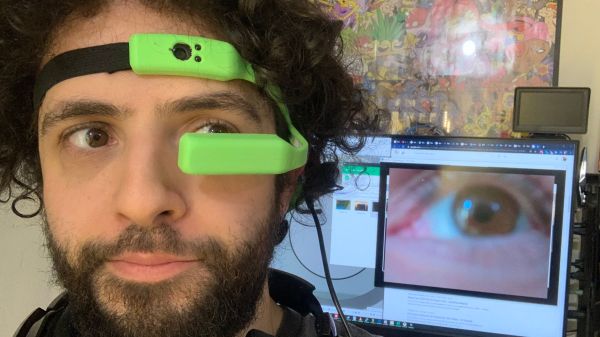
Some of us have computer mice with more buttons than we have fingers, resolution tracking finer than a naked eye can discern, and forced-air vents. All these features presuppose one thing; the user has a functioning hand. [Federico Runco] knows that amyotrophic lateral sclerosis, ALS, or Lou Gehrig’s disease, will rob a person of their ability to use standard computer inputs, or the joystick on a motorized wheelchair. He is building EyesDrive for the 2020 Hackaday Prize, to restore that mobility to ALS patients. There are already some solutions, but this one focuses on a short bill of materials.

Existing systems are expensive and often track pupil location, which returns precise data, but EyesDrive only discerns, left, right, and resting. For these, we need three non-invasive electrodes, a custom circuit board with amplifiers, signal processing circuits, and a microcontroller. He includes a Bluetooth socket on the custom PCBs, which is the primary communication method. In the video below he steers a virtual kart around a knotty course to prove that his system is up to the task of an urban wheelchair.

EyesDrive by [Federico Runco] should not be confused with the HackadayPrize2015 winner, Eyedrivomatic, lead by two remarkable hackers, Steve Evans and Patrick Joyce.

Continue reading “Karting Hands-Free”

Read My Lips, Under This No-Sew Mask

Humans continuously communicate with our bodies, and face masks cover one of the most expressive parts. For some, this is a muffler on strangers, but devastating for people who rely on lip-reading. Several masks exist that have a clear window for precisely this purpose, but they’re specialty and high-demand. [Erin St Blaine] over at Adafruit shows how she makes windowed masks with stuff you may already have in your house. Even if your sewing machine is locked up the local maker-space, you are in luck, because you don’t need a single stitch. For the thread-inclined, it is easy to tweak the recipe.

The part of the mask that touches your face is terry cloth, but any breathable cotton towel should work. There is a PDF in the instructions where you can print templates in four sizes. You will also find a cutout for the plastic window salvaged from your cold soft drink cup. A water bottle should work too. Flexible glue holds the fabric together, but to attach the ear-loops, we fall back on our old friend, the red Swingline. If you don’t have that color and brand, any stapler will do in a pinch. Don’t forget to add some defogger and keep smiling.

Wear your homemade mask proudly and fasten it well, but not too fast.

Continue reading “Read My Lips, Under This No-Sew Mask”

A New Spin On A Medical Test

Most of us can say that we have taken an obsolete hard drive out of a computer and felt it was a waste to toss it in the e-waste pile. Some of us have children’s drawings hung on the fridge with actuator magnets, or maybe a vast spreadsheet suspended on a steel filing cabinet. Let us not forget that there is also a high-speed, low-noise motor in there. On some models it is separate from the PCB, so grab an Electronic Speed Controller (ESC), your microcontroller of choice, and make yourself a salvaged HDD centrifuge like [Cave Man] has. His build uses the tray as a chassis, but he modeled and printed a new face in the same style as the original.

On top, he has an OLED screen for displaying the requested speed, measured speed, and runtime. Next to the display is a four-button pad with a customized legend for setting parameters. The video after the break shows the machine running through its paces. This version accommodates the tiny capillary tubes, microhematocrit tubes, for processing raw blood. This test can calculate the packed cell volume, which professionals use to determine things from dehydration to anemia.

There are other builds out there where people have modified an old drive into the kind of centrifuge that accepts larger diameter tubes, but this was a shining example of what is possible. One good turn deserves another, so we recommend a desktop bio-lab companion, or enlist some LEGO Mindstorms to help out.

Continue reading “A New Spin On A Medical Test”

Building A Heavy Duty Open Source Ventilator

Since the COVID-19 pandemic started, we’ve seen several attempts to create homebrew ventilators designed to address the shortage of these lifesaving machines. Unfortunately, most hackers aren’t terribly experienced when it comes to designing practical medical equipment. So while many of the designs might have appeared functional on the workbench, there’s little chance they’d get used in any official capacity.

The open source DP Ventilator is still clearly the product of a couple plucky hackers, but we think it shows a level of design maturity that’s been missing in many of the earlier attempts. Made primarily with 3D printed components, this mechanical device is designed to operate a hand-held manual resuscitator; essentially standing in for a human operator. This makes the design far less complex than if it had to actually pump air itself, not to mention safer for the patient since the resuscitator (often referred to as an Ambu Bag) installed in it would be a sterile pre-packaged item.

In the video after the break, you can see just how much thought and effort has been put into the device’s touch screen interface. With a few quick taps the medical professional operating the DP Ventilator can dial in variables such as breathing rate, pressure, and volume to match the patient’s needs. While the Arduino Mega 2560 at the machine’s heart wouldn’t pass muster for any regulating body in charge of medical devices, we think with a few more tweaks, this design is getting close to something that might actually be able to save lives.

Continue reading “Building A Heavy Duty Open Source Ventilator”

Assistive Gloves Come In Pairs

We have to hand it to this team, their entry for the 2020 Hackaday Prize is a classic pincer maneuver. A team from [The University of Auckland] in New Zealand and [New Dexterity] is designing a couple of gloves for both rehabilitation and human augmentation. One style is a human-powered prosthetic for someone who has lost mobility in their hand. The other form uses soft robotics and Bluetooth control to move the thumb, fingers, and an extra thumb (!).

The human-powered exoskeleton places the user’s hand inside a cabled glove. When they are in place, they arch their shoulders and tighten an artificial tendon across their back, which pulls their hand close. To pull the fingers evenly, there is a differential box which ensures pressure goes where it is needed, naturally. Once they’ve gripped firmly, the cables stay locked, and they can relax their shoulders. Another big stretch and the cords relax.

In the soft-robotic model, a glove is covered in inflatable bladders. One set spreads the fingers, a vital physical therapy movement. Another bladder acts as a second thumb for keeping objects centered in the palm. A cable system draws the fingers closed like the previous glove, but to lock them they evacuate air from the bladders, so jamming layers retain their shape, like food in a vacuum bag.

We are excited to see what other handy inventions appear in this year’s Hackaday Prize, like the thumbMouse, or how about more assistive tech that uses hoverboards to help move people?

Continue reading “Assistive Gloves Come In Pairs”