Fully-functional Oscilloscope On A PIC

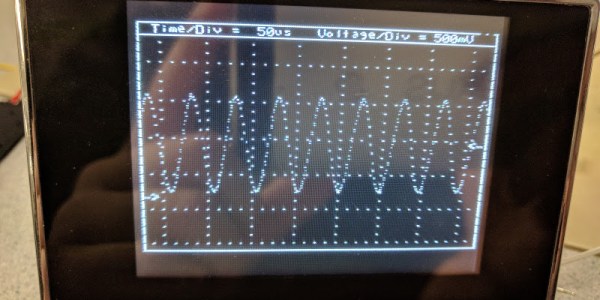
When troubleshooting circuits it’s handy to have an oscilloscope around, but often we aren’t in a lab setting with all of our fancy, expensive tools at our disposal. Luckily the price of some basic oscilloscopes has dropped considerably in the past several years, but if you want to roll out your own solution to the “portable oscilloscope” problem the electrical engineering students at Cornell produced an oscilloscope that only needs a few knobs, a PIC, and a small TV.

[Junpeng] and [Kevin] are taking their design class, and built this prototype to be inexpensive and portable while still maintaining a high sample rate and preserving all of the core functions of a traditional oscilloscope. The scope can function anywhere under 100 kHz, and outputs NTSC at 30 frames per second. The user can control the ground level, the voltage and time scales, and a trigger. The oscilloscope has one channel, but this could be expanded easily enough if it isn’t sufficient for a real field application.

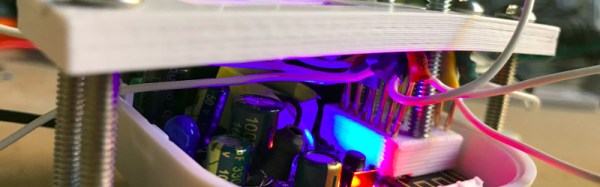
All in all, this is a great demonstration of what you can accomplish with a microcontroller and (almost) an engineering degree. To that end, the students go into an incredible amount of detail about how the oscilloscope works since this is a design class. About twice a year we see a lot of these projects popping up, and it’s always interesting to see the new challenges facing students in these classes.
Continue reading “Fully-functional Oscilloscope On A PIC”

Pogo Pins Make Light Work Of IoT Switches

Living in a condo with inadequate opportunity for fresh light wiring presented a problem for [Raphael Luckom], which he solved by taking a few off-the-shelf ESP8266-based IoT mains switches. That in itself is nothing particularly new these days, but what makes his switches special is that when faced with fiddly soldering to reprogram them, instead he fabricated a pogo pin jig to make the required contacts.

He took inspiration for his work from a Hackaday.io project hacking some Chinese switched outlets. They contain a standard ESP-12 module, so identifying the correct pins to program them was easy enough. He simply had to create a jig for his pogo pins, which he did with his 3D printer. Of course, “simply” is not an appropriate word, because along the way he had to pass through many iterations of the print, but eventually he had his jig secured to the boards with a clamp.

The result: a successful relay, and without the tricky soldering. We know many of our readers will have no problems with a bit of solder, but for those of you that don’t there might be a bit of interest here.

We’ve shown you many ESP8266 switches over the years. This all-in-one socket system was rather clever, but we’ve had some simple switches too.

PLCs In Your Browser

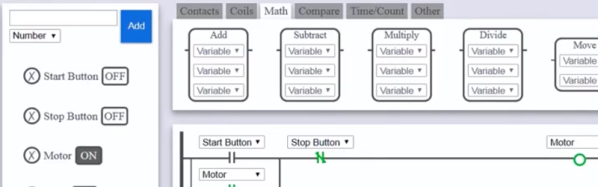
If your usual tools are the Arduino and the Raspberry Pi, you might find it surprising that the industrial world tends to run on Programmable Logic Controllers, or PLCs. You can think of a PLC as a very rugged industrial Arduino, but it’s best not to take that analogy too far. Some PLCs are very simple and some are quite complex, but one thing they do have in common is they are usually programmed using ladder logic. If you’ve ever wanted to learn how to program PLCs — a very marketable job skills in some places — you can now build and simulate ladder logic in your browser. [Garry Shortt] has a video walkthrough of the tool, that you can see below.

If you are used to conventional programming, you may find ladder logic a little frustrating. Originally, it was a documentation tool for relay logic but has grown to handle modern cases. It may actually help you to not think of it so much as a programming language, instead as a tool for drawing relay schematics. Contacts can be normally open or closed and in series or parallel to form AND and OR gates, for example, while coils can activate contacts.

Continue reading “PLCs In Your Browser”

When Is A 10-bit A/D An 8-bit A/D?

Marketing guys love bigger numbers. Bigger is better, right? After all, Subway called it a “footlong” not an 11-incher. So when it comes to analog to digital (A/D) conversion, more bits are better, right? Well, that depends. It is easy to understand that an A/D will have a low and high measurement and the low will be zero counts and the high will result in the maximum count for the number of bits. That is, an 8-bit device will top out at 255, a 10-bit at 1023, and so on.

The question is: are those bits meaningful? The answer depends on a few factors. Like most components we deal with, our ideal model isn’t reality, but maybe it is close enough.

Continue reading “When Is A 10-bit A/D An 8-bit A/D?”

Surprise Your Loved One With A Heart Keychain

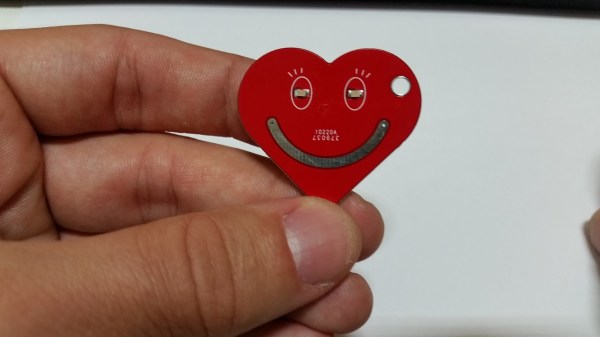
Sometimes the simplest projects can be the most impressive. Most of the time our simple projects are not as neat and elegant as our more time consuming ones. Sometimes they don’t even leave the breadboard! When [Sasa Karanovic] first envisioned his key-chain idea, he knew it would be simple. But he made up for the lack of sophistication with style.

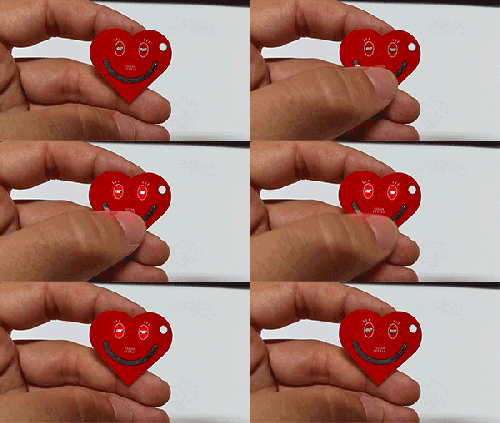
The heart-shaped key-chain has one goal – to flash a pair of red LEDs when a capacitive button is touched. He was able to accomplish this with a PIC12LF1822 and a handful of supporting components. We’re quite impressed with the soldering skills and layout of the PCB. The resistors, LEDs and single capacitor are 0603 surface mount devices, which push the limits of hand soldering. [Sasa] gives a great explanation of how capacitive touch buttons work and how they can be easily incorporated directly into a PCB.

What’s the smallest SMD you’ve soldered? Let us know in the comments, along with what you think about this nifty key-chain.


Weather Station Needs Almost No Batteries

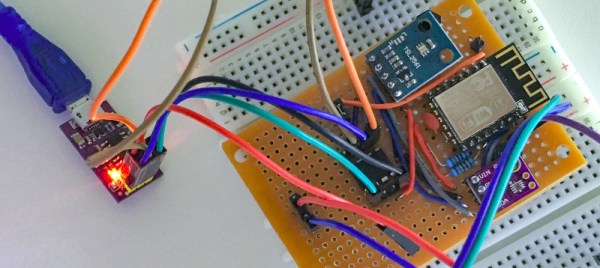
While the ESP8266 has made its way into virtually every situation where a low-cost WiFi solution is needed, it’s not known as being a low-power solution due to the amount of energy it takes to run WiFi. [Alex] took this design constraint as more of a challenge though, and with the help of an ATtiny microcontroller was able to develop a weather station using an ESP8266 that only needs new batteries every 2-4 years.

While the ESP8266 module consumes a bit of power, the ATtiny excels in low-power mode. To take advantage of this, [Alex] designed the weather station using the ATtiny to gather data every two minutes, store the data in a buffer, and upload all of it in bursts every hour using the ESP8266. This means that the power-hungry WiFi chip can stay off most of the time, drastically limiting the power demands of the station. [Alex] mostly details the setup of the ATtiny and the ESP8266 on his project page, so this could be applied anywhere that low power and network connectivity are required.

As for the weather reporting capabilities, the station is equipped to measure temperature, light, and humidity. Presumably more could be added but this might increase the power demands for the weather station as a whole. Still, changing batteries once a year instead of once every two years might be a worthwhile trade-off for anyone else attempting such an ambitious project. Other additions to the weather station that we’ve seen before might include a low-power display, too.

Smart DC Tester Better Than A Dummy Load

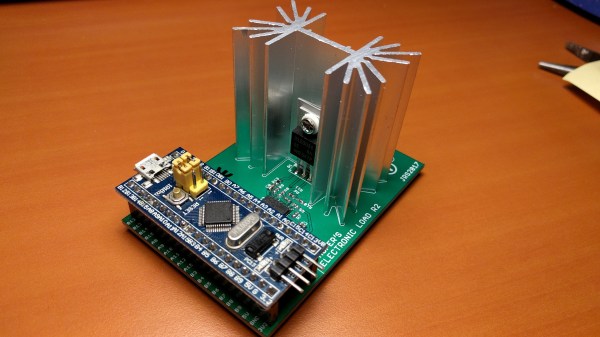
Testing DC supplies can be done in many ways, from connecting an actual load like a motor, to using a dummy load in the manner of a big resistor. [Jasper Sikken] is opening up his smart tester for everyone. He is even putting it on Tindie! Normally a supply like a battery or a generator would be given multiple tests with different loads and periodic readings. Believe us, this can be tedious. [Jasper Sikken]’s simulated load takes away the tedium and guesswork by allowing the test parameters to be adjusted and recorded over a serial interface. Of course, this can be automated.

In the video after the break, you can see an adjustment in the constant-current mode from 0mA to 1000mA. His supply, meter, and serial data all track to within one significant digit. If you are testing any kind of power generator, super-capacitor, or potato battery and want a data log, this might be your ticket.

We love testers, from a feature-rich LED tester to a lead (Pb) tester for potable water.

Continue reading “Smart DC Tester Better Than A Dummy Load”