Building A DIY Heat Pipe

Once the secret design tool for aerospace designers, the heat pipe is a common fixture now thanks to the demands of PC CPU cooling. Heat pipes can transfer lots of energy from a hot side to a cold side and is useful when you need to cool something where having a fan near the hot part isn’t feasible for some reason. Unlike active cooling, a heat pipe doesn’t require any external power or pumps, either.

[James Biggar] builds his own heat pipes using copper tubing. You can see a video of one being made, below. There’s not much to it, just a copper pipe with some water in it. However, [James] gets the water boiling to reduce the pressure in the tube before sealing it, which is an interesting trick.

One limitation of his technique is that there is no internal wick. That means the tube can only be installed vertically. If you haven’t looked at heat pipes before, most of them do have a wick. The idea is that some working fluid is in the pipe. You select that fluid so that it boils at or below the temperature you want to handle. The hot vapor rushes to the cool side of the pipe (carrying heat) where you have a large heatsink that may have a fan or active cooling system. The vapor condenses and–in this case–drops back to the bottom of the tube. However, if there is a wick, capillary action will return the fluid to the hot end of the tube.

You might think that using water as the working fluid would limit you to 100°C, but remember, [James’] technique lowers the pressure in the tube. At a lower pressure, the water will boil at a lower temperature.

We’ve seen heat pipes and wine chillers used to cool a PC before. In fact, we’ve even seen them in builds of completely fanless PCs.

Continue reading “Building A DIY Heat Pipe”

Laser-Cut ArcSin Dress Is Wearable Math

Using sewing simulation, 3D modeling and laser-cutting [Nancy Yi Liang] makes custom dresses that fit like a glove. Her project documentation walks us through all the steps from the first sketch to the final garment.

After sketching the design on paper, the design process moves into the digital domain, where an accurate 3D model of the wearer is required. [Nancy] created hers with Make Human, a free software that creates to-size avatars of humans from tape-measured parameters. Using the professional garment modeling software MarvelousDesigner (which offers a 30 day trial version), she then created the actual layout. The software allows her to design the cutting patterns, and then also drapes the fabric around the human model in a 3D garment simulation to check the fit. The result are the cutting patterns and a 3D model of the garment.

Continue reading “Laser-Cut ArcSin Dress Is Wearable Math”

Arc Lighter Become Plasma Pyrography Pen

Wood burning can be quite a striking art form, but who wants to be stuck using an old-fashioned resistive heating element to char wood? You could go with laser engraving, of course, but that seems to take too much of the human touch out of it. So why not try a mini plasma pen and blow torch powered by a fancy cigarette lighter?

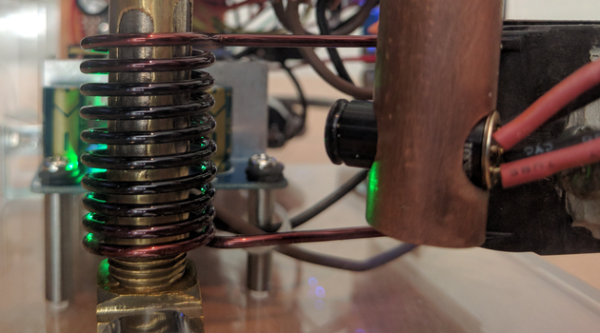
Arc lighters are rechargeable electronic lighters that look like a tiny stun-gun, and [NightHawkInLight] has been coming up with some interesting hacks for them. In this case, he extended the electrode leads out and mounted them to a wooden handle. The spark gap is only about 2mm, but the resulting arc is plenty hot enough to char wood with considerable precision. You’ve got to work fast, though, or the high voltage will start finding interesting paths through the char, producing Lichtenberg figures. And if a micro-scale blow torch is a tool you need, [NightHawkInLight] has got that covered too – a small brass tube with a pinched-off nozzle hooked to an aquarium pump provides the pressure for that.

Might there be other applications for this beyond pyrography? Maybe soldering or desoldering? Of non-ESD sensitive components, naturally.

Continue reading “Arc Lighter Become Plasma Pyrography Pen”

Solar-powered Weather Station Has The Complete Suite Of Sensors

There was a time when getting weather conditions was only as timely or as local as the six o’clock news from the nearest big-city TV station. Monitoring the weather now is much more granular thanks to the proliferation of personal weather stations. For the ultimate in personalized weather, though, you might want to build your own solar powered weather station.

It looks like [Brian Masney] went all out in designing his weather station. It supports a full stack of sensors – wind speed and direction, rain, temperature, pressure, and dew point. About the only other parameters not supported (yet) are solar radiation, UV, and soil moisture and temperature. The design looks friendly enough that adding those sensors should be a snap – if fact, the 3D models in his GitHub repo suggest that he’s already working on soil sensors. The wind and rain sensor boom is an off-the-shelf unit from Sparkfun, and the temperature and pressure sensors are housed in a very professional 3D printed screen enclosure. All the sensors talk to a Raspberry Pi living in a (hopefully) waterproof enclosure topped with a solar panel for charging the stations batteries. All in all it’s a comprehensive build; you can check out the conditions at [Brian]’s place on Weather Underground.

Weather stations are popular around these parts, as witnessed by this reverse-engineered sensor suite or even this squirrel-logic based station.

16-channel Sampler Tests Arcade Buttons With Style

The goal is simple: test a bunch of arcade buttons from different manufacturers to get the one with the best function and feel. The resulting build is anything but simple: this wonderfully over-designed 16-channel WAV sampler and mixer.

For those wondering why [Atarity] would go to this much trouble to test arcade buttons, we suspect an ulterior motive – skip to the 21:14 mark of the long video below to see the real design inspiration. Regardless of the motive, there’s no doubting the care that went into the build – CNC-milled birch case, extremely detailed laser-engraved graphics, and a carbon-fiber back plate covered with suede, because suede. We especially like the detail on the speaker grill: the embroidered fabric and puffed-up look really works with the rest of the design, including the leather hand strap.

It’s not entirely clear from the post what the end goal of the testing is, but we assume it’ll be some sort of MAME build. In which case, [Atarity] might want to check out our recent articles on a tabletop MAME cabinet or this portable MAME rig. But whatever he comes up with, we’re sure the craftsmanship will be there.

Continue reading “16-channel Sampler Tests Arcade Buttons With Style”

Blob Grid Array Technique Mounts Board-To-Board

[Howard Matthews] mills his own PCBs, and man, does he hate drilling through-holes. Manually changing the bits between engraving and drilling after isolation routing? What is this? The stone age? [Howard] decided to rethink his DIY PCB manufacturing process, and came to one essential conclusion: Only a fraction of these drills are actually necessary.

Continue reading “Blob Grid Array Technique Mounts Board-To-Board”

Etching A PCB In Ten Minutes.

Most circuit boards any maker could need for their projects can be acquired online at modest cost, but what if you need something specific? [Giorgos Lazaridis] of pcbheaven.com has designed his own etching bath complete with a heater and agitator to sped up the process of creating your own custom circuit boards.

[Lazaridis] started by building a circuit to control — in a display of resourcefulness — a fish tank heater he would later modify. The circuit uses a PIC 16F526 microcontroller and two thermristors to keep the temperature of the etching bath between 38 and 41 degrees Celsius. The fish tank heater was gingerly pried from its glass housing, and its bimetallic strip thermostat removed and replaced with a wire to prevent it shutting off at its default 32 degrees. All of it is mounted on a small portable stand and once heated up, can etch a board in less than 10 minutes.

Continue reading “Etching A PCB In Ten Minutes.”