It wasn’t too long ago that one could conjecture that most hackers are not avid video game players. We spend most of our free time taking things apart, tinkering with microcontrollers and reading the latest [Jenny List] article on Hackaday.com. When we do think of video games, our neurons generally fire in the direction of emulating a console on a single board computer, such as a Raspberry Pi or a Beaglebone. Or even emulating the actual console processor on an FPGA. Rarely do we venture off into 3D programs meant to make modern video games. If we can’t export an .STL with it, we’re not interested. It’s just not our bag.
Oculus Rift changed this. The VR headset was originally invented for 3D video games, but quickly became a darling to hackers the world over. Virtual Reality technology is far bigger than just video games, and brings opportunity to many fields such as real estate, construction, product visualization, education, social interaction… the list goes on and on.
The Oculus team got together with the folks over at Unity in the early days to make it easy for video game makers to make content for the Rift. Unity is a game engine designed with a shallow learning curve and is available for free for non-commercial use. The Oculus Rift can be integrated into a Unity environment with the check of a setting and importing a small package, available on the Oculus site. This makes it easy for anyone interested in VR technology to get a Rift and start pumping out content.
Hackers have taken things a step further and have written scripts that allow Unity to communicate with an Arduino. VR is fun. But VR plus physical reality is just down right exciting! In this article, we’re going to walk you through setting up your Oculus Rift and Unity game engine to communicate with the outside world via an Arduino.
The Arduino Wars officially ended last October, and the new Arduino-manufacturing company was registered in January 2017. At the time, we were promised an Arduino Foundation that would care for the open-source IDE and code infrastructure in an open and community-serving manner, but we don’t have one yet. Is it conspiracy? Or foul play? Our advice: don’t fret. These things take time.
But on the other hand, the Arduino community wants to know what’s going on, and there’s apparently some real confusion out there about the state of play in Arduino-land, so we interviewed the principals, Massimo Banzi and Federico Musto, and asked them for a progress report.
The short version is that there are still two “Arduinos”: Arduino AG, a for-profit corporation, and the soon-to-be Arduino Foundation, a non-profit in charge of guiding and funding software and IDE development. The former was incorporated in January 2017, and the latter is still in progress but looks likely to incorporate before the summer is over.
Banzi, who is a shareholder of Arduino AG, is going to be the president of the Foundation, and Musto, AG’s CEO, is going to be on the executive board and both principals told us similar visions of incredible transparency and community-driven development. Banzi is, in fact, looking to get a draft version of the Foundation’s charter early, for comment by the community, before it gets chiseled in stone.
It’s far too early to tell just how independent the Foundation is going to be, or should be, of the company that sells the boards under the same name. Setting up the Foundation correctly is extremely important for the future of Arduino, and Banzi said to us in an interview that he wouldn’t take on the job of president unless it is done right. What the Arduino community doesn’t need right now is a Foundation fork. Instead, they need our help, encouragement, and participation once the Foundation is established. Things look like they’re on track.
Humanity is a planetwide force. We have the power to change our weather. We have the power to change the shape of the land. We have the power to selectively wipe a species from this earth if we choose. We’ve had this power for a while and we’re still coming to terms with it. Many of us even deny it.
With such power, what do we do? We have very few projects which are in line with our ability. Somewhere in the past few years, I feel like most of us have lost our audacity. We’ve culturally come to appreciate the safe bet too much. We pull the dreamers and doers down. We want to solve the small problems first, and see if we have time for the big problems later. We don’t dream big enough, and there is zero reason for this hesitation. We could leverage our planetwide power for planetwide improvements. Nothing is truly stopping us. No law, no government, nothing.
To put it simply, as far as technology goes, everything is still low-hanging fruit. We’ve barely done anything. Even some of our greatest accomplishments can happen randomly in nature. We’ve not left our planet in any numbers or for any length of time. Our cities are disorganized messes. In every single field today, the unexplored territory is orders larger than the explored. Yet despite this vast territory, there are very few explorers. People want to optimize the minutia of life. A slightly faster processor for a slightly smaller phone. It’s okay.
Yet that same small optimization applied to a larger effort could have vast positive impact. Those same microprocessors could catalog our planet or drive probes into space. The very same efforts we spend on micro upgrades could be leveraged if we just look at the bigger picture then get out of our own way. All that is lacking is ambition. Money, time, skill, industry, and people are all there, waiting. We have the need for and have the resources to support ten thousand Elon Musks, not just the one.
Big projects make us bigger than our cellphones and Facebook. When you see a rocket launch into the sky, suddenly, “the world” becomes, simply, “a world.” Order of magnitude improvements reduce the order of our perception of previously complex problems. They should be our highest goal. Whatever field you’re in, you should be trying to be ten times better than the top competitor.
However, there are some societal changes that have to occur before we can.
Guitarists are a special breed, and many of them have a close connection with the instruments they play. It might be a specific brand of guitar, or a certain setup required to achieve the sound they’re looking for. No one has a closer bond with an instrument than Brian May to his Red Special. The guitar he toured with and played through his career with Queen and beyond had very humble beginnings. It was built from scratch by Brian and his father Harold May.
A young Brian May playing the brand new Red Special. Note the disk magnets of the original handmade pickups
It was the early 1960’s and a young teenaged Brian May wanted an electric guitar. The problem was that the relatively new instruments were still quite expensive — into the hundreds of dollars. Well beyond the means of the modest family’s budget. All was not lost though. Brian’s father Harold was an electrical engineer and a hacker of sorts. He built the family’s radio, TV, and even furniture around the house. Harold proposed the two build a new electric guitar from scratch as a father-son project. This was the beginning of a two-year odyssey that resulted in the creation of one of the world’s most famous musical instruments.
Brian was already an accomplished guitarist, learning first on his dad’s George Formby Banjo-ukulele, and graduating to an Egmond acoustic guitar. Brian’s first forays into electric guitars came from experimenting with that Egmond. If you look close, you can even see the influence it had on the final design of the Red Special.
Being able to do all this well, and in some cases better than humans, is a recent development. Creating photorealistic images is only a few months old. So how did all this come about?
It seems to be a perennial feature of our wider community of hackers and makers, that television production companies come up with new ideas for shows featuring us and our skills. Whether it is a reality maker show, a knockout competition, a scavenger hunt, or any other format, it seems that there is always a researcher from one TV company or another touting around the scene for participants in some new show.
These shows are entertaining and engaging to watch, and we’ve all probably wondered how we might do were we to have a go ourselves. Fame and fortune awaits, even if only during one or two episodes, and sometimes participants even find themselves launched into TV careers. Americans may be familiar with [Joe Grand], for instance, and Brits will recognise [Dick Strawbridge].
It looks as if it might be a win-win situation to be a TV contestant on a series filmed in exotic foreign climes, but it’s worth taking a look at the experience from another angle. What you see on the screen is the show as its producer wants you to see it, fast-paced and entertaining. What you see as a competitor can be entirely different, and before you fill in that form you need to know about both sides.
A few years ago I was one member of a large team of makers that entered the UK version of a very popular TV franchise. The experience left me with an interest in how TV producers craft the public’s impression of an event, and also with a profound distrust of much of what I see on my screen. This prompted me to share experiences with those people I’ve met over the years who have been contestants in other similar shows, to gain a picture of the industry from more than just my personal angle. Those people know who they are and I thank them for their input, but because some of them may still be bound by contract I will keep both their identities and those of the shows they participated in a secret. It’s thus worth sharing some of the insights gleaned from their experiences, so that should you be interested in having a go yourself, you are forewarned. Continue reading “Hacking On TV: What You Need To Know”→
It’s not too often that you see handkerchiefs around anymore. Today, they’re largely viewed as unsanitary and well… just plain gross. You’ll be quite disappointed to learn that they have absolutely nothing to do with this article other than a couple of similarities they share when compared to your neocortex. If you were to pull the neocortex from your brain and stretch it out on a table, you most likely wouldn’t be able to see that not only is it roughly the size of a large handkerchief; it also shares the same thickness.
The neocortex, or cortex for short, is Latin for “new rind”, or “new bark”, and represents the most recent evolutionary change to the mammalian brain. It envelopes the “old brain” and has several ridges and valleys (called sulci and gyri) that formed from evolution’s mostly successful attempt to stuff as much cortex as possible into our skulls. It has taken on the duties of processing sensory inputs and storing memories, and rightfully so. Draw a one millimeter square on your handkerchief cortex, and it would contain around 100,000 neurons. It has been estimated that the typical human cortex contains some 30 billion total neurons. If we make the conservative guess that each neuron has 1,000 synapses, that would put the total synaptic connections in your cortex at 30 trillion — a number so large that it is literally beyond our ability to comprehend. And apparently enough to store all the memories of a lifetime.
In the theater of your mind, imagine a stretched-out handkerchief lying in front of you. It is… you. It contains everything about you. Every memory that you have is in there. Your best friend’s voice, the smell of your favorite food, the song you heard on the radio this morning, that feeling you get when your kids tell you they love you is all in there. Your cortex, that little insignificant looking handkerchief in front of you, is reading this article at this very moment.
What an amazing machine; a machine that is made possible with a special type of cell – a cell we call a neuron. In this article, we’re going to explore how a neuron works from an electrical vantage point. That is, how electrical signals move from neuron to neuron and create who we are.
Despite the amazing feats a human brain performs, the neuron is comparatively simple when observed by itself. Neurons are living cells, however, and have many of the same complexities as other cells – such as a nucleus, mitochondria, ribosomes, and so on. Each one of these cellular parts could be the subject of an entire book. Its simplicity arises from the basic job it does – which is outputting a voltage when the sum of its inputs reaches a certain threshold, which is roughly 55 mV.
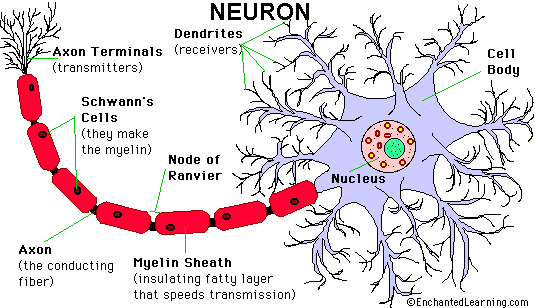
Using the image above, let’s examine the three major components of a neuron.
Soma
The soma is the cell body and contains the nucleus and other components of a typical cell. There are different types of neurons whose differing characteristics come from the soma. Its size can range from 4 to over 100 micrometers.
Dendrites
Dendrites protrude from the soma and act as the inputs of the neuron. A typical neuron will have thousands of dendrites, with each connecting to an axon of another neuron. The connection is called a synapse but is not a physical one. There is a gap between the ends of the dendrite and axon called a synaptic cleft. Information is relayed through the gap via neural transmitters, which are chemicals such as dopamine and serotonin.
Axon
Each neuron has only a single axon that extends from the soma, and acts similar to an electrical wire. Each axon will terminate with terminal fibers, forming synapses with as many as 1,000 other neurons. Axons vary in length and can reach a few meters long. The longest axons in the human body run from the bottom of the foot to the spinal cord.
The basic electrical operation of a neuron is to output a voltage spike from its axon when the sum of its input voltages (via its dendrites) crosses a specific threshold. And since axons are connected to dendrites of other neurons, you end up with this vastly complicated neural network.
Since we’re all a bunch of electronic types here, you might be thinking of these ‘voltage spikes’ as a difference of potential. But that’s not how it works. Not in the brain anyway. Let’s take a closer look at how electricity flows from neuron to neuron.
Action Potentials – The Communication Protocol of the Brain
The axon is covered in a myelin sheet which acts as an insulator. There are small breaks in the sheet along the length of the axon which are named after its discoverer, called Nodes of Ranvier. It’s important to note that these nodes are ion channels. In the spaces just outside and inside of the axon membrane exists a concentration of potassium and sodium ions. The ion channels will open and close, creating a local difference in the concentration of sodium and potassium ions.
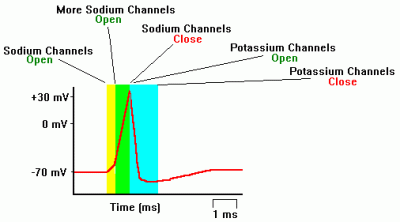
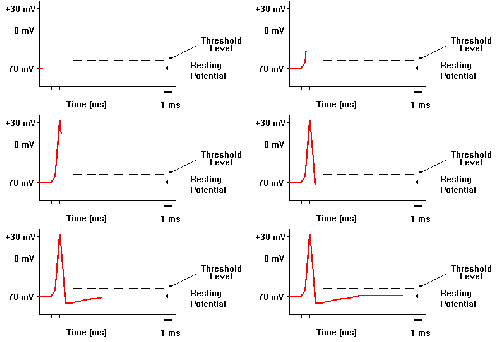
We all should know that an ion is an atom with a charge. In a resting state, the sodium/potassium ion concentration creates a negative 70 mV difference of potential between the outside and inside of the axon membrane, with there being a higher concentration of sodium ions outside and a higher concentration of potassium ions inside. The soma will create an action potential when -55 mV is reached. When this happens, a sodium ion channel will open. This lets positive sodium ions from outside the axon membrane to leak inside, changing the sodium/potassium ion concentration inside the axon, which in turn changes the difference of potential from -55 mV to around +40 mV. This process in known as depolarization.
One by one, sodium ion channels open along the entire length of the axon. Each one opens only for a short time, and immediately afterward, potassium ion channels open, allowing positive potassium ions to move from inside the axon membrane to the outside. This changes the concentration of sodium/potassium ions and brings the difference of potential back to its resting place of -70 mV in a process known as repolarization. Fro start to finish, the process takes about five milliseconds to complete. The process causes a 110 mV voltage spike to ride down the length of the entire axon, and is called an action potential. This voltage spike will end up in the soma of another neuron. If that particular neuron gets enough of these spikes, it too will create an action potential. This is the basic process of how electrical patterns propagate throughout the cortex.
The mammalian brain, specifically the cortex, is an incredible machine and capable of far more than even our most powerful computers. Understanding how it works will give us a better insight into building intelligent machines. And now that you know the basic electrical properties of a neuron, you’re in a better position to understand artificial neural networks.