What I particularly like about the Van de Graaff (or VDG) is that it’s a combination of a few discrete scientific principles and some mechanically produced current, making it an interesting study. For example, did you know that its voltage is limited mostly by the diameter and curvature of the dome? That’s why a handheld one is harmless but you want to avoid getting zapped by one with a 15″ diameter dome. What follows is a journey through the workings of this interesting high voltage generator.
Last week we covered the past and current state of artificial intelligence — what modern AI looks like, the differences between weak and strong AI, AGI, and some of the philosophical ideas about what constitutes consciousness. Weak AI is already all around us, in the form of software dedicated to performing specific tasks intelligently. Strong AI is the ultimate goal, and a true strong AI would resemble what most of us have grown familiar with through popular fiction.
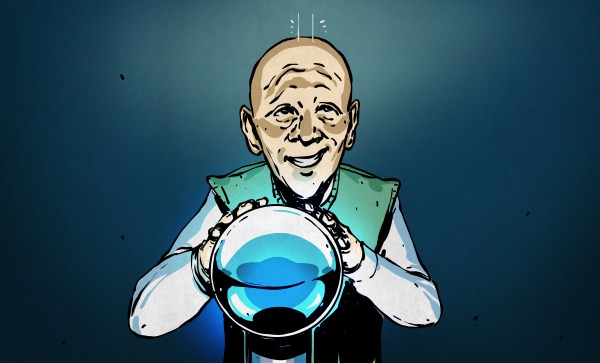
Artificial General Intelligence (AGI) is a modern goal many AI researchers are currently devoting their careers to in an effort to bridge that gap. While AGI wouldn’t necessarily possess any kind of consciousness, it would be able to handle any data-related task put before it. Of course, as humans, it’s in our nature to try to forecast the future, and that’s what we’ll be talking about in this article. What are some of our best guesses about what we can expect from AI in the future (near and far)? What possible ethical and practical concerns are there if a conscious AI were to be created? In this speculative future, should an AI have rights, or should it be feared?
We tend to think that there was a time in America when invention was a solo game. The picture of the lone entrepreneur struggling against the odds to invent the next big thing is an enduring theme, if a bit inaccurate and romanticized. Certainly many great inventions came from independent inventors, but the truth is that corporate R&D has been responsible for most of the innovations from the late nineteenth century onward. But sometimes these outfits are not soulless corporate giants. Some are founded by one inventive soul who drives the business to greatness by the power of imagination and marketing. Thomas Edison’s Menlo Park “Invention Factory” comes to mind as an example, but there was another prolific inventor and relentless promoter who contributed vastly to the early consumer electronics industry in the USA: Powel Crosley, Jr.
The concept of artificial intelligence dates back far before the advent of modern computers — even as far back as Greek mythology. Hephaestus, the Greek god of craftsmen and blacksmiths, was believed to have created automatons to work for him. Another mythological figure, Pygmalion, carved a statue of a beautiful woman from ivory, who he proceeded to fall in love with. Aphrodite then imbued the statue with life as a gift to Pygmalion, who then married the now living woman.
Pygmalion by Jean-Baptiste Regnault, 1786, Musée National du Château et des Trianons
Throughout history, myths and legends of artificial beings that were given intelligence were common. These varied from having simple supernatural origins (such as the Greek myths), to more scientifically-reasoned methods as the idea of alchemy increased in popularity. In fiction, particularly science fiction, artificial intelligence became more and more common beginning in the 19th century.
But, it wasn’t until mathematics, philosophy, and the scientific method advanced enough in the 19th and 20th centuries that artificial intelligence was taken seriously as an actual possibility. It was during this time that mathematicians such as George Boole, Bertrand Russel, and Alfred North Whitehead began presenting theories formalizing logical reasoning. With the development of digital computers in the second half of the 20th century, these concepts were put into practice, and AI research began in earnest.
Over the last 50 years, interest in AI development has waxed and waned with public interest and the successes and failures of the industry. Predictions made by researchers in the field, and by science fiction visionaries, have often fallen short of reality. Generally, this can be chalked up to computing limitations. But, a deeper problem of the understanding of what intelligence actually is has been a source a tremendous debate.
Despite these setbacks, AI research and development has continued. Currently, this research is being conducted by technology corporations who see the economic potential in such advancements, and by academics working at universities around the world. Where does that research currently stand, and what might we expect to see in the future? To answer that, we’ll first need to attempt to define what exactly constitutes artificial intelligence.
There are certain design guidelines for PCBs that don’t make a lot of sense, and practices that seem excessive and unnecessary. Often these are motivated by the black magic that is RF transmission. This is either an unfortunate and unintended consequence of electronic circuits, or a magical and useful feature of them, and a lot of design time goes into reducing or removing these effects or tuning them.
You’re wondering how important this is for your projects and whether you should worry about unintentional radiated emissions. On the Baddeley scale of importance:
Pffffft – You’re building a one-off project that uses battery power and a single microcontroller with a few GPIO. Basically all your Arduino projects and around-the-house fun.
Meh – You’re building a one-off that plugs into a wall or has an intentional radio on board — a run-of-the-mill IoT thingamajig. Or you’re selling a product that is battery powered but doesn’t intentionally transmit anything.
Yeeeaaaaahhhhhhh – You’re selling a product that is wall powered.
YES – You’re selling a product that is an intentional transmitter, or has a lot of fast signals, or is manufactured in large volumes.
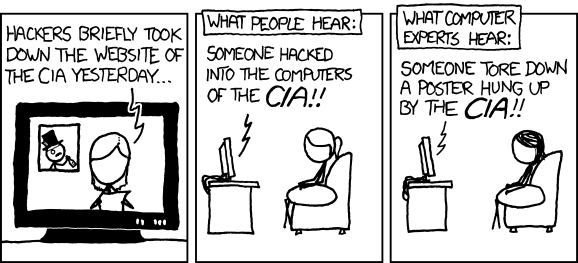
To a casual observer it might seem as though our community is in the news rather a lot at the moment. It’s all about hacks on our TV screens in the soap opera of Washington politics, who hacked this, whether those people over there helped that lot hack the other lot, or even whether that person’s emails could have been hacked on that server. Keeping up with it as an outsider can become a full-time job.
Of course, as we all know even if the mainstream journalists (or should I refer to them colloquially as “hacks”?) don’t, it’s not us they’re talking about. Their hackers are computer criminals, while we are people with some of the hardware and software skills to bend technology to our will, even beyond what its designers might have intended. And that divergence between the way we use the word in a sense of reappropriation and they use it in disapprobation sometimes puts us in an odd position. Explaining to a sober-suited businessman as the director of a hackspace, that no, we’re not *those*hackers can sometimes feel like skating on thin ice.
Recharging your mobile phone or your electric vehicle in a few minutes sure sounds appealing. Supercapacitor technology has the potential to deliver that kind of performance that batteries currently can’t, and while batteries are constantly improving, the pace of development is not very fast. Just remember your old Nokia mobile with Ni-Cad batteries and several days of usage before a recharge was needed. Today we have Lithium-Ion batteries and we have to charge our phones every single day. A better energy storage option is clearly needed, and supercapacitors seem to be the only technology that is close to replace the battery.