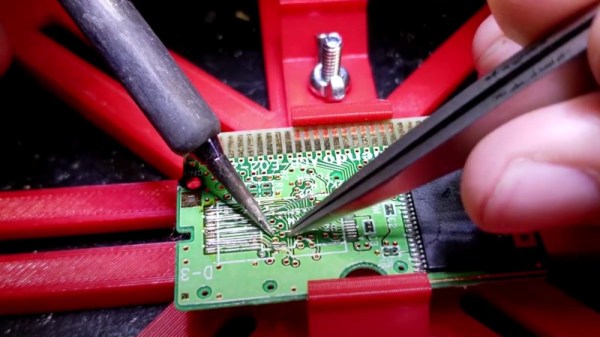
If someone gifted you a cheap laptop this holiday season, you might be a little put out by the 2GB of RAM and the 400 MHz CPU. However, you might appreciate it more once you look at [Noel’s Retro Lab’s] 4.8 Kg Amstrad PPC512 He shows it off inside and out in the video below.
Unlike a modern laptop, this oldie but goodie has a full keyboard that swings out of the main body. The space below the keyboard contains the LCD screen, which [Noel] is going to have to replace with an LCD from another unit that was in worse shape but had a good-looking screen. In this video, he gets as far as getting video output to an external monitor, but neither LCD shows any sign of life. But he’s planning more videos soon.
Happily the right to repair movement is slowly gaining ground, and recently they’ve scored a major success in the European Parliament that includes a requirement that products be labelled with expected lifetime and repairability information, long-term availability of parts, and numerous measures aimed at preventing waste.
… including by requiring improved product information through mandatory labelling on the durability and reparability of a product (expected lifetime, availability of spare parts, etc.), defining durability and reparability as the main characteristics of a product…
Even the UK, whose path is diverging from the EU due to Brexit, appears to have a moment of harmony on this front. This builds upon existing rights to repair in that devices sold in Europe will eventually have to carry a clearly visible repair score to communicate the ease of repairability and supply of spare parts, making a clear incentive for manufacturers to strive for the highest score possible.
We live in an age in which our machines, appliances, and devices are becoming ever more complex, while at the same time ever more difficult to repair. Our community are the masters of fixing things, but even we are becoming increasingly stumped in the face of the latest flashy kitchen appliance or iDevice. The right to repair movement, and this measure in particular, seeks to improve the ability of all consumers, not just us hackers, to makebuying decisions for better products and lower environmental impact.
With a population of around 450 million people spread across 27 member countries, the EU represents a colossal market that no manufacturer can afford to ignore. Therefore while plenty of other regions of the planet have no such legislation this move will have a knock-on effect across the whole planet. Since the same products are routinely sold worldwide it is to be expected that an improvement in repairability for European markets will propagate also to the rest of the world. So when your next phone has a replaceable battery and easier spares availability, thank the EU-based right to repair campaigners and some European lawmakers for that convenience.
Have you ever pulled a piece of electronics from the trash that looked like nothing was wrong with it, only to take it home and find out it really is dead? Since you’re reading Hackaday, we already know the answer. Trash picking is an honored hacker tradition, and we all know it’s a gamble every time you pull something from the curb. But when the Samsung Galaxy Tab S that [Everett] pulled from the e-waste bin wouldn’t take a charge, he decided to crack it open and see if it was really beyond repair.
The first step was using a USB power meter to see if the tablet was actually pulling any current when plugged in. With just 10 mA on the line, [Everett] knew the device wasn’t even attempting to charge itself. So his next step was to pull the battery and charge it from a bench supply. This got the tablet to wake up, and as far as he could tell, everything else worked as expected. It seemed like the only issue was a blown charging circuit.
Where we’re going, we don’t need ribbon cables.
Now at this point, [Everett] could have just gone online and bought a new motherboard for the tablet and called it a day. But where’s the fun in that? Instead, he wired up a simple charging circuit using a TP4056 IC on a scrap of flexible PCB and mounted it to a square of Kapton tape. He then used 34 AWG magnet wire to connect it between the tablet’s USB port and the battery, bypassing the tablet’s electronics entirely.
The fix worked, but there was a slight problem. Since the TP4056 only goes up to 4.2 V and the battery maxes out at 4.35 V, [Everett] says his hacked charger can only bring the tablet up to 92% capacity according to Android. But considering the alternative, we think its more than a worthy trade-off.
Microwave oven design and manufacturing have been optimized to the point where the once-expensive appliances are now nearly disposable. Despite the economics, though, some people can’t resist fixing stuff, especially when you get a chance to do it in style. Thus we present this microwave repair with its wholly unnecessary yet fabulous adornments.
The beginning of the end for [dekuNukem]’s dirt cheap second-hand microwave started where many of the appliances begin to fail first — the membrane keyboard. Unable to press the buttons reliably anymore, [dekuNukem] worked out the original keypad’s matrix wiring arrangement and whipped up a little keypad from some pushbutton switches and a scrap of perfboard. Wired into the main PCB, it was an effective and cheap solution, if a bit on the artless side.
To perk things up a bit, [dekuNukem] turned to duckyPad, a hot-swappable macropad with mechanical switches and, of course, RGB LEDs. Things got interesting from here; since duckyPad outputs serial data, an adapater was needed inside the microwave. An STM32 microcontroller and a pair of ADG714 analog switches did the trick, with power pulled from the original PCB.
The finished repair is pretty flashy, and [dekuNukem] now has the only microwave in the world with a clicky keypad. And what’s more, it works.
Anyone who enjoys opening up consumer electronics knows iFixit to be a valuable resource, full of reference pictures and repair procedures to help revive devices and keep them out of electronic waste. Champions of reparability, they’ve been watching in dismay as the quest for thinner and lighter devices also made them harder to fix. But they wanted to cheer a bright spot in this bleak landscape: increasing use of stretch-release adhesives.
An elegant battery, for a more civilized age.
Once upon a time batteries were designed to be user-replaceable. But that required access mechanisms, electrical connectors, and protective shells around fragile battery cells. Eliminating such overhead allowed slimmer devices, but didn’t change the fact that the battery is still likely to need replacement. We thus entered into a dark age where battery pouches were glued into devices and replacement meant fighting clingy blobs and cleaning sticky residue. Something the teardown experts at iFixit are all too familiar with.
This is why they are happy to see pull tabs whenever they peer inside something, for those tabs signify the device was blessed with stretch-release adhesives. All we have to do is apply a firm and steady pull on those tabs to release their hold leaving no residue behind. We get an overview of how this magic works, with the caveat that implementation details are well into the land of patents and trade secrets.
But we do get tips on how to best remove them, and how to reapply new strips, which are important to iFixit’s mission. There’s also a detour into their impact on interior design of the device: the tabs have to be accessible, and they need room to stretch. This isn’t just a concern for design engineers, they also apply to stretch release adhesives sold to consumers. Advertising push by 3M Command and competitors have already begun, reminding people that stretch-release adhesive strips are ideal for temporary holiday decorations. They would also work well to hold batteries in our own projects, even if we aren’t their advertised targets.
Our end-of-year gift-giving traditions will mean a new wave of gadgets. And while not all of them will be easily repairable, we’re happy that this tiny bit of reparability exists. Every bit helps to stem the flow of electronics waste.
Wiggling this connector caused the backlight to turn off and on.
[Tweepy]’s TV stopped working, and the experience is a brief reminder that if a modern appliance fails, it is worth taking a look inside because the failure might be something simple. In this case, the dead TV was actually a dead LED backlight, and the fix was so embarrassingly simple that [Tweepy] is tempted to chalk it up to negligently poor DFM (design for manufacture) at best, or even some kind of effort at planned obsolescence at worst.
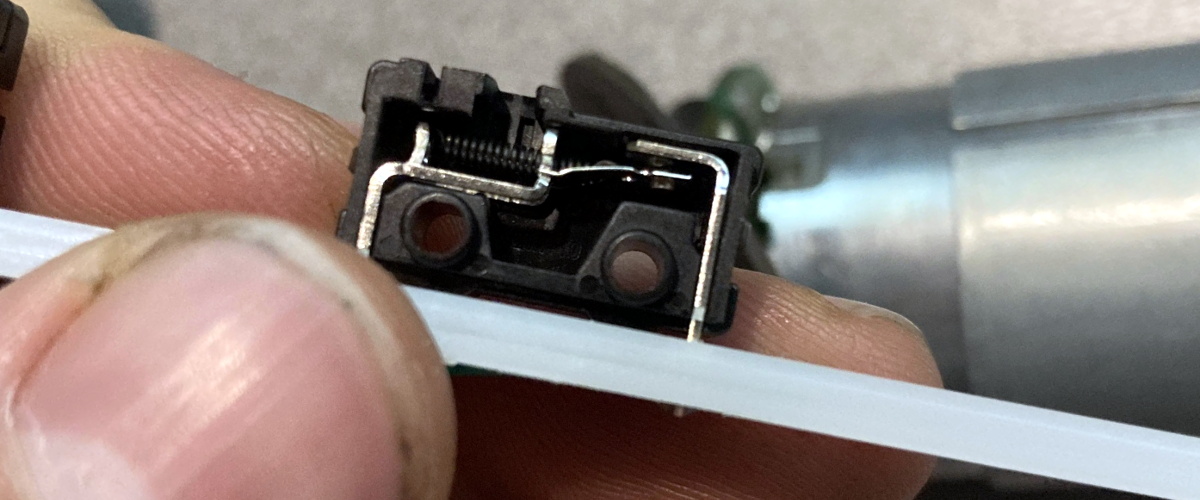
What happened is this: the TV appeared to stop working, but one could still make out screen content while shining a bright light on the screen. Seeing this, [Tweepy] deduced that the backlight had failed, and opened up the device to see if it could be repaired. However, the reason for the backlight failure was a surprise. It was not the power supply, nor even any of the LEDs themselves; the whole backlight wouldn’t turn on because of a cheap little PCB-to-PCB connector, and the two small spring contacts inside that had failed.
The failed connector, once cut open, showed contacts in poor condition (click to enlarge). It was ditched for a soldered connection, and the TV lived again.
From the outside things looked okay, but wiggling the connector made the backlight turn on and off, so the connection was clearly bad. Investigating further, [Tweepy] saw that the contact points of the PCBs and the two little conductors inside the connector showed clear signs of arcing and oxidation, leading to a poor connection that eventually failed, resulting in a useless TV. The fix wasn’t to clean the contacts; the correct fix was to replace the connector with a soldered connection.
Using that cheap little connector doubtlessly saved some assembly time at the factory, but it also led to failure within a fairly short amount of time. Had [Tweepy] not been handy with a screwdriver (or not bothered to investigate) the otherwise working TV would doubtlessly have ended up in a landfill.
It serves as a good reminder to make some time to investigate failures of appliances, even if one’s repair skills are limited, because the problem might be a simple one. Planned obsolescence is a tempting doorstep upon which to dump failures like this, but a good case can be made that planned obsolescence isn’t really a thing, even if manufacturers compromising products in one way or another certainly is.
A few months ago, I fell down the internet rabbit hole known as Ted Munk’s typewriter site. I don’t remember if I just saw this Brother EP43 typewriter for sale and searched for information about them, or went looking for one after reading about them. Either way, the result is the same — I gained a typewriter.
Now I’m not really a typewriter collector or anything, and this is my first word processor typewriter. When it arrived from Goodwill, I anxiously popped four ‘C’ cells in and hoped for the best. It made a print head noise, so that was a good sign. But almost immediately after that, there was a BANG! and then a puff of smoke wafted out from the innards. My tiny typewriter was toast. Continue reading “Clacker Hacker: Popping A Cap In A Brother EP43 Thermal Typewriter”→