MULTICS Gets A New Release… 52 Years After Launch

If you have ever read anything about the history of UNIX, you may remember that its early development was influenced by an older operating system. MULTICS was developed in the 1960s by MIT and General Electric as a commercial operating system, and had been the system which UNIX writers [Thompson] and [Ritchie] had used. It became a Honeywell product, and the source code for its final commercial version was eventually released to the public. Has it become a dusty relic of interest only to historians? Seemingly not, because a new version has been released. It’s intended for us on the dps8m Honeywell mainframe simulator rather than physical hardware, so perhaps while it’s not such a dusty relic it remains something only for the enthusiast.

We won’t pretend to be experts on the architectures of 1960s mainframe operating systems, but it’s interesting to read for a moment about what it was in MULTICS that caused UNIX to be written. For something described by [Ken Thompson] as “Close to unusable”, with a fresh release in its 52nd year it isn’t doing badly.

We’ve traced the UNIX story in the past, without realising that MULTICS never entirely went away. Shame on us for the omission!

[Via Hacker News]

Retro Computers From Paper

Want to start your own collection of retro computers, for free? Well graphic designer [Rocky Bergen]’s collection of paper craft models might be the answer. [Rocky] has designed over a dozen models of old computers, including classics such as the IMSAI 8080, Commodore Pet, and the BBC Microcomputer to name just a few.

The completed size of these models isn’t mentioned, but inspecting the PDF file of a randomly selected Commodore C64 model shows it was intended to be printed on A3 paper ( 297 x 420 mm, or roughly the size of an 11 x 17 ANSI C page if you think better in inches ). That still doesn’t give us the finished size of a model, but one collector posted on [Rocky]’s site that when he scaled it to A4 paper, the resulting computer was a perfect match for use with common 1/6 scale dolls and dollhouses (also known as playscale). Of course, the pattern existing as a computer PDF file, you can scale it to any size you want.

We’ve covered a few paper craft projects in the past, including these cool automata, a claw from a crane game, and even a gyroscope that really spins. Check out the video below the break to see [Rocky] assembling the Apple II paper craft model. Thanks to [CollegeCop] for sending this into our tip line.

Continue reading “Retro Computers From Paper”

Raspberry Pi Pico Used As A Transputer

You can’t fake that feeling when a $4 microcontroller dev board can stand in as cutting-edge 1980s technology. Such is the case with the working transputer that [Amen] has built using a Raspberry Pi Pico.

For a thorough overview of the transputer you should check out [Jenny List’s] longer article on the topic but boiled down we’re talking about a chip architecture mostly forgotten in time. Targetting parallel computing, each transputer chip has four serial communication links for connecting to other transputers. [Amen] has wanted to play with the architecture since its inception. It was expensive back then and today, finding multiple transputers is both difficult and costly. However, the RP2040 chip found on the Raspberry Pi Pico struck him as the perfect way to emulate the transputer design.

The RP2040 chip on the Pico board has two programmable input/output blocks (PIOs), each with four state machines in them. That matches up perfectly with the four transputer links (each is bi-directional so you need eight state machines). Furthermore, the link speed is spec’d at 10 MHz which is well within the Pico’s capabilities, and since the RP2040 runs at 133 MHz, it’s conceivable that an emulated core can get close to the 20 MHz top speed of the original transputers.

Bringing up the hardware has been a success. To see what’s actually going on, [Amen] sourced some link adapter chips (IMSC011), interfacing them through an Arduino Mega to a computer to use the keyboard and display. The transputer architecture allows code to be loaded via a ROM, or through the links. The latter is what’s running now. Future plans are to figure out a better system to compile code, as right now the only way is by running the original INMOS compiler on DOS in a VM.

Listen to [Amen] explain the project in the first of a (so far) six video series. You can find the links to the rest of those videos on his YouTube channel.

Continue reading “Raspberry Pi Pico Used As A Transputer”

EXPS/2 Keyboard Adapter Translates PS/2 And USB To MSX

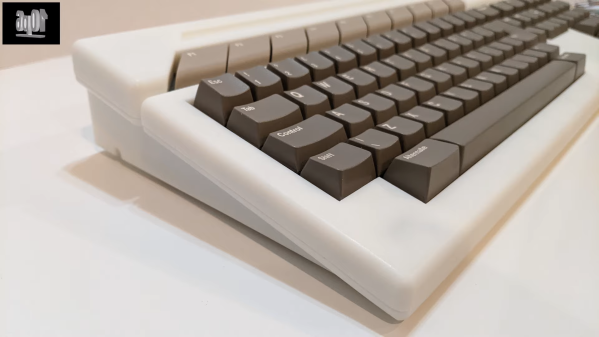
Say what you will about suitcase computers, but at least most of them still have their keyboards with them. [danjovic] has this vintage Brazilian computer from the 1980s called a Gradiente Expert. These were MSX machines with Z80 chips that ran BASIC, DOS, and CP/M, and they looked like state-of-the-art dual-deck stereo systems. You can still find them pretty easily, but sadly, most of them have lost their rad mechanical keyboard with its giant arrow keys and proprietary connector.

If you now want to get one of these awesome pieces of computing history and would like to be able to talk to it, [danjovic] has you covered with the open-source EXPS/2 keyboard adapter. It will allow you to connect either a PS/2 keyboard or a USB keyboard in fallback mode to the Expert using an ATMega328P and a bespoke DIN-13 to DB-13 cable. As it turns out, there’s a wealth of information on MSX keyboard matrices out there.

How much do you know about the USB keyboard interface? If you want a warehouse of information delivered to your brain in the most pleasant way possible, go watch [Ben Eater] break it down with pen and paper.

Apollo DSKY Display Glows Again

We love seeing old technology brought back to life, especially when it’s done in the context of how the device was originally intended to be used. And double points when it’s space gear, like what [Curious Marc] and his usual merry band of cohorts did when they managed to light up a couple of real Apollo DSKY displays.

The “Display and Keyboard” formed the human interface to the Apollo Guidance Computer, the purpose-built machine that allowed Apollo missions to fly to the Moon, land safely, and return to Earth. Complete DSKYs are hard to come by, but a lucky collector named [Marcel] was able to score a pair of the electroluminescent panels, one a prototype and one a flight-qualified spare. He turned them over to AGC guru [Carl Claunch], who worked out all the details of getting the display working again —  a non-trivial task with a device that needs 250 volts at 800 Hertz.

The first third of the video below mostly concerns the backstory of the DSKY displays and the historical aspects of the artifacts; skip to around the 12:30 mark to get into the technical details, including the surprising use of relays to drive the segments of the display. It makes sense once you realize that mid-60s transistors weren’t up to the task, and it must have made the Apollo spacecraft a wonderfully clicky place. We were also intrigued by the clever way the total relay count was kept to a minimum, by realizing that not every combination of segments was valid for each seven-segment display.

The video has a couple of cameos, like [Ben Krasnow], no slouch himself when it comes to electroluminescent displays and DSKY replicas. We also get a glimpse of well-known component slicer and MOnSter 6502-tamer [TubeTime] too. Continue reading “Apollo DSKY Display Glows Again”

Build A Barebones 68000

The 68000 chip was ubiquitous in the computing world well past its heyday in the 1980s. It was used as the basis for many PCs and video game consoles, and even in embedded microcontrollers. Now, one of its niche applications is learning about the internal functions of computers. 68000 builds are fairly common when building homebrew computers from scratch, but projects like these can be complicated and quickly get out of hand. This 68000 project, on the other hand, gets the job done with the absolute minimum of parts and really dives into the assembly language programming on these chips. (Google Translate from Spanish)

[osbox68] built this computer by first simulating its operation. Once he was satisfied with that, the next step was to actually build the device. Along with the MC68008 it only uses two other TTL chips, a respectable 32 kilobytes of ram, and additionally supports a serial port and an expansion bus. A few 74-series chips round out the build including a 74HC574 used for debugging support. With a custom PCB to tie everything together, it’s one of the most minimal 68000 builds we’ve seen that still includes everything needed to be completely functional.

After all, including the TTL and 74XX chips the entire circuit board only uses 10 integrated circuits and a few other passive elements for a completely functional retro computer. [osbox68] also includes complete schematics for building a PCB based on these chips to make construction that much easier. Of course, emulating an old microcontroller instead of using TTL components can save a lot of real estate on a PCB especially if you’re using something like an FPGA.

Fresh Paint Or Patina Of Ages, That’s The Antique Question

The world of antique furniture and the world of hackers rarely coincide, and perhaps the allure of the latest tech is greater for most of us than that of a Chipendale cabinet. But there are times when there are analagous situations in both worlds, so it’s worth taking a moment to consider something.

This late-17th-century dressing box would not be of such value or interest were a restoration to strip it of its patina. Daderot, CC0.

Antique furniture has survived for hundreds of years before being owned by today’s collectors. Along the way it picks up bumps and scrapes, wear, and even the occasional repair. Valuable pieces turn up all the time, having been discovered in dusty attics, cowsheds, basements, and all sorts of places where they may have been misused in ways that might horrify those who later pay big money for them. Thus there is a whole industry of craft workers in the field of furniture restoration whose speciality lies in turning the wreck of a piece of furniture into a valuable antique for the showroom.

The parallel in our community if you hadn’t already guessed, can be found in the world of retrocomputers. They are the antiques we prize, they come to us after being abused by kids and then left to languish in a box of junk somewhere. Their capacitors are leaking, their cases may be cracked or dirty, and they often possess the signature look of old ABS mouldings, their characteristic yellowing. This is caused by the gradual release of small quantities of bromine as the fire retardant contained within the plastic degrades under UV light, and causes considerable consternation among some retrocomputing enthusiasts. Considerable effort goes into mitigating it, with the favourite technique involving so-called Retr0bright recipes that use hydrogen peroxide to bleach away the colour.

Continue reading “Fresh Paint Or Patina Of Ages, That’s The Antique Question”