Cynus Chess Robot: A Chess Board With A Robotic Arm

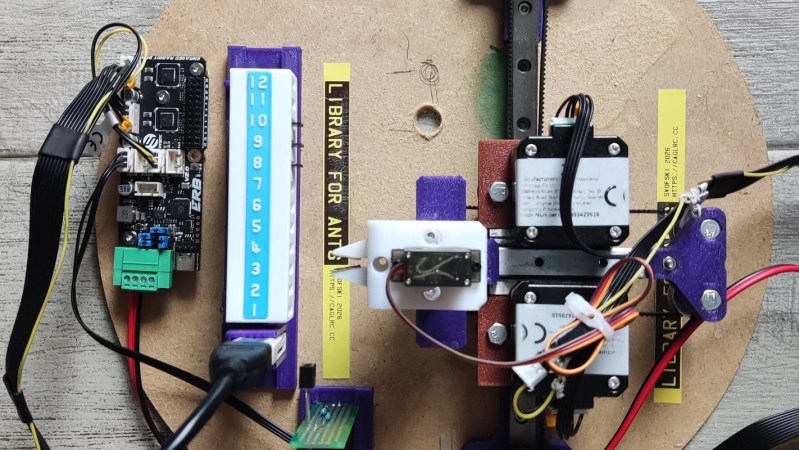
Downward-facing camera and microphone in the arm. (Credit: Techmoan, YouTube)

There are many chess robots, most of which require the human player to move the opposing pieces themselves, or have a built-in mechanism that can slide the opposing pieces around to their new location. Ideally, such a chess robot would move the pieces just like how a human would, of course. That’s pretty much the promise behind the Manya Cynus chess robot, which [Matt] over at the Techmoan YouTube channel bought from the Kickstarter campaign.

Advertising itself as a ‘Portable AI Chess Robot’, the Manya Cynus chess robot comes in the form of a case that unfolds into a chess board and also contains the robotic arm that contains the guts of the operation. Powered by the open source Stockfish chess engine, it can play games against a human opponent at a few difficulty levels without requiring any online connectivity or a companion app. It moves its own pieces by picking up the metal-cored chess pieces with its arm, while its front display tries to display basic emotions with animated eyes. A 3-MP downward-facing camera is located on the head section, along with a microphone.

As for how well it works, [Matt] isn’t the best chess player, but he had a fair bit of fun with the machine. His major complaints circle around how unfinished the firmware still feels, with e.g., invalid moves basically ignored with only a barely visible warning popping up on the screen. In general, he’d rather classify it as an interesting development kit for a chess robot, which is where the BLE 5.1-based interface and a purported Python-based development environment provided by Manya seem to come into focus.

Continue reading “Cynus Chess Robot: A Chess Board With A Robotic Arm”

Fish Drives Tank

Fish are popular animals to keep as pets, and for good reason. They’re relatively low maintenance, relaxing to watch, and have a high aesthetic appeal. But for all their upsides, they aren’t quite as companionable as a dog or a cat. Although some fish can do limited walking or flying, these aren’t generally kept as pets and would still need considerable help navigating the terrestrial world. To that end, [Everything is Hacked] built a fish tank that allows his fish to move around on their own. We presume he’s heard the old joke about two fish in a tank. One says, “Do you know how to drive this thing?”

The first prototype of this “fish tank” is actually built on a tracked vehicle with differential steering, on which the fish tank would sit. But after building a basic, driveable machine, the realities of fish ownership set in. The fish with the smallest tank needs is a betta fish, but even that sort of fish needs much more space than would easily fit on a robotics platform. So [Everything is Hacked] set up a complete ecosystem for his new pet, making the passenger vehicle a secondary tank.

The new fish’s name is [Carrot], named after the carrots that [Everything is Hacked] used to test the computer vision system that would track the fish’s movements and use them to control the mobile fish tank. There was some configuration needed to ensure that when this feisty fish swam in circles, the tank didn’t spin around uncontrollably, but eventually he was able to get it working in an “arena” where [Carrot] could drive towards some favorite items he might like to interact with. Mostly, though, he drove his tank to investigate the other fish in the area.

The ultimate goal was for [Everything is Hacked] to take his fish on a walk, though, so he set about training [Carrot] to respond to visual cues and swim towards them. In theory, this would have allowed him to be followed by his fish tank, but a test at a local grocery did not go as smoothly as hoped. Still, it’s an interesting project that pushes the boundaries of pet ownership much like other fish-driving projects we’ve seen.

Continue reading “Fish Drives Tank”

Evolved Nerf RC Tank Now Leaves Welts

[Joshua Clay] recently unveiled his newest RC Nerf Dart Robot and talks through his design choices, pointing out that in his aim to have it launch darts fast and hard he may have somewhat overshot the mark. He found out first hand during testing that it shoots hard enough to leave welts through a sweatshirt and probably should be downgraded a bit. Thankfully, one of the features of his new unit is a highly modular design that makes iterating easier than ever.

A modular, glue-free assembly that leaves wiring accessible helps make design iterations faster and easier.

This model is an evolution of his first Nerfbot, and the new one is a smaller, tighter design that trades a wheeled base for a tracked one, among other changes.

The tank platform is one example of [Joshua] using affordable, off-the-shelf solutions where it makes sense to do so. For example, the inexpensive tank-track platform means he can focus on the rest of the bot without having to design or make his own tank treads. Similarly, to control the bot he opts for a PlayStation 4 controller, paired to the bot over Bluetooth. It’s high quality, inexpensive, commonly available, and easily interfaced with the RP2040 that runs the show.

[Joshua] aims for a modular, LEGO-inspired mechanical assembly that makes maintenance, wiring, and iteration as easy as possible. We especially like how the battery, wiring, and things like gears for the pan-and-tilt mechanism of the Nerf launcher are easily accessible.

The dart launcher uses two flywheels to grip and propel each dart fed from a high-capacity magazine, and you can watch it move and shoot around the 9:44 mark in the video, embedded below. It’s plenty loud, but the camera is barely able to register darts leaving the barrel.

If you like the looks of [Joshua]’s newest Nerfbot, keep an eye out because he’s got more to share about it and is considering other features like a camera. In the meantime, there are a few more photos on his website.

Continue reading “Evolved Nerf RC Tank Now Leaves Welts”

Let Hauntimator Steer Your Next Animatronic Display

Animatronic displays aren’t just for Halloween, and hackers today have incredible access to effective, affordable parts with which to make spectacles of light, sound, and movement. But the hardware is only half the battle. Getting everything synchronized properly can be a daunting task, so get a head start on your next holiday display with the Hauntimator by [1031-Systems].

Synchronizing control channels to audio is at the heart of solid animations.

After all, synchronizing movements, sound, and light by trial and error can get tiresome even in small setups. Anyone who makes such a display — and contemplates doing it twice — tends to quickly look into making things modular.

At its heart, Hauntimator works with a Raspberry Pi Pico-based controller board. The GUI makes it easy to create control channels for different hardware (for example, doing things like moving servos) and synchronize them to audio. Once an animation is validated, it gets uploaded to the control board where it runs itself. It’s open-source and designed to make plugins easy, so give it a look. There’s a video channel with some demonstrations of the tools that should fill in any blanks.

Intrigued by animatronics, but not sure where to begin? Get inspired by checking out this DIY set of servo-driven eyes, and see for yourself the benefits of smooth motor control for generating lifelike motion.

Robot Looks Exactly Like A Roll Of Filament, If Filament Had Eyes

[Matt Denton]’s SpoolBot is a surprisingly agile remote-controlled robot that doesn’t just repurpose filament spool leftovers. It looks exactly like a 2 kg spool of filament; that’s real filament wound around the outside of the drum. In fact, Spoolie the SpoolBot looks so much like the real thing that [Matt] designed a googly-eye add-on, because the robot is so easily misplaced.

The robot’s mass rotates around a central hub in order to move forward or back.

SpoolBot works by rotating its mass around the central hub, which causes it to roll forward or back. Steering is accomplished by tank-style turning of the independent spool ends. While conceptually simple, quite a bit of work is necessary to ensure SpoolBot rolls true, and doesn’t loop itself around inside the shell during maneuvers. Doing that means sensors, and software work.

To that end, a couple of rotary encoders complement the gearmotors and an IMU takes care of overall positional sensing while an ESP32 runs the show. The power supply uses NiMH battery packs, in part for their added weight. Since SpoolBot works by shifting its internal mass, heavier batteries are more effective.

The receiver is a standard RC PWM receiver which means any RC transmitter can be used, but [Matt] shows off a slick one-handed model that not only works well with SpoolBot but tucks neatly into the middle of the spool for storage. Just in case SpoolBot was not hard enough to spot among other filament rolls, we imagine.

The googly-eye add-on solves that, however. They clip to the central hub and so always show “forward” for the robot. They do add quite a bit of personality, as well as a visual indication of the internals’ position relative to the outside.

The GitHub repository and Printables page have all the design files, and the video (embedded just below) shows every piece of the internals.

The kind of hardware available nowadays makes self-balancing devices much more practical and accessible than they ever have been. Really, SpoolBot has quite a lot in common with other self-balancing robots and self-balancing electric vehicles (which are really just larger, ridable self-balancing robots) so there’s plenty of room for experimentation no matter one’s budget or skill level.

Continue reading “Robot Looks Exactly Like A Roll Of Filament, If Filament Had Eyes”

Love Complex Automata? Don’t Miss The Archer

[Oliver Pett] loves creating automata; pieces of art whose physicality and motion come together to deliver something unique. [Oliver] also has a mission, and that mission is to complete the most complex automata he has ever attempted: The Archer. This automaton is a fully articulated figure designed to draw arrows from a quiver, nock them in a bow, draw back, and fire — all with recognizable technique and believable motions. Shoot for the moon, we say!

He’s documenting the process of creating The Archer in a series of videos, the latest of which dives deep into just how intricate and complex of a challenge it truly is as he designs the intricate cams required.

A digital, kinematic twin in Rhino 3D helps [Oliver] to choose key points and determine the cam profiles required to effect them smoothly.
In simple automata rotational movement can be converted by linkages to create the required motions. But for more complicated automata (like the pen-wielding Maillardet Automaton), cams provide a way to turn rotational movement into something much more nuanced. While creating the automaton and designing appropriate joints and actuators is one thing, designing the cams — never mind coordinating them with one another — is quite another. It’s a task that rapidly cascades in complexity, especially in something as intricate as this.

[Oliver] turned to modern CAD software and after making a digital twin of The Archer he’s been using it to mathematically generate the cam paths required to create the desired movements and transitions, instead of relying on trial and error. This also lets him identify potential collisions or other errors before any metal is cut. The cams are aluminum, so the fewer false starts and dead ends, the better!

Not only is The Archer itself a beautiful piece of work-in-progress, seeing an automaton’s movements planned out in this way is a pretty interesting way to tackle the problem. We can’t wait to see the final result.

Thanks [Stephen] for the tip!

A marketing image of a Dash educational robot is shown. It is made of a triangle pyramid of four plastic spheres. Two of the base spheres house wheels, and the top sphere houses a speaker, lights, and sensors.

Reverse Engineering A Dash Robot With Ghidra

One of the joys of browsing secondhand shops is the possibility of finding old, perhaps restorable or hackable, electronics at low prices. Admittedly, they usually seem to be old flat-screen TVs, cheap speakers, and Blu-ray players, but sometimes you find something like the Dash, an educational toy robot. When [Jonathan] came across one of these, he decided to use it as a turtle robot. However, he found the available Python libraries insufficient, and improving on them required some reverse-engineering.

Continue reading “Reverse Engineering A Dash Robot With Ghidra”