The Chernobyl NPP And Forty Years Of Robots For High Radiation Environments

With the massive steam explosion that shredded the #4 RBMK reactor at the Chernobyl Nuclear Power Plant in 1986 it suddenly made robots that could survive a high ionizing radiation environment into the hottest item on the planet. Over the course of forty years many generations of such robots were developed, tested, improved upon or discarded, all to explore and handle hazardous waste throughout the depths of the #4 reactor’s remains.
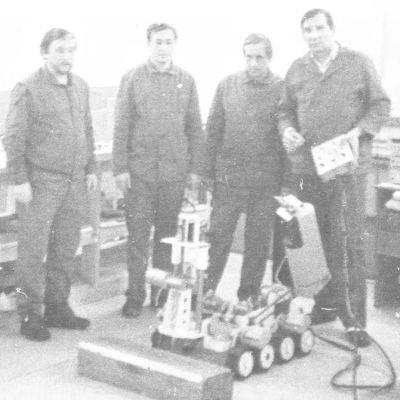
Researchers of the ISP NPP next to one of the TR robots. (Credit: ISP NPP)

Even if the entire development and decisions here would easily fit a couple of feature length movies, the recent documentary by the [Chornobyl Family] provides a solid overview of the engineering challenges, the issues encountered along the way and the forced evolution of initially very basic designs into the robotics that today trundle and wriggle around inside reactor #4, as well as their cousins over at the couple of stricken reactors at Japan’s Fukushima Daiichi power station.

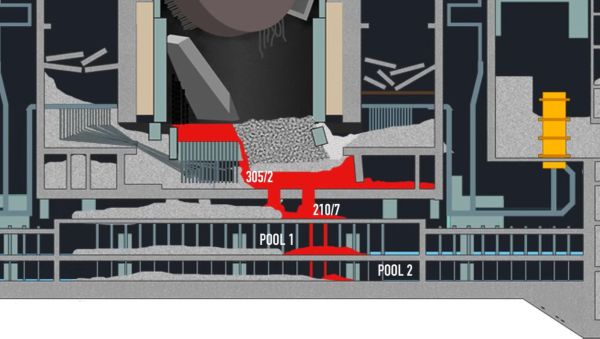
Unlike the other robots developed from 1986 onwards to provide general clean-up of scattered core material outside of the core, these robots had to venture deep inside, where radiation levels were the highest and correspondingly the challenges much more severe. This was such a problem that initially it were humans who did the exploration, as robots proved to be too fragile and too prone to getting stuck.

Until the 1990s exploration of the ruined core was quite limited, also because of a lack of urgency. While the outside clean-up and construction of the sarcophagus had to be done as quickly as possible, the core exploration was more slow and methodical, based around trying to establish its condition, what core material remained inside and try to take samples of interesting objects like the well-known ‘elephant’s foot’.

Continue reading “The Chernobyl NPP And Forty Years Of Robots For High Radiation Environments”
Robotic Screw And Bolt Sorter Seeks A New Challenge

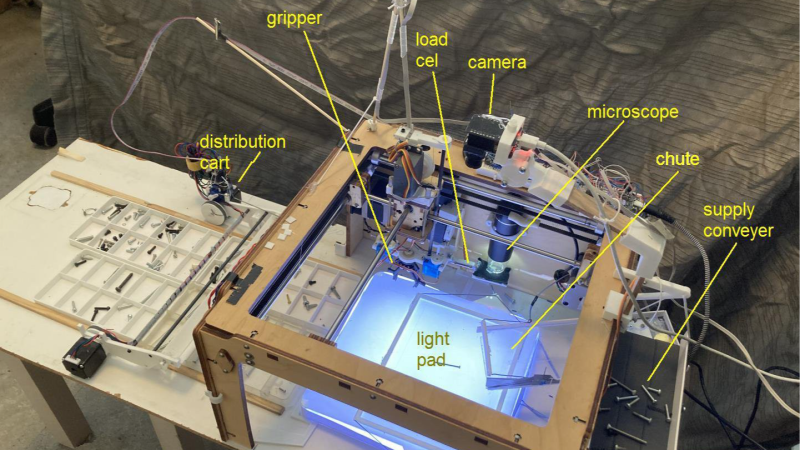
As someone who disassembles and repairs hardware, [Aad] eventually ended up with a huge collection of mixed bolts and screws. This led to creating the automatic bolt and screw sorting system you see here, although in a way it is just a proof of concept. Bolts and screws happen to be a useful application for now, but the system is capable of sorting just about any small objects.

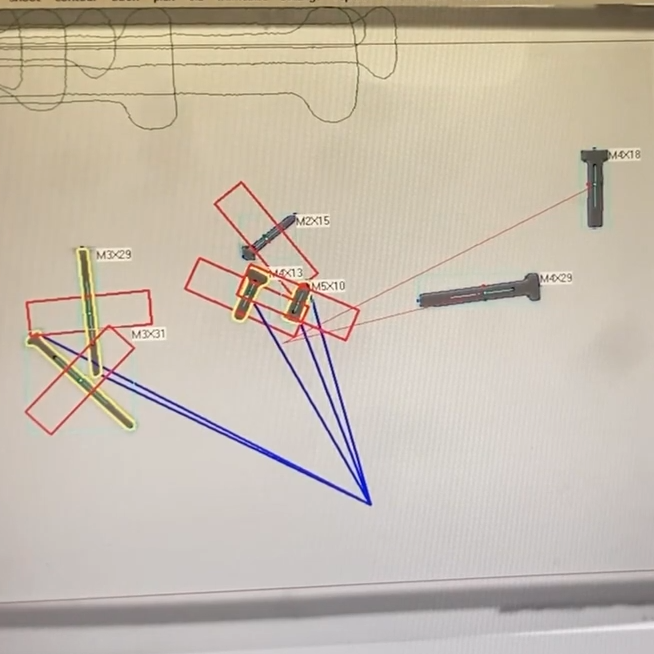
A bit of machine vision detects the size and shape of each object. Weight can also be measured.

Mixed pieces go onto a large conveyor belt, shown on the right. This feeds a few screws at a time down a chute, where they roll onto an illuminated platform.

Above the lit platform is a camera, and machine vision is used to detect the size and shape and orientation of each screw. A robotic gripper on a gantry picks the screws up one by one — separating them first if they happened to clump together — and places each in a drop-off cart. The cart drops the object into a receptacle with its brethren, making sure similar ones are grouped together. Watch it in action in the video, embedded below the page break.

It’s a great build that shows fancy components aren’t necessary for good results. Servos and steppers are controlled with an ESP32-WROOM board, and a piezo sensor detects screws falling off the conveyor. Some of you may have noticed a repurposed Ultimaker 3D printer serving as the bulk of the system, its hot end having been replaced with a gripper that can raise and lower. The overhead camera is an ESP32-CAM adapted to accept M12 lenses so it can focus on the platform.

There’s one more feature worth mentioning — the system also has the ability to measure the weight of a picked object by placing it onto a moveable inspection platform, which can optionally put it under a USB microscope for a closer look. Everything is controlled by a nearby PC, so there’s a lot of flexibility built into the system.

We suppose that once all the screws and bolts in a shop are sorted, it only makes sense to sort all the nuts. Are there other objects besides screws and bolts that would be useful to sort with a system like this? If you have any ideas, don’t keep them to yourself! [Aad] would love to hear your comments and ideas, so share them below.

Continue reading “Robotic Screw And Bolt Sorter Seeks A New Challenge”

Chernobyl’s Robots, Or The Hackathon From Hell

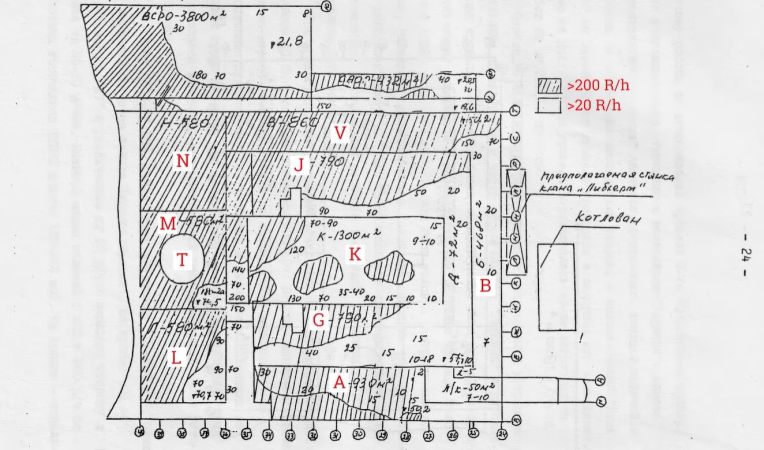
When the Chernobyl Nuclear Power Plant’s #4 reactor experienced an extreme criticality event on that infamous day in 1986, the resulting steam explosion and lack of any kind of containment building meant that parts of the core were scattered throughout the site. In an extensive update to the original 2023 video, the [Chornobyl Family] covers the mad scramble to design robots to perform on-the-ground measurements, and ultimately remove all this debris for safe disposal.

The TR-1A, an early debris removal robot. (Source: Chornobyl Family, YouTube)

This essentially took the form of a hackathon, involving teams from all over the USSR and allied nations, creating the most diverse range of robots that 1980s Soviet technology and later Western technology could muster.

Many of these robots didn’t perform very well, or at all, mostly due to the bypassing of any kind of testing before deployment. Especially at the beginning of the clean-up the robots were being pushed into the high-radiation zones as soon as they were finished, with not only mechanical issues being a problem, but also with e.g. inaccurate radiation measurements by the RR-1 robot, that overstated measurements by more than a factor of ten. Meanwhile the RR-2 and RR-3 were too top-heavy and after deployment by helicopter simply tipped over. Eventually manual measurements proved to be faster and safer.

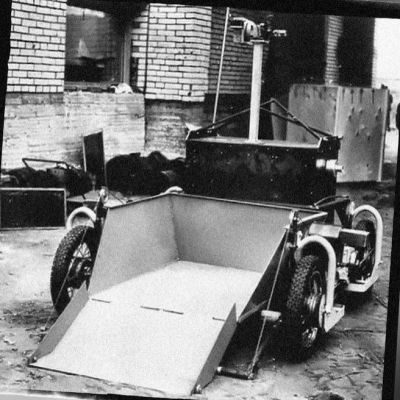
Early debris removal robots like the TR-1A were rather simplistic, with successive generations of robots over the next weeks and months improving on it. The use of a combustion engine instead of batteries provided to be a boon, as combustion engines are far less affected by radiation.

The BAER Beloyarets used an airport cart as the basis, with its electronics relying on vacuum tube technology and relays, with an internal combustion engine. This proved to be one of the most reliable designs and it’s been largely preserved on display in the Chornobyl Exclusion Zone, with many others of these robots also being on display around the nuclear plant or in the city of Chornobyl.

Overall an absolutely dizzying number of robotic designs were invented on the spot, adapted from existing designs or repurposed for operation in a high-radiation zone. Eventually bulldozer designs like the STR-1 helped to push radioactive debris off the roofs into containers, massively reducing the radioactive contamination of the area.

The fact that following #4’s RUD the other three RBMK units were able to keep operating safely without risks to its operators, and with the zone now safe for tourists, is a real testament to the success of the worst hackathon imaginable. Many of the lessons learned are relevant today, including during the decommissioning of Fukushima Daiichi’s melted-down cores.

Continue reading “Chernobyl’s Robots, Or The Hackathon From Hell”

A 3D Printed Cycloidal Gearbox

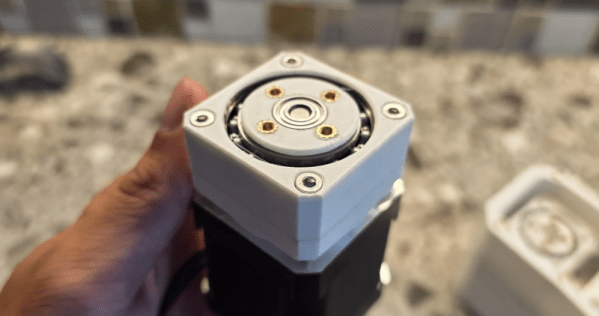
Stepper motors are undeniably useful, but sometimes they need a bit of gearing to help perform their task. [Gjhudson2008] has a compact gearbox for NEMA 17 or 23 steppers that is mostly 3D printed. How compact? The gearbox, named VANTIX, is exactly the height of a standard NEMA 17 axle.

However, for it to be that thin, your stepper has to have the D-bore on the shaft go all the way down. Some steppers leave a shank uncut at the base, and that won’t work for VANTIX.

The recommendation is to print in ABS with a 0.2 mm nozzle for certain parts to help improve tolerance. Most of the assembly is either press fit or installed during the printing process. Some parts of the gearbox are better to print with a larger nozzle, too.

There are some heat-set inserts and, of course, you’ll need lube to keep everything moving smoothly. There are a few top plates you can print to fit various mounting scenarios.

We have seen a number of similar designs. We’ve also looked at some e-bike-inspired drives.

Stewart Platform Walker Gains Feeling In Legs From Resistors

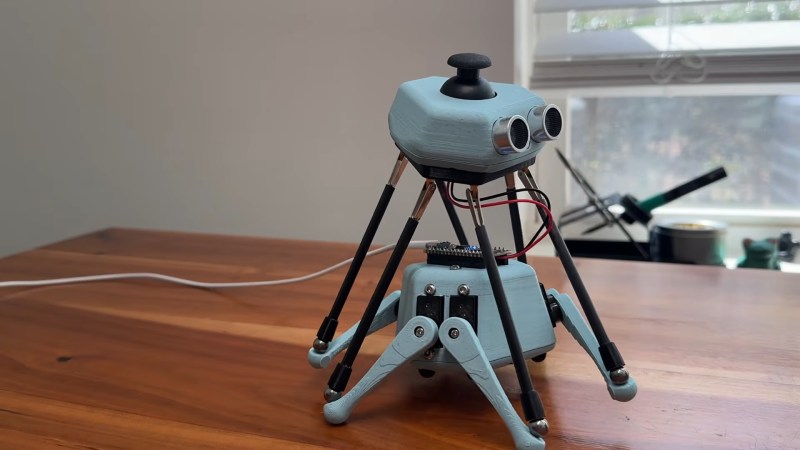
Stewy is a very interesting robot, with some slightly odd kinematics. Its head is a Stewart platform, which is a common-enough 6-DOF actuated plate normally used with a fixed base. By connecting legs to the same servos running the Stewart platform, [JD] turned it into an adorable hexapod walker. The walker had a problem, though: it can’t feel its feet, and [JD] thinks that would make it much more mobile on uneven surfaces. So he got some resistors to turn the cheap servos in its legs into force-sensing actuators.

Well, almost. He’s not actually putting strain gauges or anything like that into the legs; he’s just measuring the voltage drop across a resistor in series with the servos. Since the motors draw more current the more torque they’re putting out, he has a very quick and easy way to sense the current and thus the torque using good old Ohm’s law and an analog input on the microcontroller driving the robot. It’s a simple hack, but the data he’s getting is surprisingly good for how much work it is to add to a robot, as you can see in the video — at least once he slowed down the servos a touch.

Perhaps this isn’t a ground-breaking innovation, but [JD] does a very good idea explaining it. Of course if you want to use resistors to sense force directly, force-sensitive resistors are a thing that we’ve seen in everything from Twister-mat MIDI controllers to self-leveling 3D printers.

Continue reading “Stewart Platform Walker Gains Feeling In Legs From Resistors”

Tiny Desktop Robot Has Radar

One thing our futuristic world is largely lacking in is droids and robot companions and the like. [solitary dev] is helping to rectify that problem by building a little robot called TongDou.

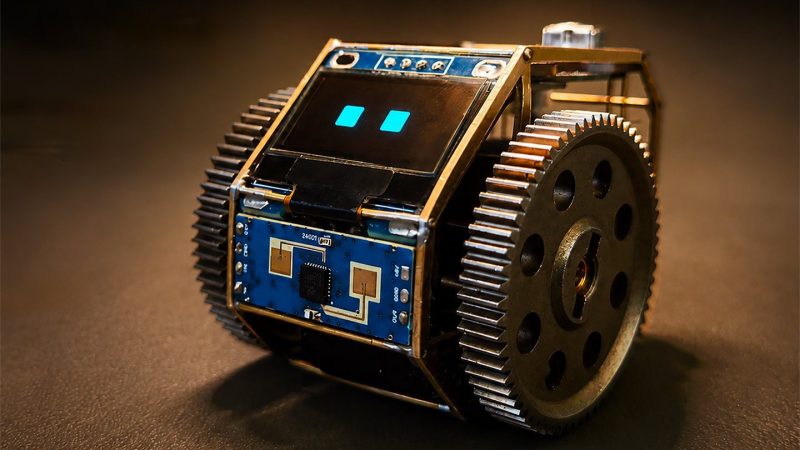
As [solitary dev] tells it, TongDou is a “tiny open-source desktop gremlin.” An ESP32-S3 serves as TongDou’s brain, buried inside a tasteful brass chassis. An OLED display is TongDou’s face, and he uses a pair of wheels driven by gearmotors for locomotion. A speaker plays back pre-recorded voice lines, while a 24 GHz radar and an IMU enables TongDou to keep track of the space it’s moving through. They are publishing the design files on GitHub so other makers can build their own if so desired.

[solitary dev] hopes to develop TongDou into something to make a “workspace feel less dead.” It’s not dissimilar from the way studios used to use robots to liven up otherwise hackneyed movies and TV shows, and we could absolutely use some of that whimsy in the real world. We’ve featured other fun desktop companions before, too.

Continue reading “Tiny Desktop Robot Has Radar”

Custom Beach Robot Handles The Hard Work

A day at the beach can involve hauling a surprising amount of gear, from coolers, towels, blankets, chairs, and umbrellas, and if children are involved the amount of beach stuff needed seems to go nonlinear very quickly. Some turn to beach carts with large, low-pressure pneumatic tires, but even that seemed like too much work for [John] who built this remote controlled cart for his summertime needs.

The cart is based around an old cargo rack from an e-bike. To mount all of the robotic components, a sheet of plywood was cut and attached to the underside. Two motors are used to drive the rear wheels independently, allowing for differential steering rather than adding the complexity of a steering system. Some safety features are built in to this design as well, including lights for night driving, a start button controlling a relay for the motors and electronics, and a time-of-flight sensor to stop the robot if it encounters an obstacle.

The ESP32 at the center of the build ties all of the electronics together, and a smartphone app lets the user remotely pilot the rover. It’s not autonomous (yet) but a fair alternative to dragging all of one’s beach gear through the sand without any assistance. You could also minimize your excursions through the sand by timing your visits at high tide, but [John] is out on the Great Lakes so this may be of marginal utility here.

Continue reading “Custom Beach Robot Handles The Hard Work”