New Silicon Carbide Semiconductors Bring EV Efficiency Gains

After spending much of the 20th century languishing in development hell, electric cars have finally hit the roads in a big way. Automakers are working feverishly to improve range and recharge times to make vehicles more palatable to consumers.

With a strong base of sales and increased uncertainty about the future of fossil fuels, improvements are happening at a rapid pace. Oftentimes, change is gradual, but every so often, a brand new technology promises to bring a step change in performance. Silicon carbide (SiC) semiconductors are just such a technology, and have already begun to revolutionise the industry.

Mind The Bandgap
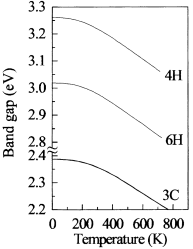
A graph showing the relationship between band gap and temperature for various phases of Silicon Carbide.

Traditionally, electric vehicles have relied on silicon power transistors in their construction. Having long been the most popular semiconductor material, new technological advances have opened it up to competition. Different semiconductor materials have varying properties that make them better suited for various applications, with silicon carbide being particularly attractive for high-power applications. It all comes down to the bandgap.

Electrons in a semiconductor can sit in one of two energy bands – the valence band, or the conducting band. To jump from the valence band to the conducting band, the electron needs to reach the energy level of the conducting band, jumping the band gap where no electrons can exist. In silicon, the bandgap is around 1-1.5 electron volts (eV), while in silicon carbide, the band gap of the material is on the order of 2.3-3.3 eV. This higher band gap makes the breakdown voltage of silicon carbide parts far higher, as a far stronger electric field is required to overcome the gap. Many contemporary electric cars operate with 400 V batteries, with Porsche equipping their Taycan with an 800 V system. The naturally high breakdown voltage of silicon carbide makes it highly suited to work in these applications.

Continue reading “New Silicon Carbide Semiconductors Bring EV Efficiency Gains”
Texas Tesla Tower Titillates

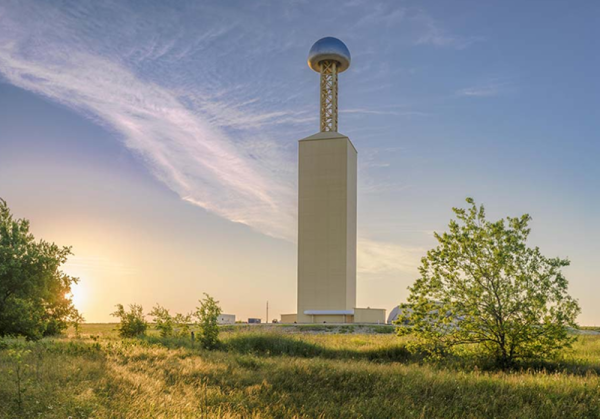
One of the nice things about a road trip is you often get to see something that really surprises you. A recent trip through Texas may have resulted in my second most surprising sighting. There’s a strange tower that looks oddly like a Tesla tower in the middle of rural Texas, right off the main interstate. What is it? Although Google did answer the question — sort of — I’m still not sure how legitimate its stated purpose is.

First Sighting

I was driving between Wimberly and Frisco — two towns that aren’t exactly household names outside of Texas. Near Milford, there’s a very tall structure that looks like a giant mechanical mushroom on top of a grain silo. If the mushroom were inverted or pointing towards the horizon, it would be easy to imagine it was some very odd antenna. This dish, however, is pointed right down its own odd-shaped mast. The top of the thing sure looks like the top of a Van de Graf generator.

Continue reading “Texas Tesla Tower Titillates”

Starlink Satellites Posing Issues For Astronomers

Spotting satellites from the ground is a popular pastime among amateur astronomers. Typically, the ISS and Iridium satellites have been common sightings, with their orbits and design causing them to appear sufficiently bright in the sky. More recently, SpaceX’s mass launches of Starlink satellites have been drawing attention for the wrong reasons.

A capture from the Cerro Telolo observatory, showing the many Starlink satellite tracks spoiling the exposure.

Starlink is a project run by SpaceX to provide internet via satellite, using a variety of techniques to keep latency down and bandwidth high. There’s talk of inter-satellite laser communications, autonomous obstacle avoidance, and special designs to limit the amount of space junk created. We’ve covered the technology in a comprehensive post earlier this year.

The Starlink craft have long worried astronomers, who rely on a dark and unobstructed view of the sky to carry out their work. There are now large numbers of the satellites in relatively low orbits, and the craft have a high albedo, meaning they reflect a significant amount of the sunlight that hits them. With the craft also launching in a closely-packed train formation, there have already been impacts on research operations.

There is some hope that as the craft move to higher orbits when they enter service, this problem will be reduced. SpaceX are also reportedly considering modifications to the design to reduce albedo, helping to keep the astronomy community onside. Regardless, with plans on the table to launch anywhere from 12,000 to 42,000 satellites, it’s likely this isn’t the last we’ll hear about the issue.

Behold A 3D Display, Thanks To A Speeding Foam Ball

We’ve seen 3D image projection tried in a variety of different ways, but this is a new one to us. This volumetric display by Interact Lab of the University of Sussex creates a 3D image by projecting light onto a tiny foam ball, which zips around in the air fast enough to create a persistence of vision effect. (Video, embedded below.) How is this achieved? With a large array of ultrasonic transducers, performing what researchers call ‘acoustic trapping’.
This is the same principle behind acoustic levitation devices which demonstrate how lightweight objects (like tiny polystyrene foam balls) can be made to defy gravity. But this 3D display is capable of not only moving the object in 3D space, but doing so at a high enough speed and with enough control to produce a persistence of vision effect. The abstract for their (as yet unreleased) paper claims the trapped ball can be moved at speeds of up to several meters per second.

It has a few other tricks up its sleeve, too. The array is capable of simultaneously creating sounds as well as providing a limited form of tactile feedback by letting a user touch areas of high and low air pressure created by the transducers. These areas can’t be the same ones being occupied by the speeding ball, of course, but it’s a neat trick. Check out the video below for a demonstration.
Continue reading “Behold A 3D Display, Thanks To A Speeding Foam Ball”

Peltier Device Experiments

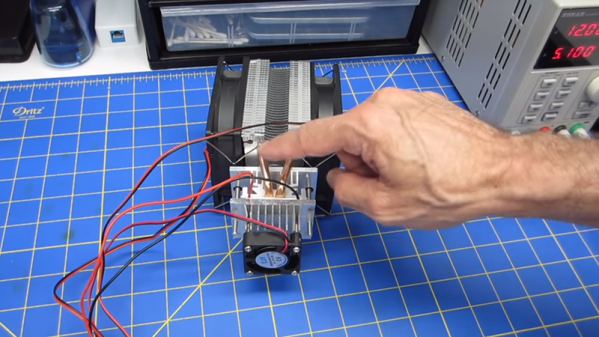
Once an exotic component, solid state heat pumps or Peltier devices are now pretty mainstream. The idea is simple: put electricity through a Peltier device and one side gets hot while the other side gets cold. [DroneBot] recently posted a video showing how these cool — really cool — devices work. You can see the video, below.

Many things in physics are reversible, and the Peltier is no exception. The device is actually a form of thermocouple, and in a thermocouple a temperature difference causes a voltage difference. This is known as the Seebeck effect as opposed to the Peltier effect in which current flowing between voltage differences causes a temperature difference. It was known for many years, but wasn’t very practical until modern semiconductor materials arrived.

Continue reading “Peltier Device Experiments”

An Open Source Toolbox For Studying The Earth

Fully understanding the planet’s complex ecosystem takes data, and lots of it. Unfortunately, the ability to collect detailed environmental data on a large scale with any sort of accuracy has traditionally been something that only the government or well-funded institutions have been capable of. Building and deploying the sensors necessary to cover large areas or remote locations simply wasn’t something the individual could realistically do.

But by leveraging modular hardware and open source software, the FieldKit from [Conservify] hopes to even the scales a bit. With an array of standardized sensors and easy to use software tools for collating and visualizing collected data, the project aims to empower independent environmental monitoring systems that can scale from a handful of nodes up to several hundred.

We’ve all seen more than enough DIY environmental monitoring projects to know there’s nothing particularly new or exciting about stuffing a few cheap sensors into a plastic container. But putting high quality, reliable hardware into large scale production is another thing entirely. Especially when your target user may have limited technical knowledge.

That’s why FieldKit is designed around a common backplane with modular sensors and add-on boards that can be plugged in and easily configured with a smartphone application. Whether the node is going to be mounted to a pole and powered by a solar panel, or attached to a buoy, most of the hardware stays the same.

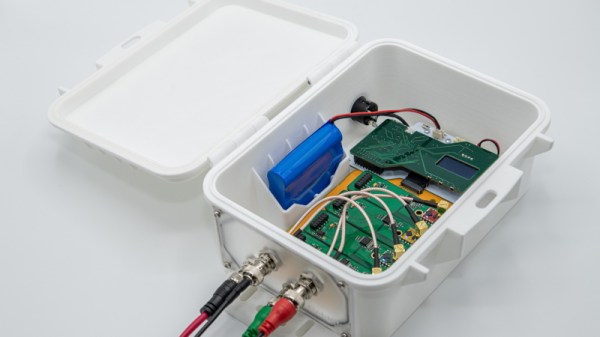
While the electronics and the software interface are naturally the stars of the show here, we can’t help but also be impressed with the enclosure for the FieldKit. It seems a minor thing, but as we’ve seen from the projects that have come our way over the years, finding a box to put your hardware in that’s affordable, adaptable, and weatherproof is often a considerable challenge in itself. Rather than using something commercially available, [Conservify] has designed their own enclosure that’s inspired by the heavy duty (but prohibitively expensive) cases from Pelican. It features a replaceable panel on one side where the user can pop whatever holes will be necessary to wire up their particular project without compromising the case itself; just get a new panel when you want to reconfigure the FieldKit for some other task. Prototypes have already been 3D printed, and the team will be moving to injection molded versions in the near future.

As a finalist in the 2019 Hackaday Prize, FieldKit exemplifies everything we’re looking for this year: a clear forward progression from prototype to final hardware, an obvious need for mass production, and the documentation necessary to show why this project is deserving of the $125,000 grand prize up for grabs.

Continue reading “An Open Source Toolbox For Studying The Earth”

Azobenzene Stores Solar Energy

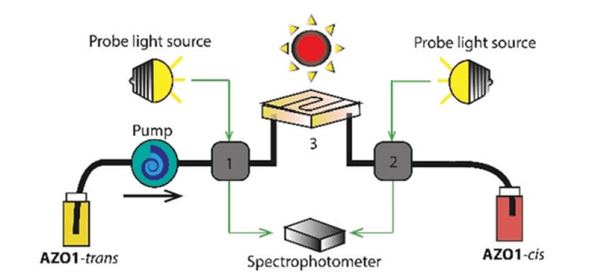
Probably the most efficient way to convert solar energy into electricity is the old fashioned way, heating water into steam and turning a turbine. This remains a messy affair though and you don’t really want a steam boiler on your roof, so solar cells are popular. However, there’s some new research showing how a molecule can absorb solar energy, store it, and then release the heat on demand years later. This could offer new ways to collect and even transport solar power. This new molecule, derived from azobenzene, holds immense promise to change the way we work with solar power.

Continue reading “Azobenzene Stores Solar Energy”