Windows security problems due to insecure drivers is nothing new, but this one is kinda special. Plug in a Razer mouse, tell the install dialog you want to install to a non-standard location, and then shift+right click the Explorer window. Choose a powershell, and boom, you now have a SYSTEM shell. It’s not as impressive as an RCE, and it requires hands-on the machine, but it’s beautiful due to the simplicity of it.
The problem is a compound one. First, Windows 10 and 11 automatically downloads and starts the install of Razer Synapse when a Razer device is plugged in. Note it’s not just Razer, any branded app that auto installs like this is possibly vulnerable in the same way. The installation process runs as system, and because it was started automatically, there is no admin account required. The second half of the issue is that the installer itself doesn’t take any precautions to prevent a user from spawning additional processes. There isn’t an obvious way to prevent the launch of Powershell from within the FolderPicker class, so an installer running as SYSTEM would have to go out of its way to drop privileges, to make this a safe process. The real solution is for Microsoft to say no to GUI installers bundled with WHQL signed drivers. Continue reading “This Week In Security: Through The Mouse Hole, Zoom RCE, And Defeating Defender”→
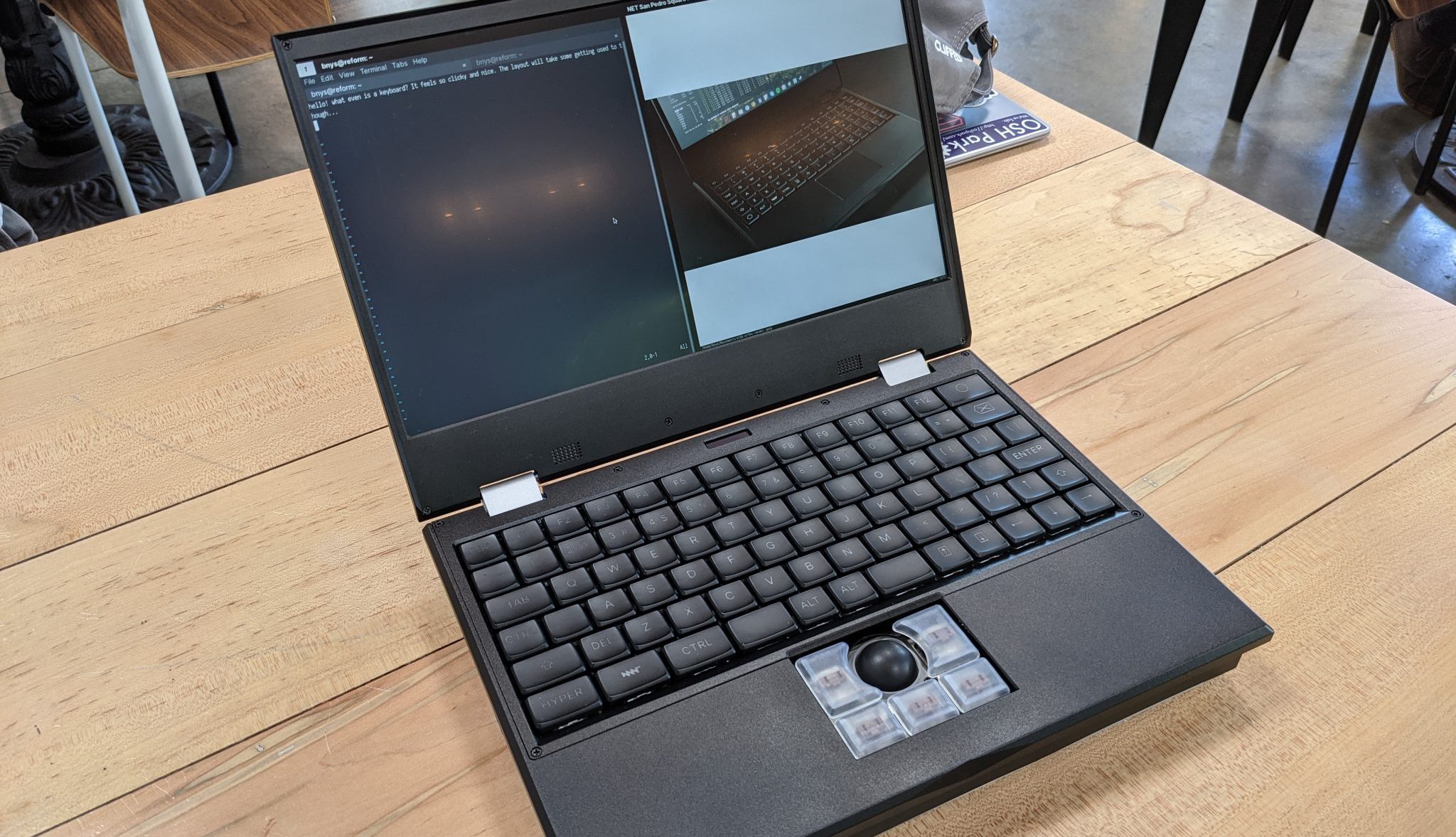
When we met our contact from MNT in the coffee shop, he was quietly working away on his laptop. Jet black and standing thick it was like an encyclopedia that didn’t quite blend in with the sea of silver MacBook lookalikes on the surrounding tables. After going through all the speeds and feeds we eagerly got our 64 piece driver kit out to open it up and see what made this marvel tick, but when the laptop was turned over it became clear that no tools were needed. The entire bottom of the machine was a single rectangle of transparent acrylic revealing everything from sharp white status LEDs on the bare mainboard to individual 18650 LiFePO4 battery cells in a tidy row. In a sense that’s the summary of the entire product: it’s a real laptop you can use to get work done, and every element of it from design to fabrication is completely transparent.
The MNT Reform
The device pictured here is called the Reform and is designed and manufactured by MNT, a company in Berlin, Germany (note MNT stands for MNT, it’s not an acronym). The Reform is a fully open source laptop which is shipping today and available via distribution through Crowd Supply. If the aesthetic doesn’t make it clear the Reform is an opinionated product designed from the ground up to optimize for free-as-in-freedom: from it’s solid metal chassis to the blob-free GNU/Linux distribution running inside.
We’re here to tell you that we’ve held one, it’s real, and it’s very well built.
Computers in working order and with correct software don’t make mistakes. People, however, make plenty of mistakes (including writing bad software or breaking computers). In quality circles, there’s a Japanese term, poka yoke, which roughly means ‘error avoidance’. The idea is to avoid errors by making them too obvious for them to occur. For example, consider a SIM card in your phone. The little diagonal corner means it only goes in one way. If you put it in the wrong way, it is obviously wrong.
To be successful at poka yoke, you have to be able to imagine what a user might do wrong and then come up with some way to make it obvious that it is wrong. There are examples of this all around us and we sometimes don’t even know it. For example, what do your credit card number, your car’s VIN code, and a UPC code on a can of beans have in common?
You may have noticed that I neglected to write an introductory paragraph for the last one of these — I was just too excited to get into the keyboards and keyboard accessories, I guess. I can’t promise that I’ll always have something to say up here, but this week I definitely do: thank you for all the tips I’ve received so far! The readers are what make Hackaday great, and this little keyboard roundup column is no exception. Fabulous fodder, folks!
Kamina Chameleon
This is [deʃhipu]’s daily driver. Vroom!Like any keyboard enthusiast worth their soldering iron, [deʃhipu] keeps trying for the ultimate keyboard — ideally, one that runs CircuitPython and makes a great daily driver for high-speed typing.
The latest version is the Kamina, a one-piece split with a SAMD21 brain that is slim and narrow without being cramped. [deʃhipu] started by splitting the Planck layout, spreading it, adding a number row, and eventually, an extra column of Kailh Chocs on the right hand. One-piece splits are great as long as the split suits your shoulders, because everything stays in place. When you do move it around, both halves move as one and you don’t have to mess with the positioning nearly as much as with a two-piece. And of course, since he designed it himself, it fits.
The really cool thing here is the center module concept. It’s functional, it looks nice, and as long as it doesn’t get in the way of typing, seems ideal. So far, [deʃhipu] has made a couple different versions with joysticks, encoders, and buttons, and is currently working on one with a Home button made for cell phones to take advantage of their built-in optical trackpads.
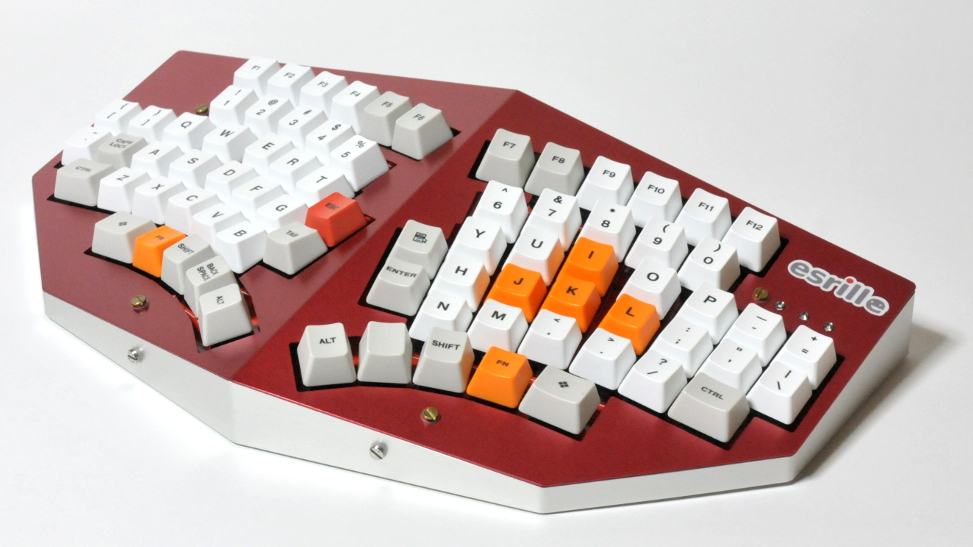
Esrille NISSE Looks Nice
This is the Esrille NISSE keyboard and it comes in two sizes! Okay, the two sizes don’t look that different, but the key spacing specs say otherwise. To me, this looks like an Alice with a better and ortholinear layout. These bat-wing beauties are new to me, but they’ve been around for a few years now and are probably difficult to stumble upon outside of Japan. Although Esrille doesn’t seem to make any other keyboards, they do make a portable PC built on the Raspberry Pi compute module.
I love me a one-piece split when its done properly, and this one seems to be pretty darn close to perfect. How do I know? You can print out a paper-craft version to try out either of the two sizes. I didn’t take it quite that far, but you can bet that I opened the smaller size’s image in a new tab and put my hands all over the screen to test the layout.
I especially like the thumb clusters and the inside keys on this thing, but I think the innermost thumb keys would be too painful to use, and I would probably just use my index finger. I would totally buy one of these, but they’re a little too expensive, especially since the smaller one costs more. (What’s up with that?) The great news is that the firmware is open-source. Between that and the paper-craft models, a person could probably build their own. Check out [xahlee]’s site for a review and a lot more pictures of the NISSE and similar keebs.
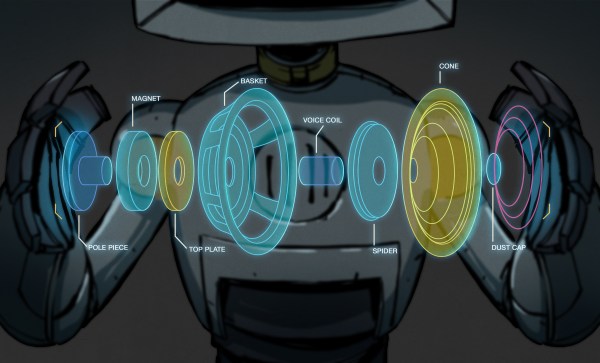
As we’ve followed a trail through Hi-Fi and audio systems from the listener’s ear towards the music source, we’ve reached the amplifier. In our previous article we gave a first introduction to distortion and how some amplifier characteristics can influence it, and here we’ll continue along that path and look at the amplifier itself. What types of audio amplifier circuits will you encounter, and what are their relative merits and disadvantages?
A Few Amplifier Basics
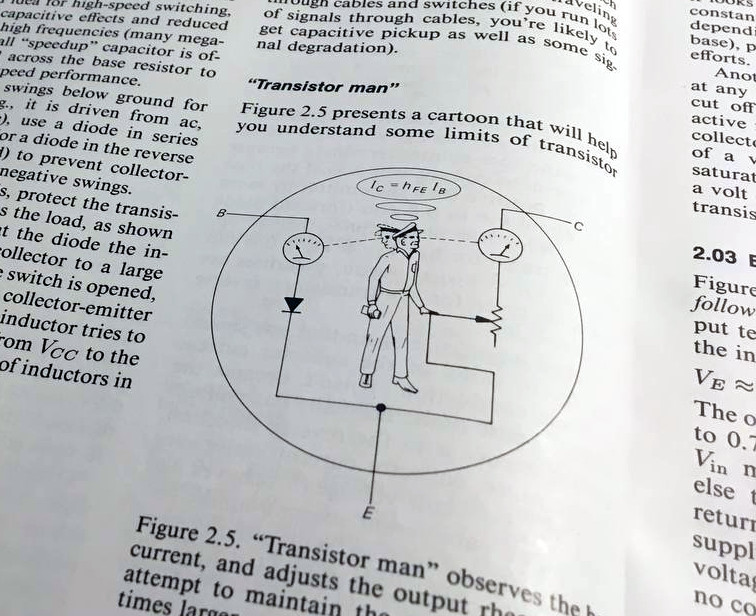
Horowitz and Hill’s Transistor Man
If you know anything about a transistor, it’s probably that it’s a three terminal device whose output pin forms part of a potential divider whose state is dependent on what is presented to its input pin. The Art of Electronics had it as a cartoon of a man standing inside a bipolar transistor and adjusting a variable resistor between collector and emitter while watching an ammeter on the base.
Properly biased in its conducting range, a transistor can behave as a linear device, in which the potential divider voltage moves in response to the input in a linear relationship, and thus the voltage on the output is an amplified version of the voltage on the output. This is the simplest of transistor amplifiers, and because different types of amplifier are referred to by lettered classes, it’s known as a class A amplifier. Continue reading “Know Audio: Amplifier Nuts And Bolts”→
There was a time when the idea of an international space station would have been seen as little more than fantasy. After all, the human spaceflight programs of the United States and the Soviet Union were started largely as a Cold War race to see which country would be the first to weaponize low Earth orbit and secure what military strategists believed would be the ultimate high ground. Those early rockets, not so far removed from intercontinental ballistic missiles (ICBMs), were fueled as much by competition as they were kerosene and liquid oxygen.
Atlantis docked to Mir in 1995.
Luckily, cooler heads prevailed. The Soviet Almaz space stations might have carried a 23 mm cannon adapted from tail-gun of the Tu-22 bomber to ward off any American vehicles that got too close, but the weapon was never fired in anger. Eventually, the two countries even saw the advantage of working together. In 1975, a joint mission saw the final Apollo capsule dock with a Soyuz by way of a special adapter designed to make up for the dissimilar docking hardware used on the two spacecraft.
Relations further improved following the dissolution of the Soviet Union in 1991, with America’s Space Shuttle making nine trips to the Russian Mir space station between 1995 and 1997. A new era of cooperation had begun between the world’s preeminent space-fairing countries, and with the engineering lessons learned during the Shuttle-Mir program, engineers from both space agencies began laying the groundwork for what would eventually become the International Space Station.
Unfortunately after more than twenty years of continuous US and Russian occupation of the ISS, it seems like the cracks are finally starting to form in this tentative scientific alliance. With accusations flying over who should take the blame for a series of serious mishaps aboard the orbiting laboratory, the outlook for future international collaboration in Earth orbit and beyond hasn’t been this poor since the height of the Cold War.
This is newsworthy in itself because despite several years and significant resources being devoted to the problem of drones hitting planes, demonstrable cases remain vanishingly rare. The machine in this case being a police one will we expect result in many fewer column inches for the event than had it been flown at the hands of a private multirotor pilot, serving only to heighten the contrast with coverage of previous events such as the Gatwick closure lacking any drone evidence.
It’s picking an easy target to lay into the Your Regional Police over this incident, but it is worth making the point that their reaction would have been disproportionately larger had the drone not been theirs. The CTV news report mentions that air traffic regulators were unaware of the drone’s presence:
NAV Canada, the country’s air navigation service provider, had not been notified about the YRP drone, Transport Canada said.
Given the evident danger to aviation caused by their actions it’s not unreasonable to demand that the officers concerned face the same penalties as would any other multirotor pilot who caused such an incident. We aren’t holding our breath though.






![[deshipu]'s DIY keyboard with various center modules](https://hackaday.com/wp-content/uploads/2021/08/deʃhipu-Kamina.png)