Hackaday Podcast 121: Crazy Bikes, DIY Flip Dots, EV Mountain Climbing, And Trippy Tripterons

Hackaday editors Mike Szczys and Elliot Williams discuss a great week of hardware hacks. Two delightful mechanical hacks focus on bicycles: one that puts a differential on the front fork, and the other a flywheel between the knees. Elliot was finally impressed by something involving AI — a machine-learning guitar pedal. You’ve heard of a delta bot? The tripteron is similar but with a single rail for the three arms. After a look at flip dots, tiny robots, and solar air planes we close the show geeking out about racing electric vehicles up a hill and stories of the hardware that has made closed captions possible.

Take a look at the links below if you want to follow along, and as always, tell us what you think about this episode in the comments!

Direct download (55 MB or so.)

Places to follow Hackaday podcasts:

Continue reading “Hackaday Podcast 121: Crazy Bikes, DIY Flip Dots, EV Mountain Climbing, And Trippy Tripterons”

Mariner 4: Our First Up-Close Look At Mars

In the grand scheme of things, it wasn’t all that long ago that the entire body of knowledge of our solar system was built solely with Earth-based observations. Turning first their naked eyes to the heavens, and then a succession of increasingly complex and sensitive optical and radio telescopes gathering light from all across the spectrum, our astronomically curious forbears did a commendable job working out the broad strokes of what’s going on in the neighborhood.

But there’s only so much information that can be gathered by instruments operating at the bottom of a roiling ocean of air, so when the opportunity to send instruments to our planetary neighbors began to be possible some 60 years ago, scientists started planning how to accomplish it. What resulted was the Mariner program, a series of interplanetary probes launched between 1962 and 1973 that performed flyby missions of the inner planets.

The list of accomplishments of the Mariner program is long indeed, and the number of firsts achieved by its ten spacecraft is impressive. But it is Mariner 4, the first flyby mission of Mars, which set the stage for a lot of the science being done on and around Mars today, and the first mission where NASA wisely took a “pics or it didn’t happen” approach to planetary science. It was the first time a TV camera had traveled to another world, and it was anything but a sure bet that it would pay dividends.

Continue reading “Mariner 4: Our First Up-Close Look At Mars”

Know Audio: Start At The Very Beginning

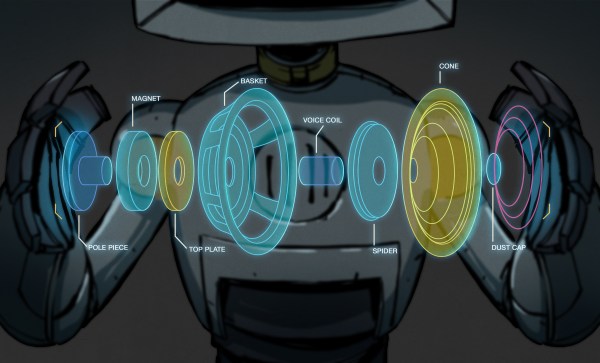
A lot of our projects make noise. It can be something as simple as a microcontroller driving a small speaker or a truly ambitious Hi-Fi project, but common to all of them is the desire to get that sound out in as audible and high-quality a manner as possible. We’ve been known to make fun of the more preposterous side of the Hi-Fi world at times, but behind it all there’s a basis of solid and provable audio engineering that can be brought to bear on almost any project involving sound and electronics. Perhaps it’s time to devote some time to a series exploring the topic, and what better place to start than the ultimate destination for all that sound. Any Hi-Fi is only as good as the ears of the person listening to it, so in out journey through the world of audio that’s where we’ll start. Continue reading “Know Audio: Start At The Very Beginning”

Fueling Up For Fusion: MAST’s Super-X, JET’s Deuterium-Tritium Experiments For ITER, And More

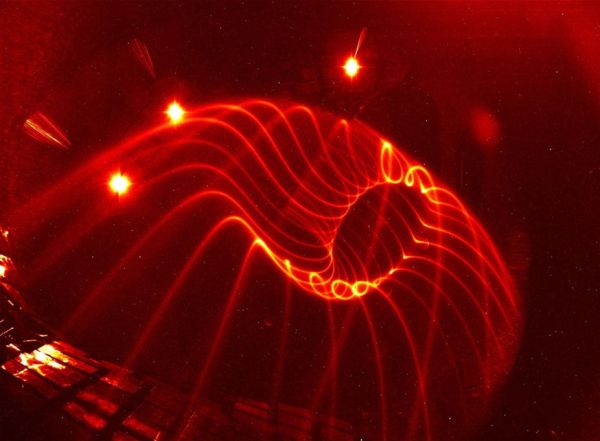
We’ve had nuclear fission reactors in operation all over the world for ages, but nuclear fusion always seems to be a decade or two away. While one cannot predict when we’ll reach the goal of sustained nuclear fusion, the cutting edge in test hardware is advancing at a rapid pace that makes us optimistic. Beginning as soon as this month and extending over a few years, we’re living through a very exciting time for nuclear fusion and plasma physics.

The Mega Ampere Spherical Tokamak (MAST) got a big upgrade to test a new cooled divertor design. JET (Joint European Torus) will be testing the deuterium-tritium fuel mixture that will be powering the ITER (the research project whose name began as an acronym for International Thermonuclear Experimental Reactor but has since been changed to just ITER). And the Wendelstein 7-X stellarator is coming back online with upgraded cooled divertors by next year.

Here the MAST Upgrade’s Super-X divertors have so far shown a ten-fold decrease in the temperature which the divertor is exposed to while carrying thermal energy out of the tokamak reactor. This means a divertor design and ultimately a fusion reactor that will last longer between maintenance sessions. On the stellarator side of things, Wendelstein 7-X’s new divertors may allow it to demonstrate the first continuous operation of a stellarator fusion reactor. Meanwhile, JET’s fuel experiments should allow us to test the deuterium-tritium fuel while ITER is working towards first plasma by 2025.

Continue reading “Fueling Up For Fusion: MAST’s Super-X, JET’s Deuterium-Tritium Experiments For ITER, And More”

Anti-Gravity, Time Travel, And Teleportation: Dr. Hamming Gives Advice

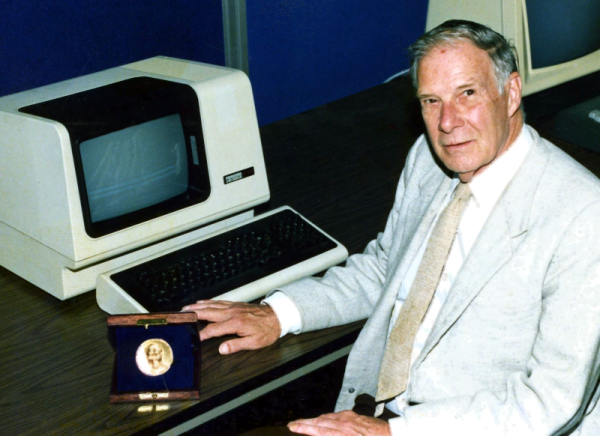
You may not know the name [Richard Hamming], but you definitely use some of his work. While working for Bell Labs, he developed Hamming codes — the parent of a class of codes that detect, and sometimes correct, errors in everything from error-correcting memory to hard drives. He also worked on the Manhattan Project and was a lecturer at the Naval Postgraduate school.

Turns out [Hamming] has an entire class from the 1990s on YouTube and if you are interested in coding theory or several other topics, you could do worse than watch some of them. However, those videos aren’t what attracted me to the lectures. As the last lecture of his course, [Hamming] used to give a talk called “You and Your Research” and you can see one of the times he delivered it in the video below. You might think that it won’t apply to you because you aren’t a professional academic or researcher, but don’t be too quick to judge.

Turns out, [Hamming’s] advice — even by his own admission — is pretty general purpose for your career or even your life. His premise: As far as we know, you have one life to live, so why shouldn’t it be a worthwhile one by your definition of worthwhile.

Along the way, he has an odd combination of personal philosophy, advice for approaching technical problems, and survival skills for working with others. If you are in the field, you’ll probably recognize at least some of the names he drops and you’ll find some of this technical advice useful. But even if you aren’t, you’ll come away with something. Some of it seems like common sense, but it is different, somehow, to hear it spoken out loud. For example:

If you don’t work on important problems, it’s not likely that you’ll do important work.

One piece of technical advice? Don’t waste time working on problems you have no way to attack. He points out that anti-gravity, time travel, and teleportation would be very lucrative. But why work on them when there appears to be no way to even remotely accomplish them today. Well, at least when he said that. There has been a little progress on a form of teleportation, but that wasn’t what he was talking about anyway.

While not a hack in the traditional sense, examining your life, career, and technical research to improve your own effectiveness is something to take seriously. We were hoping he would throw in a joke about error-correcting your career, but unless we blinked, no such luck.

Hamming’s work on block codes was followed about ten years later by the Reed-Solomon code which is found nearly everywhere now. Hamming is also associated with the term “hamming distance,” something we talked about when discussing Gray code.

Continue reading “Anti-Gravity, Time Travel, And Teleportation: Dr. Hamming Gives Advice”

Virgin Galactic’s Long Road To Commercial Spaceflight

To hear founder Richard Branson tell it, the first operational flight of Virgin Galactic’s SpaceShipTwo has been 18 months out since at least 2008. But a series of delays, technical glitches, and several tragic accidents have continually pushed the date back to the point that many have wondered if it will ever happen at all. The company’s glacial pace has only been made more obvious when compared with their rivals in the commercial spaceflight field such as SpaceX and Blue Origin, which have made incredible leaps in bounds in the last decade.

Richard Branson watching Unity’s test flight.

But now, at long last, it seems like Branson’s suborbital spaceplane might finally start generating some income for the fledgling company. Their recent successful test flight, while technically the company’s third to reach space, represents an important milestone on the road to commercial service. Not only did it prove that changes made to Virgin Space Ship (VSS) Unity in response to issues identified during last year’s aborted flight were successful, but it was the first full duration mission to fly from Spaceport America, the company’s new operational base in New Mexico.

The data collected from this flight, which took pilots Frederick “CJ” Sturckow and Dave Mackay to an altitude of 89.23 kilometers (55.45 miles), will be thoroughly reviewed by the Federal Aviation Administration as part of the process to get the vehicle licensed for commercial service. The next flight will have four Virgin Galactic employees join the pilots, to test the craft’s performance when loaded with passengers. Finally, Branson himself will ride to the edge of space on Unity’s final test flight as a public demonstration of his faith in the vehicle.

If all goes according to plan, the whole process should be wrapped up before the end of the year. At that point, between the government contracts Virgin Galactic has secured for testing equipment and training astronauts in a weightless environment, and the backlog of more than 600 paying passengers, the company should be bringing in millions of dollars in revenue with each flight.

Continue reading “Virgin Galactic’s Long Road To Commercial Spaceflight”

Living Robots: Revisiting BEAM

You’re hit by the global IC shortage, reduced to using stone knives and bearskins, but you still want to make something neat? It’s time to revisit BEAM robots.

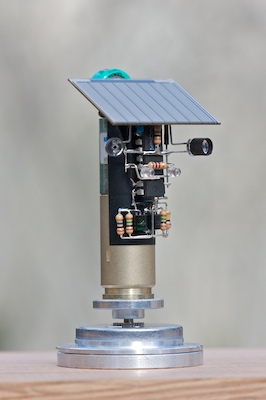
Biology, electronics, aesthetics, and mechanics — Mark Tilden came up with the idea of minimalist electronic creatures that, through inter-coupled weak control systems and clever mechanical setups, could mimic living bugs. And that’s not so crazy if you think about how many nerves something like a cockroach or an earthworm have. Yet their collection of sensors, motors, and skeletons makes for some pretty interesting behavior.

My favorite BEAM bots have always been the solar-powered ones. They move slowly or infrequently, but also inexorably, under solar power. In that way, they’re the most “alive”. Part of the design trick is to make sure they stay near their food (the sun) and don’t get stuck. One of my favorite styles is the “photovore” or “photopopper”, because they provide amazing bang for the buck.

Back in the heyday of BEAM, maybe 15 years ago, solar cells were inefficient and expensive, circuits for using their small current were leaky, and small motors were tricky to come by. Nowadays, that’s all changed. Power harvesting circuits leak only nano-amps, and low-voltage MOSFETs can switch almost losslessly. Is it time to revisit the BEAM principles? I’d wager you’d put the old guard to shame, and you won’t even need any of those newfangled microcontroller thingies, which are out of stock anyway.

If you make something, show us!