What Can A $30 USB Spectrum Analyser Do For Me?

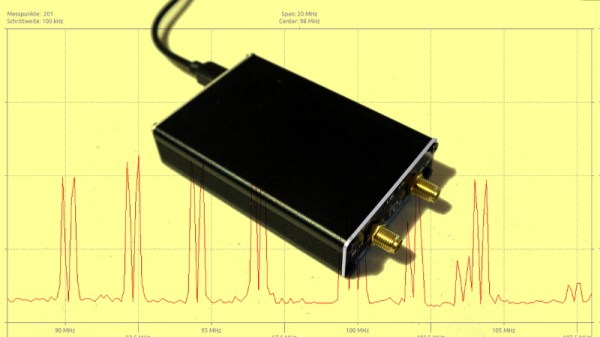
As mildly exotic silicon has become cheaper and the ingenuity of hardware hackers has been unleashed upon it, it’s inevitable that some once-unattainably expensive instruments will appear as cheap modules from China. The LTDZ spectrum analyser on the bench today covers 35 MHz to 4.4 GHz, and has a USB interface and tracking source. It has been available from all the usual outlets for a while now either as a bare PCB or in a metal box about the size of a pack of cards.

We’ve already taken a look at the $50 VNA, and this time it’s the turn of the $30 spectrum analyser, in the form of a little device that I succumbed to while browsing Banggood.

I ordered one, along with an attenuator and RF bridge for SWR measurements, and after the usual wait for postage my anonymous grey package arrived and it was time to give it a look and consider its usefulness. It’s a design derived from one published in Germany’s Funkamateur (“amateur radio”) magazine early in the last decade, and unscrewing the end plate to slide out the board from its extruded enclosure we can see what makes it tick. Continue reading “What Can A $30 USB Spectrum Analyser Do For Me?”

Sea Level: How Do We Measure Global Ocean Levels And Do Rising Oceans Change That Benchmark?

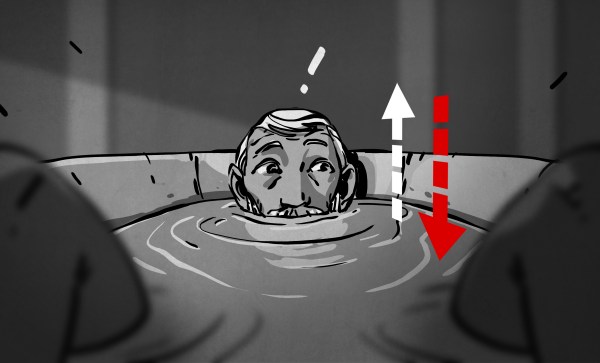
Every summer you go down the shore, but lately you’ve begun to notice that the beach seems narrower each time you visit. Is that the sea level rising, or is the sand just being swept away? Speaking of sea levels, you keep hearing that they rise higher every year — but how exactly is that measured? After all, you can’t exactly use a ruler. As it turns out, there are a number of clever systems in place that can accurately measure the global sea level down to less than an inch and a half.

Not only are waves always rippling across the ocean’s surface, but tides periodically roll in and out, making any single instantaneous measurement of sea level hopelessly inaccurate. Even if you plan to take hundreds or thousands of measurements over the course of weeks or months, taking the individual measurements is still difficult. Pick a nice, stable rock in the surf, mark a line on it, and return every hour for two weeks to hold a tape measure up to it. At best you’ll get within six inches on each reading, no matter what you’ll get wet, and at worst the rock will move and you’ll get a damp notebook full of useless numbers. So let’s take a look at how the pros do it.

Continue reading “Sea Level: How Do We Measure Global Ocean Levels And Do Rising Oceans Change That Benchmark?”

99% Inspiration, 99% Perspiration, And 99% Collaboration

I was watching an oldish TEDx talk with Rodney Mullen, probably the most innovative street skater ever, but that’s not the point, and it’s not his best talk either. Along the way, he makes a claim that ideas — in particular the idea that a particular skateboard trick is even possible — are the most important thing.

His experience, travelling around the world on skateboard tours, is that there are millions of kids who are talented enough that when they see a video demonstrating that a particular trick idea is possible, they can replicate it in short order. Not because the video showed them how, but because it expanded their mind’s-eye view of what is possible. They were primed, and so what pushed them over the edge was the inspiration.

On the other side of the street, we’ve got Thomas Edison and his “1% inspiration, 99% perspiration” routine. Edison famously tried a bazillion filament recipes before settling on tungsten, and attributes his success to “putting his time in” or “good old-fashioned hard work” or similar. So who’s right?

The inventor of Casper Slide and the phonograph are both right. Rodney is taking it for granted that these kids have put their time in; they are skaters after all, they skate. He doesn’t see the 99% perspiration because it is the natural background, while the inspiration flashes out in Eureka moments.

Similarly, Thomas E. way underestimates inspiration. He’s already fixated on this novel idea to take an arc lamp and contain it in a glass envelope — that’s what he’s spending all of his perspiration on, after all. But without that key inspiration, all he’d be is sweaty.

And they’re also both wrong! They’re both missing a third ingredient: collaboration. Certainly Mullen, who spent his life hanging out with other skaters, teaching them what he knows, and learning from them in turn, wouldn’t say the community of skaters didn’t shape him. Even in the loner’s sport of skating, nobody is alone. And Edison? His company profited greatly from broader advances in science, and the scientific literature. Menlo Park existed to take bright, well-trained minds and put them all in one place, sharing, teaching, and working together. It embodied the idea of collaborative innovation, and that’s where some of his best work was done.

So I’m with Isaac Newton, “standing on the shoulders of giants“. Success is 99% collaboration. This leaves us with one problem: the percentages don’t add up. But that’s alright by me.

The Rise And Fall Of The Fan Car

The advent of aerodynamic wings in motorsport was one of the most dramatic changes in the mid-20th century. Suddenly, it was possible to generate more grip at speed outside of altering suspension setups and fitting grippier tyres. However, it was just the beginning, and engineers began to look at more advanced ways of generating downforce without the drag penalty incurred by fitting wings to a racecar.

Perhaps the ultimate expression of this was the fan car. Mechanically complex and arguably dangerous, the technology offered huge downforce with minimal drag. However, the fan car’s time in the spotlight was vanishingly brief, despite the promise inherent in the idea. Let’s take a look at the basic theory behind the fan car, how they worked in practice, and why we don’t see them on racetracks today. Continue reading “The Rise And Fall Of The Fan Car”

This Week In Security: Text Rendering On Windows, GNU Poke, And Bitsquatting

Project Zero just unrestricted the details on CVE-2021-24093, a potentially nasty vulnerability in Windows 10’s DirectWrite, a text rendering library. The flaw got fixed in this month’s patch Tuesday roundup. The flaw is accessible in all the major browsers on Windows 10, as they use DirectWrite for font rendering. The trick here is to use a malicious font that uses some nonsense values. Those values result in a buffer allocation that is too small for complex characters such as Æ.

Because the vulnerability is a Windows library, it’s possible that an exploit would automatically work as a sandbox escape, but I haven’t seen confirmation either way. Let us know if you have some insight there.

Via Bleeping Computer

GNU Poke

The good folks at GNU have minted the 1.0 release of poke, a new binary editing tool. The real killer feature of poke is that it can interpret binary data, decoding it back into readable data structures. If you’re familiar with the way Wireshark can decode packets and give useful, organized output, it seems that poke will provide a similar function, but not limited to network traffic.

It looks like it could become a useful tool for getting a look inside otherwise opaque binaries. What poke brings is a system where you can write pretty-printing templates on the fly, which should be very useful when mapping out an unfamiliar binary. Distros will likely pick up and start packaging poke in the coming weeks, making it even easier to get and play with. Continue reading “This Week In Security: Text Rendering On Windows, GNU Poke, And Bitsquatting”

We’re Cloning Animals From The “Frozen Zoo”; Like A Seed Bank But For Animals

Seed banks are facilities of great value to biodiversity and agriculture around the world. These facilities are used to house stocks of seeds of a wide variety, helping to maintain genetic diversity and avoid the permanent loss of various plant species. While there are some challenges, the basic requirements to run a simple seed bank are to keep a selection of seeds at low temperature and humidity to maximise their viable lifespan.

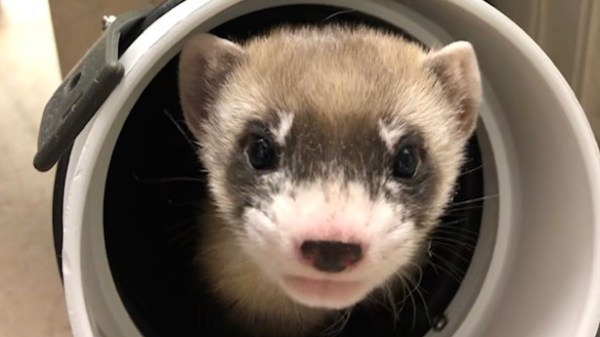
When it comes to animals, things become more difficult — one can’t simply plant an old seed in the ground and grow a fresh new meerkat, for example. Preservation of animal genetic material poses its own unique set of challenges — ones that the San Diego “Frozen Zoo” don’t shy away from. They’ve recently shown the viability of the program with the healthy birth of a ferret cloned from an animal that died in 1988.

Continue reading “We’re Cloning Animals From The “Frozen Zoo”; Like A Seed Bank But For Animals”

Arduboy FX Mod-Chip: Now You’re Playing With Power

Traditionally, a forum full of technical users trying integrate their own hardware into a game system for the purposes of gaining unfettered access to its entire software library was the kind of thing that would keep engineers at Sony and Nintendo up at night. The development and proliferation of so called “mod chips” were an existential threat to companies that made their money selling video games, and as such, sniffing out these console hackers and keeping their findings from going public for as long as possible was a top priority.

But the Arduboy is no traditional game system. Its games are distributed for free, so a chip that allows users to cram hundreds of them onto the handheld at once isn’t some shady attempt to pull a fast one on the developers, it’s a substantial usability improvement over the stock hardware. So when Arduboy creator Kevin Bates found out about the grassroots effort to expand the system’s internal storage on the official forums, he didn’t try to put a stop to it. Instead, he asked how he could help make it a reality for as many Arduboy owners as possible.

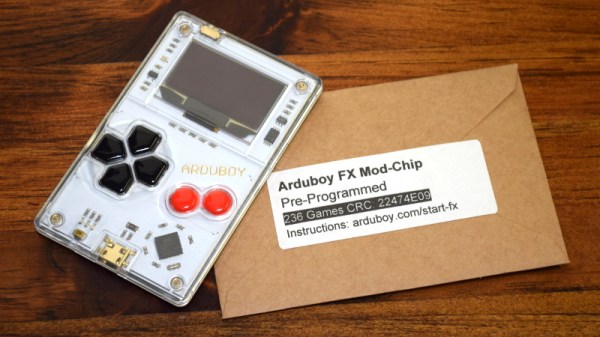
Now, a little less than three years after forum member Mr.Blinky posted his initial concept for hanging an external SPI flash chip on the system’s test pads, the official Arduboy FX Mod-Chip has arrived. Whether you go the DIY route and build your own version or buy the ready-to-go module, one thing is for sure: it’s a must-have upgrade for the Arduboy that will completely change how you use the diminutive handheld.

Continue reading “Arduboy FX Mod-Chip: Now You’re Playing With Power”