As anyone who has been faced with a recently-manufactured household appliance that has broken will know, sometimes they can be surprisingly difficult to fix. In many cases it is not in the interests of manufacturers keen to sell more products to make a device that lasts significantly longer than its warranty period, to design it with dismantling or repairability in mind, or to make spare parts available to extend its life. As hardware hackers we do our best with home-made replacement components, hot glue, and cable ties, but all too often another appliance that should have plenty of life in it heads for the dump.
Czech waste management workers dismantle scrap washing machines. Tormale [CC BY-SA 3.0].If we are at a loss to fix a domestic appliance then the general public are doubly so, and the resulting mountain of electrical waste is enough of a problem that the European Union is introducing new rules governing their repairability. The new law mandates that certain classes of household appliances and other devices for sale within the EU’s jurisdiction must have a guaranteed period of replacement part availability and that they must be designed such that they can be worked upon with standard tools. These special classes include washing machines, dishwashers, refrigerators, televisions, and more.
Let’s dig into the ramifications of this decision which will likely affect markets beyond the EU and hopefully lead to a supply of available parts useful for repair and beyond.
Many of the biggest stars are hesitant to do sequels, believing that the magic captured the first time around is hard to reproduce in subsequent productions. As I’m known (at least around the former closet that now serves as my home office) as the “Meryl Streep of Teardowns”, I try to follow her example when it comes to repeat performances. But if they could get her to come back for another Mamma Mia film, I suppose I can take a look at a second Quirky product.
An elderly egg calls to inquire about euthanasia services.
This time around we’ll be looking at the Quirky Egg Minder, a smart device advertised as being able to tell you when your eggs are getting old. Apparently, this is a problem some people have. A problem that of course is best solved via the Internet of Things, because who wouldn’t pay $80 USD for a battery-powered WiFi device that lives in their refrigerator and communicates vital egg statistics to an online service?
As it turns out, the answer to that question is “most people”. The Egg Minder, like most of its Quirky peers, quickly became a seemingly permanent fixture of retailer’s clearance shelves. This particular unit, which I was able to pick up new from Amazon, only cost me $9.99. This is still more than I would have paid under normal circumstances, but such sacrifices are part and parcel with making sure the readers of Hackaday get their regular dose of unusual gadgetry.
You may recall that our last Quirky device, the “Refuel” propane tank monitor, ended up being a fantastically engineered and built piece of hardware. The actual utility of the product was far from certain, but nobody could deny that the money had been spent in all the right places.
What will the internals of the Egg Minder reveal? Will it have the same level of glorious over-engineering that took us by surprise with the Refuel? Will that zest for form over function ultimately become the legacy of these Quirky devices, or was it just a fluke? Let’s crack this egg and find out.
The discovery of nuclear fission in the 1930s brought with it first the threat of nuclear annihilation by nuclear weapons in the 1940s, followed by the promise of clean, plentiful power in the 1950s courtesy of nuclear power plants. These would replace other types of thermal plants with one that would produce no exhaust gases, no fly ash and require only occasional refueling using uranium and other fissile fuels that can be found practically everywhere.
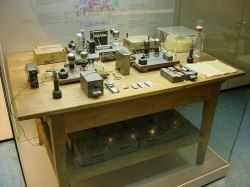
The equipment with which nuclear fission was experimentally proven in 1938.
As nuclear reactors popped up ever faster during the 1950s and 1960s, the worry about running out of uranium fuel became ever more present, which led to increased R&D in so-called fast reactors, which in the fast-breeder reactor (FBR) configuration can use uranium fuel significantly more efficiently by using fast neutrons to change (‘breed’) 238U into 239Pu, which can then be mixed with uranium fuel to create (MOX) fuel for slow-neutron reactors, allowing not 1% but up to 60% of the energy in uranium to be used in a once-through cycle.
The boom in uranium supplies discovered during the 1970s mostly put a stop to these R&D efforts, with some nations like France still going through its Rapsodie, Phénix and SuperPhénix designs until recently finally canceling the Generation IVASTRID demonstrator design after years of trying to get the project off the ground.
This is not the end of fast reactors, however. In this article we’ll look at how these marvels of engineering work and the various fast reactor types in use and under development by nations like Russia, China and India.
Since Dick Tracy all the way back in ’46, smart watches have captured the public imagination. After several false starts, the technology has gone through a renaissance in the last 10 years or so. For the average consumer, there’s been a proliferation of hardware in the marketplace, with scores of different models to choose from. For the hackers, however, pickings are a little more slim. So what is the best smart watch for the tinkerers among us? Continue reading “Ask Hackaday: What’s The Perfect Hacker Smart Watch?”→
The lead-acid rechargeable battery is a not-quite-modern marvel. Super reliable and easy to use, charging it is just a matter of applying a fixed voltage to it and waiting a while; eventually the battery is charged and stays topped off, and that’s it. Their ease is countered by their size, weight, energy density, and toxic materials.
The lithium battery is the new hotness, but their high energy density means a pretty small package that can get very angry and dangerous when mishandled. Academics have been searching for safer batteries, better charge management systems, and longer lasting battery formulations that can be recharged thousands of times, and a recent publication is generating a lot of excitement about it.
Consider the requirements for a battery cell in an electric car:
High energy density (Lots of power stored in a small size)
Quick charge ability
High discharge ability
MANY recharge cycles
Low self-discharge
Safe
Lithium ion batteries are the best option we have right now, but there are a variety of Li-ion chemistries, and depending on the expected use and balancing and charging, different chemistries can be optimized for different performance characteristics. There’s no perfect battery yet, and conflicting requirements mean that the battery market will likely always have some options.
Hackaday Editors Tom Nardi and Mike Szczys comb through their favorite hacks from the past week. We loved Donald Papp’s article on considerations before making the leap from FDM 3D Printers to a resin-based process, and we solidify our thoughts on curing cement in low-gravity. Tom’s working on a Cyberdeck build, and he also found an ancient episode of an earlier and much different version of the Hackaday podcast. We’re impressed with a mostly 3D-printed useless machine, a thermal-insert press that’s also 3D-printed, and the Raspberry-Pi based Sidekick clone that popped up this week. A DIY wire-bending robot is an incredible build, as is the gorgeous wire-routing in a mechanical keyboard, and the filigree work on this playing card press. Plus you need to spend some time getting lost in this one hydrogen-line telescope project.
Take a look at the links below if you want to follow along, and as always tell us what you think about this episode in the comments!
Take a look at the links below if you want to follow along, and as always, tell us what you think about this episode in the comments!
Ever wondered what “cyberwar” looks like? Apparently it’s a lot of guessing security questions and changing passwords. It’s an interesting read on its own, but there are some interesting clues if you read between the lines. A General in the know mentioned that Isis:
clicked on something or they did something that then allowed us to gain control and then start to move.
This sounds very similar to stories we’ve covered in the past, where 0-days are used to compromise groups or individuals. Perhaps the NSA supplied such an exploit, and it was sent in a phishing attack. Through various means, the U.S. team quietly compromised systems and collected credentials.
The article mentions something else interesting. Apparently the targets of this digital sting had also been compromising machines around the world, and using those machines to manage their efforts. The decision was made by the U.S. team to also compromise those machines, in order to lock out the Isis team. This might be the most controversial element of the story. Security researchers have wanted permission to do this for years. How should the third parties view these incursions?
The third element that I found particularly interesting was the phase 2 attack. Rather than outright delete, ban, and break Isis devices and accounts, the U.S. team installed persistent malware that emulated innocuous glitches. The internet connection is extremely laggy on certain days, certain websites simply don’t connect, and other problems. These are the sort of gremlins that networking pros spend all day trying to troubleshoot. The idea that it’s intentional gives me one more thing to worry about. Continue reading “This Week In Security: Is RSA Finally Broken? The Push For Cloud Accounts, Encrypted DNS, And More Mobile Mayhem”→


![Czech waste management workers dismantle scrap washing machines. Tormale [CC BY-SA 3.0].](https://hackaday.com/wp-content/uploads/2019/10/1280px-DVO_4792.jpg)