The South American Power Outage That Plunged 48 Million Into Blackout

A massive power outage in South America last month left most of Argentina, Uruguay, and Paraguay in the dark and may also have impacted small portions of Chile and Brazil. It’s estimated that 48 million people were affected and as of this writing there has still been no official explanation of how a blackout of this magnitude occurred.

While blackouts of some form or another are virtually guaranteed on any power grid, whether it’s from weather events, accidental damage to power lines and equipment, lightning, or equipment malfunctioning, every grid will eventually see small outages from time to time. The scope of this one, however, was much larger than it should have been, but isn’t completely out of the realm of possibility for systems that are this complex.

Initial reports on June 17th cite vague, nondescript possible causes but seem to focus on transmission lines connecting population centers with the hydroelectric power plant at Yacyretá Dam on the border of Argentina and Paraguay, as well as some ongoing issues with the power grid itself. Problems with the transmission line system caused this power generation facility to become separated from the rest of the grid, which seems to have cascaded to a massive power failure. One positive note was that the power was restored in less than a day, suggesting at least that the cause of the blackout was not physical damage to the grid. (Presumably major physical damage would take longer to repair.) Officials also downplayed the possibility of cyber attack, which is in line with the short length of time that the blackout lasted as well, although not completely out of the realm of possibility.

This incident is exceptionally interesting from a technical point-of-view as well. Once we rule out physical damage and cyber attack, what remains is a complete failure of the grid’s largely automatic protective system. This automation can be a force for good, where grid outages can be restored quickly in most cases, but it can also be a weakness when the automation is poorly understood, implemented, or maintained. A closer look at some protective devices and strategies is warranted, and will give us greater insight into this problem and grid issues in general. Join me after the break for a look at some of the grid equipment that is involved in this system.

Continue reading “The South American Power Outage That Plunged 48 Million Into Blackout”

Forget The Walkman: It’s The Headphones

Forty years ago this month, a product was launched  in Japan that would have such a huge impact on the consumer electronics market that we are still using its descendants today. The story goes that one of the Sony founders would listen to music while traveling for the business, and found the company’s existing products cumbersome and awkward so asked his engineers to design something more convenient.

The resulting prototype became the Sony MDL-3L2, a set of miniaturised hi-fi headphones with distinctive foam earpads and a sliding metal headband that in total weighed an astoundingly svelte 45 g. It was paired with a cassette player called a “Walkman” derived from the company’s existing recorder that had been intended for journalists, and went on to sell in the millions. The market for headphones would never be the same again, and if you have a set of lightweight cans in your possession then this was their revolutionary progenitor.

But Hang On, What’s So Special About Headphones?

You probably won’t have heard the Walkman’s 40th anniversary described in those terms in the various reports covering the event, because of course the social impact of the portable music player rather than its headphones is what people remember. The joy of making a mix tape, of listening to The Human League on the bus, and of the adult disapproval of anything involving Kids Having Fun. Previously, music had been a static affair involving bulky record players, but now it could be taken anywhere. The other youth audio icon of that era, the boombox, simply couldn’t match the Walkman, and everybody wanted one.
Continue reading “Forget The Walkman: It’s The Headphones”

Hacking Shelters And Swimming Pools

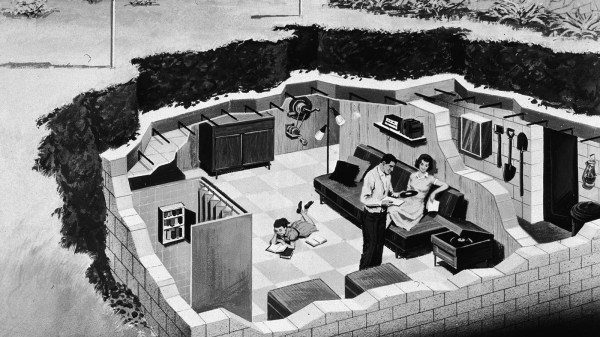
How would you survive in a war-torn country, where bombs could potentially fall from the sky with only very short notice? And what if the bomb in question were The Bomb — a nuclear weapon? This concern is thankfully distant for most of us, but it wasn’t always so. Only 75 years ago, bombs were raining down on England, and until much more recently the threat of global thermonuclear war was encouraging school kids to “duck and cover”. How do you protect people in these situations?

The answers, naturally, depend on the conditions at hand. In Britain before the war, money was scarce and many houses didn’t have basements or yards that were large enough to build a family-sized bomb shelter in, and they had to improvise. In Cold War America, building bomb shelters ended up as a boon for the swimming pool construction industry. In both cases, bomb shelters proved to be a test of engineering ingenuity and DIY gumption, attempting to save lives in the face of difficult-to-quantify danger from above.

Continue reading “Hacking Shelters And Swimming Pools”

Tuning Into Atomic Radio: Quantum Technique Unlocks Laser-Based Radio Reception

The basic technology of radio hasn’t changed much since an Italian marquis first blasted telegraph messages across the Atlantic using a souped-up spark plug and a couple of coils of wire. Then as now, receiving radio waves relies on antennas of just the right shape and size to use the energy in the radio waves to induce a current that can be amplified, filtered, and demodulated, and changed into an audio waveform.

That basic equation may be set to change soon, though, as direct receivers made from an exotic phase of matter are developed and commercialized. Atomic radio, which does not rely on the trappings of traditional radio receivers, is poised to open a new window on the RF spectrum, one that is less subject to interference, takes up less space, and has much broader bandwidth than current receiver technologies. And surprisingly, it relies on just a small cloud of gas and a couple of lasers to work.

Continue reading “Tuning Into Atomic Radio: Quantum Technique Unlocks Laser-Based Radio Reception”

Counter-Strike At 20: Two Hackers Upend The Gaming Industry

Choices matter. You’ve only got one shot to fulfill the objective. A single coordinated effort is required to defuse the bomb, release the hostages, or outlast the opposition. Fail, and there’s no telling when you’ll get your next shot. This is the world that Counter-Strike presented to PC players in 1999, and the paradigm shift it presented was greater than it’s deceptively simple namesake would suggest.

The reckless push forward mantra of Unreal Tournament coupled with the unrelenting speed of Quake dominated the PC FPS mind-share back then. Deathmatch with a side of CTF (capture the flag) was all anyone really played. With blazing fast respawns and rocket launchers featured as standard kit, there was little thought put towards conservative play tactics. The same sumo clash of combatants over the ever-so inconveniently placed power weapon played out time and again; while frag counts came in mega/ultra/monster-sized stacks. It was all easy come, easy go.

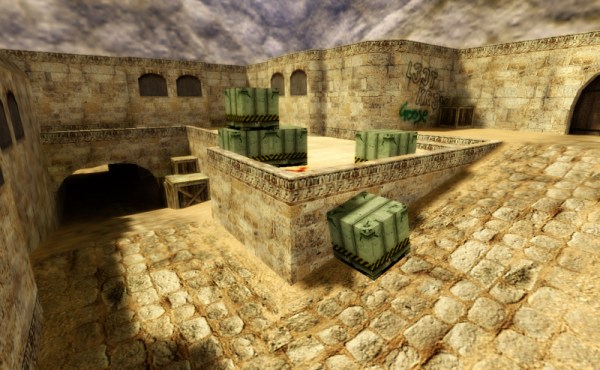
Counter-Strike didn’t follow the quick frag, wipe, repeat model. Counter-Strike wasn’t concerned with creating fantastical weaponry from the future. Counter-Strike was grounded in reality. Military counter terrorist forces seek to undermine an opposing terrorist team. Each side has their own objectives and weapon sets, and the in-game economy can swing the battle wildly at the start of each new round. What began as a fun project for a couple of college kids went on to become one of the most influential multiplayer games ever, and after twenty years it’s still leaving the competition in the de_dust(2).

Even if you’ve never camped with an AWP, the story of Counter-Strike is a story of an open platform that invited creative modifications and community-driven development. Not only is Counter-Strike an amazing game, it’s an amazing story.

Continue reading “Counter-Strike At 20: Two Hackers Upend The Gaming Industry”

Say It With Me: Bandwidth

Bandwidth is one of those technical terms that has been overloaded in popular speech: as an example, an editor might ask if you have the bandwidth to write a Hackaday piece about bandwidth. Besides this colloquial usage, there are several very specific meanings in an engineering context. We might speak about the bandwidth of a signal like the human voice, or of a system like a filter or an oscilloscope — or, we might consider the bandwidth of our internet connection. But, while the latter example might seem fundamentally different from the others, there’s actually a very deep and interesting connection that we’ll uncover before we’re done.

Let’s have a look at what we mean by the term bandwidth in various contexts.

Continue reading “Say It With Me: Bandwidth”

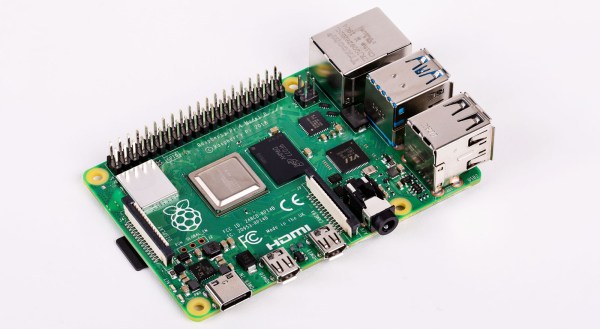
Exploring The Raspberry Pi 4 USB-C Issue In-Depth

It would be fair to say that the Raspberry Pi team hasn’t been without its share of hardware issues, with the Raspberry Pi 2 being camera shy, the Raspberry Pi PoE HAT suffering from a rather embarrassing USB power issue, and now the all-new Raspberry Pi 4 is the first to have USB-C power delivery, but it doesn’t do USB-C very well unless you go for a ‘dumb’ cable.

Join me below for a brief recap of those previous issues, and an in-depth summary of USB-C, the differences between regular and electronically marked (e-marked) cables, and why detection logic might be making your brand-new Raspberry Pi 4 look like an analogue set of headphones to the power delivery hardware.

Continue reading “Exploring The Raspberry Pi 4 USB-C Issue In-Depth”