New ThinkPad Guts Bring Intel Core I, DDR4, USB 3 To Cult Laptops

We often see people funneling their passion into keeping beloved devices in operation long past their manufacturer’s intent. These replacement Thinkpad motherboards (translated) bring old (yet beloved) Thinkpads a much desired processor upgrade. This is the work of the user [HOPE] on the enthusiast forum 51nb. The hack exemplifies what happens when that passion for legendary gear hits deep electrical expertise and available manufacturing. This isn’t your regular laptop refurbishment, [HOPE] is building something new.

ThinkPads are known for their zealous following (as our own [Brian Benchoff] underscored last year). Lenovo has steered the venerable brand into the future while the laptop market has drifted deeper and deeper into the wilds of tight integration at the expense of user modification. Along the way 4:3 screens were traded for media-friendly 16:9, TrackPoints were traded for trackpads, and the classic ThinkLight gave way to real keyboard backlights. These progressions left a shrinking but vocal group of old school Thinkpad enthusiasts — the cult of Thinkpad — clinging to beloved devices like 2007’s X61 and T60 ignored by a changing market.

In an astounding turn of ingenuity [HOPE] has revitalized these classic ThinkPads by entirely replacing their motherboards. And not just for one particular model, there are options available for at least 3 families of computers. The new devices are referred to by model numbers never used by IBM or Lenovo; the X60/61 motherboard makes an X62, the X200/201 motherboard makes an X210, and the T60 motherboard makes a T70. Depending on the customer’s preference either a bare motherboard or a fully assembled unit is available.

Classic stickers with non-classic ports

Depending on the exact model in question these motherboards slot directly into the original chassis but add recent generation Intel Core I processors, DDR4, USB 3.0/3.1, Thunderbolt 3 and more. Often they reuse the original heat sinks and fans, and expose these ports through the same chassis apertures the original motherboards used. Considering these machines are a decade older than the hardware being crammed inside them the level of integration is truly impressive. The end result looks like it could have come out of a Lenovo factory just before Spring Festival. If you look closely at the image at the top of this article, you might notice they even included an improved “Intel Inside” sticker on the palm rest and a model number label at the lower left of the display!

There is an implicit economic statement here that’s worth calling out. A motherboard for anything more significant than a basic microcontroller is an incredibly complicated piece of technology. When the bar is moved from “small ARM processor” up to “modern x86 system” this counts extra. Not only are they complex electrically but the fabrication processes required to physically create them are at the edge of what you’d find at your favorite cheap PCB fab house. We’re talking CPUs studded with about 1100 pins, DDR4 and PCI-E with extremely tight electrical timing requirements driving elaborate board layouts, and a plethora of off-board peripheral parts. On top of those constraints the board itself must be small enough to fit inside, not a purpose-built enclosure, but an existing laptop body with whatever combination of mounting brackets and connector placements Lenovo decided on. That a hobbyist (we assume) can make their own devices in this range to sell for $500-$700 is nothing short of astounding.
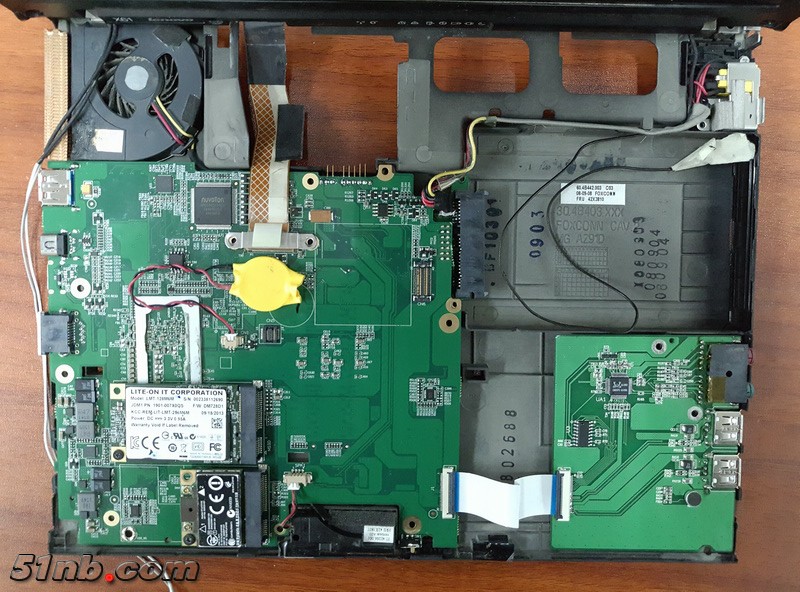
Fresh replacements being installed

This shouldn’t be possible. More accurately, it’s likely possible because there are other drivers which make the cost of PCB fabrication and assembly lower and more accessible than ever. The general march of technology certainly, but perhaps the presence of mobile devices and a desire to repair and improve them. After all and if the rumors are to be believed, anyone who can find the right Huaqiangbei stall can get the NAND replaced in their iPhone, a once complex process made simple.

It’s difficult to track the progression of each model as they are primarily covered on the 51nb forums (a Facebook page called [Lcdfans] makes some of the information available in English). However it’s possible to find hands-on information like [koobear]’s review on Reddit.


Lost In Space: How Materials Degrade In Space

Hackaday readers are well aware of the problems caused by materials left exposed to the environment over time, whether that be oxidized contact pads on circuit boards or plastics made brittle from long exposure to the sun’s UV rays.

Now consider the perils faced by materials on the International Space Station (ISS), launched beginning in 1998 and planned to be used until 2028. That’s a total of 30 years in an environment of unfiltered sunlight, extreme temperatures, micrometeoroids, and even problems caused by oxygen. What about the exposure faced by the newly launched Tesla Roadster, an entirely non-space hardened vehicle on a million-year orbit around the sun? How are the materials which make up the ISS and the Roadster affected by the harsh space environment?

Fortunately, we’ve been doing experiments since the 1970s in Earth orbit which can give us answers. The missions and experiments themselves are as interesting as the results so let’s look at how we put materials into orbit to be tested against the rigors of space.

Continue reading “Lost In Space: How Materials Degrade In Space”

2018 Hackaday Prize: Build Hope. Design The Future.

Today the 2018 Hackaday Prize begins with a roar. This is our global engineering initiative with huge prizes for those hackers, designers, and engineers who want to use their skill and energy to build something that matters. This year, we challenge you to Build Hope. Show the world the amazing ways technology enriches humanity, and that its benefits can be shared by all.

There is over $200,000 in cash prizes headed to the most interesting hardware builds of the year. With plenty of room for great ideas, the top 100 entries will each receive a $1,000 cash prize and continue the build to final judging. The top five entries will be awarded a $50,000 Grand Prize, and $20,000, $15,000, $10,000, and $5,000 for 2nd through 5th places. We even have some additional seed funding set aside to help early entries to get started.

What is Building Hope?

It feels like there is a steady drumbeat of doom and gloom surrounding technology these days. We hear this foretold in many ways, things like robots rising up to enslave humanity, artificial intelligence and big data being used to manipulate people, and quantum computing on the horizon that will invalidate cryptographic security. Our challenge? Get in there and show the incredible good that technology can do in the world.

Design something that shows the benefits of using knowledge and creativity to solve a problem. Be the shining light that proves our future is full of hope because smart people care about what happens in the world and to the people who live here. It is our responsibility as those who understand powerful technologies to show the best ways they can be used to build up humanity. This is your chance.

Build Hope. Design the Future.

Five Challenges to Choose From

We have five challenge categories to choose from in the 2018 Hackaday Prize. The top twenty entries from each category will receive $1,000 and continue work in order to compete for the top prizes.

2018 Hackaday Prize Challenges

Open Hardware Design Challenge:

This is the challenge you should enter right now. Choose a challenge facing the world today and design the best plan possible for the boldest solution you can envision.

Over the years we’ve seen thousands of Hackaday Prize entries that take on farming, transportation, pollution, safety, scientific research, education, and assistive technologies like custom prosthetics, innovative wheelchairs, and braille interfaces for smartphones. There’s plenty in the world that needs solving and you have the talent to do it!

Robotics Module Challenge:

Build a module that makes it easier to put together advanced robots. Show your designs for the parts that others can build on.

Power Harvesting Challenge:

Build a module that harvests ambient power. Show how we can reduce or remove batteries from more devices.

Human Computer Interface Challenge:

Build an innovative interface for humans to talk to machines or machines to talk to humans. Break down more barriers to make devices more intuitive and natural to use.

Musical Instrument Challenge:

Be creative with this round and build a module, interface, or full instrument that evolves or goes far beyond modern music instrumentation.

Seed Funding For Early Entries

Itching to build something? Get a boost on your material budget by securing a bit of seed funding. Enter your design in the first challenge and pack it with as much information as possible. Each “like” that you get from the Hackaday.io community translates to $1 in seed funding. We have $4000 set aside with a max of $200 per entry. You can follow progress by checking the leaderboard on the Hackaday Prize page.

2018 Hackaday Prize Celebrity Judges

Incredible Judges

The Hackaday Prize has something really special in the judges that volunteer their time and talent to review the 100 finalists. They are accomplished engineers working, researching, and forging ahead to new frontiers in technology. Learn more about the judges on the Hackaday Prize page.

Get Started at World Create Day

This coming Saturday is Hackaday World Create Day, and the perfect time to get started with your Hackaday Prize entry. Stop by a meetup in your area (or host your own) and put your heads together and pick the design challenge you want to work on. We love seeing collaborative entries and this is a great chance to build your engineering dream team.

Five Years of Amazing Engineering

Thousands of entries have been submitted to the Hackaday Prize over the years. Founded in 2014 by Supplyframe CEO Steve Flagg, the Hackaday Prize is now in its fifth year. The challenges change each year, but the goal remains the same: to Build Something That Matters. We are consistently amazed both by the quality of the solutions, and the uncovering of new and interesting problems targeted by the entries.

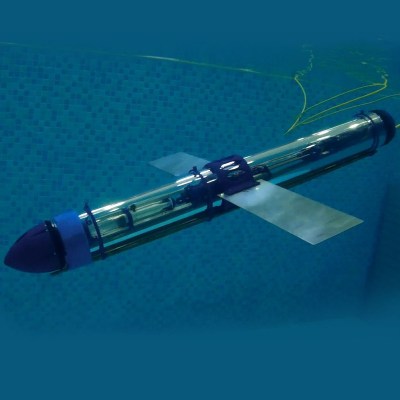
Studying earth’s oceans is increasingly important be it due to climate change or pollution. Alex Williams was awarded the 2017 Hackaday Prize for his Open Source Underwater Glider, a suite of sensors built into a cleverly low-power underwater autonomous vehicle. In 2016, Alberto Molina took the top spot for DTTO, a modular robotics system made up of multiple single-hinge segments that can reorient themselves. A team working toward an eye-controlled electric wheelchair placed first in 2015 for Eyedriveomatic — a solution that improved life for two of the team members with Motor Neuron Disease, (also called ALS). And the recipients of the first Hackaday Prize were recognized for their team’s development of a network of satellite ground stations (SatNOGS) which anyone can build, add to the network, and share time on to communicate with satellites as they make their orbit. This is an important tool to make low-cost research for things like Cubesats possible, and the network has been growing ever since.

If you feel the need for more inspiration, take a few minutes to look over the Hackaday Prize hall of fame of all of the top finishers through the years.

These are impressive ideas that began with the basic question of how can we do better? A simple idea can change the world but only if you share that idea and work to make it grow. Enter yours in the Hackaday Prize now!

3D Printering: Print Smoothing Tests With UV Resin

Smoothing the layer lines out of filament-based 3D prints is a common desire, and there are various methods for doing it. Besides good old sanding, another method is to apply a liquid coating of some kind that fills in irregularities and creates a smooth surface. There’s even a product specifically for this purpose: XTC-3D by Smooth-on. However, I happened to have access to the syrup-thick UV resin from an SLA printer and it occurred to me to see whether I could smooth a 3D print by brushing the resin on, then curing it. I didn’t see any reason it shouldn’t work, and it might even bring its own advantages. Filament printers and resin-based printers don’t normally have anything to do with one another, but since I had access to both I decided to cross the streams a little.

The UV-curable resin I tested is Clear Standard resin from a Formlabs printer. Other UV resins should work similarly from what I understand, but I haven’t tested them.

Continue reading “3D Printering: Print Smoothing Tests With UV Resin”

The Pontoon Bridge Being Floated As An NYC Transit Fix

New York City’s L train carries about 400,000 passengers a day, linking Manhattan and Brooklyn and bringing passengers along 14th Street, under the East River, and through the neighborhoods of Williamsburg, Bushwick, Ridgewood, Brownsville, and Canarsie. About 225,000 of these passengers pass through the Canarsie Tunnel, a two-tube cast iron rail tunnel built below the East River between Manhattan and Brooklyn in 1924. Like many other New York City road and subway tunnels, the Canarsie Tunnel was badly damaged when Hurricane Sandy’s storm surge inundated the tubes with million of gallons of salt water. Six years later, the impending closure of the tunnel is motivating New Yorkers to develop their own ambitious infrastructure ideas.

Continue reading “The Pontoon Bridge Being Floated As An NYC Transit Fix”

Evolution Of The Worlds Oldest Computer Festival

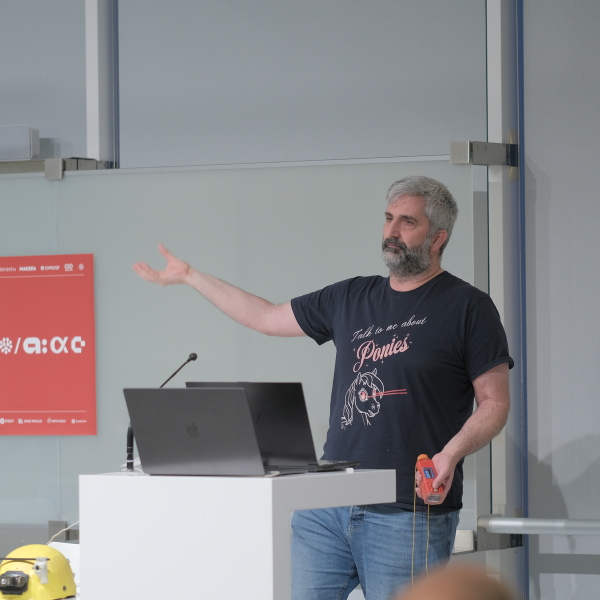
The Trenton Computer Festival (TCF) doesn’t have the name recognition of big technology conferences like DEF CON or HOPE. It’s not even as well known as smaller more localized conferences like DerbyCon, ShmooCon, or the Hackaday Superconference. In fact, there’s a good chance that most readers have never even heard of TCF. But despite not holding a place in the hacker lexicon, TCF has plenty to boast about. Its played host to technology luminaries from Bill Gates to Richard Stallman, and now in its 43rd year, holds the title as the longest continually running technology festival in the world.

Bill Gates giving the keynote at TCF in 1989

When originally conceived in 1976, the show was devoted to the dawning age of the personal computer, but since then has evolved into a celebration of technology as a whole. When TCF kicks off on March 17th, there won’t be a media blitz or huge corporate sponsorship. There won’t be a simultaneous online stream of the event, and the only badges worn by speakers or attendees will be of the paper variety.

What you will find at TCF is a full schedule of talks given by people who are passionate about technology in its varied forms. These run the gamut from quantum computing to lock picking, from Arduino to Space Shuttle avionics.

At the heart of TCF is co-founder and current Chair Dr Allen Katz. I recently had the opportunity to speak with Dr Katz about the challenges of running a conference of this type, and the secret to keeping relevant in a wildly changing technology landscape.

Continue reading “Evolution Of The Worlds Oldest Computer Festival”

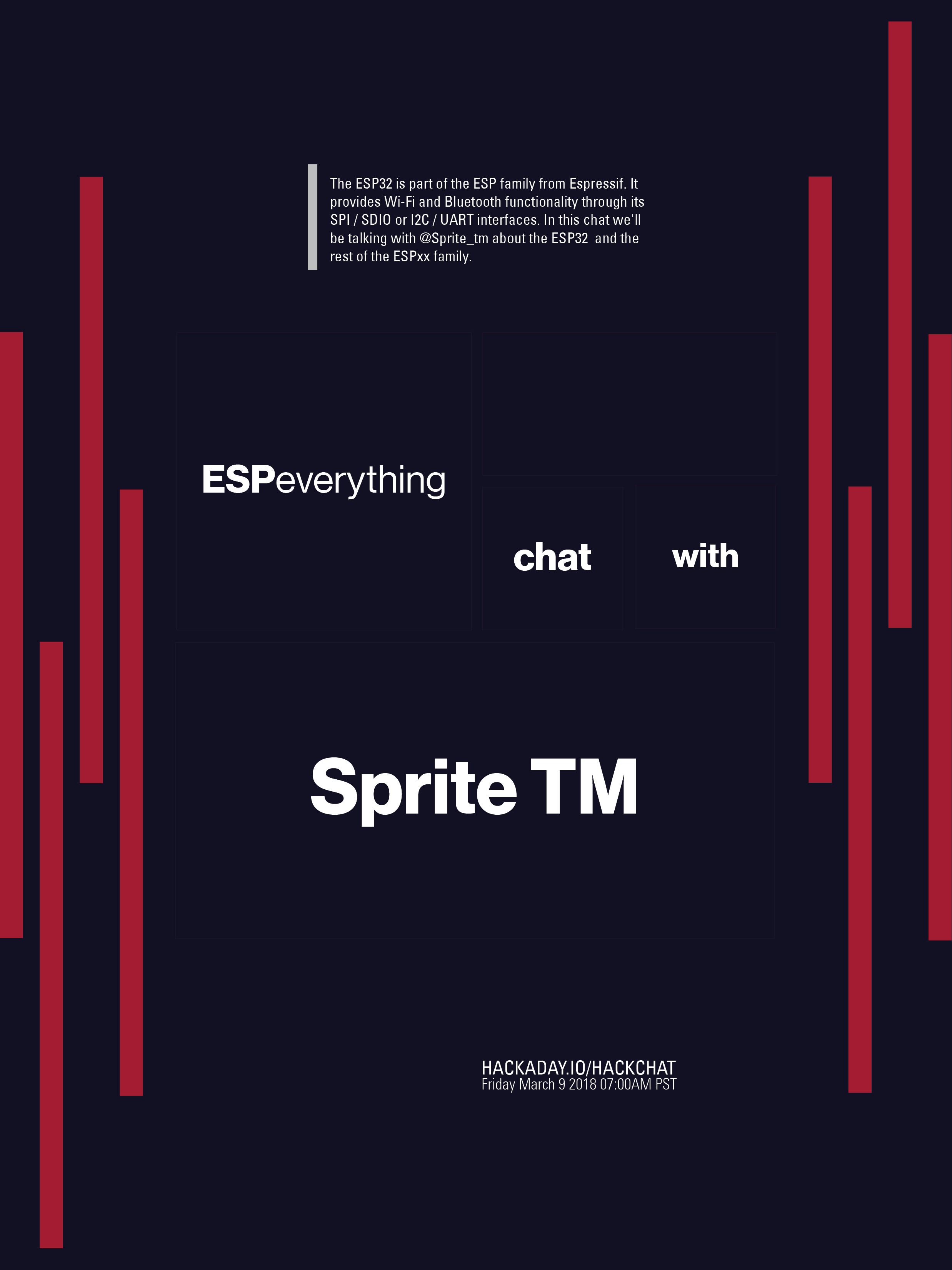
Friday Hack Chat: Everything About The ESP

When the ESP-8266 first arrived, it was a marvel. For two dollars, you could buy a simple module that could serve as a bridge between WiFi networks and microcontroller projects. It understood the Hayes command set, it didn’t use much power, and, as noted before, it only cost two dollars. The idea of cheap and accessible Internet of Things things was right there for the taking.

Then hackers figured out what was actually going on inside the ESP-8266. It was a full-blown microcontroller. There was Lua stuff you could put on it. You could program it with the Arduino IDE. It had WiFi. This was the greatest microcontroller release in the last decade, and it came from a company no one had ever heard of.

Since then, the ESP ecosystem has bloomed, and there’s a new ESP on the block. The ESP-32 is an even more powerful WiFi and Bluetooth-enabled chip that’s just as easy to program, and it costs three dollars. Microcontrollers have never been cooler.

For this week’s Hack Chat, we’re going to be talking all about the ESP. Our guest for this Hack Chat should need no introduction, but if you’re unfamiliar, [Sprite_tm] plays video games on his keyboard and has installed Linux on a hard drive. He also works at Espressif, the company behind the ESP-8266 and ESP-32, where he’s applied his skills towards tiny Game Boys and miniature Macs.

During this week’s Hack Chat, we’re going to be covering everything about the ESP, including peripherals, ultra-low power consumption, SIP packages, and what’s coming up for the ESP family. You are, as always, welcome to submit your questions for [Sprite]; just add those as a comment on the Hack Chat page.

join-hack-chat

Our Hack Chats are live community events on the Hackaday.io Hack Chat group messaging. [Sprite]’s in China, so we’re not doing this one at the usual time: This week, the Hack Chat will happen at 7:00 am, Pacific, Friday, March 9th. Want to know what time this is happening in your neck of the woods? Have a countdown timer!

Click that speech bubble to the right, and you’ll be taken directly to the Hack Chat group on Hackaday.io.

You don’t have to wait until Friday; join whenever you want and you can see what the community is talking about.