Do You Know Oleg Losev? An Engineer Tragically Ahead Of His Time

It is so often the case with a particular technological advance, that it will be invented almost simultaneously by more than one engineer or scientist. People seem to like a convenient tale of a single inventor, so one such person is remembered while the work of all the others who trod the same path is more obscure. Sometimes the name we are familiar with simply managed to reach a patent office first, maybe they were the inventor whose side won their war, or even they could have been a better self-publicist.

When there are close competitors for the crown of inventor then you might just have heard of them, after all they will often feature in the story that grows up around the invention. But what about someone whose work happened decades before the unrelated engineer who replicated it and who the world knows as the inventor? They are simply forgotten, waiting in an archive for someone to perhaps discover them and set the record straight.

Oleg Losev (Public domain)
[Oleg Losev] (Public domain)
Meet [Oleg Losev]. He created the first practical light-emitting diodes and the first semiconductor amplifiers in 1920s Russia, and published his results. Yet the world has never heard of him and knows the work of unrelated American scientists in the period after the Second World War as the inventors of those technologies. His misfortune was to born in the wrong time and place, and to be the victim of some of the early twentieth century’s more turbulent history.

[Oleg Losev] was born in 1903, the son of a retired Russian Imperial Army officer. After the Russian Revolution he was denied the chance of a university education, so worked as a technician first at the Nizhny Novgorod Radio laboratory, and later at the Central Radio Laboratory in Leningrad. There despite his  relatively lowly position he was able to pursue his research interest in semiconductors, and to make his discoveries.

Continue reading “Do You Know Oleg Losev? An Engineer Tragically Ahead Of His Time”

WikiLeaks Unveils Treasure Trove Of CIA Documents

The latest from WikiLeaks is the largest collection of documents ever released from the CIA. The release, called ‘Vault 7: CIA Hacking Tools Revealed’, is the CIA’s hacking arsenal.

While Vault 7 is only the first part in a series of leaks of documents from the CIA, this leak is itself massive. The documents, available on the WikiLeaks site and available as a torrent, detail the extent of the CIA’s hacking program.

Of note, the CIA has developed numerous 0-day exploits for iOS and Android devices. The ‘Weeping Angel’ exploit for Samsung smart TVs,  “places the target TV in a ‘Fake-Off’ mode, so that the owner falsely believes the TV is off when it is on.” This Fake-Off mode enables a microphone in the TV, records communications in the room, and sends these recordings to a CIA server. Additionally, the CIA has also developed tools to take over vehicle control systems. The purpose of such tools is speculative but could be used to send a moving car off the road.

It is not an exaggeration to say this is the most significant leak from a government agency since Snowden, and possibly since the Pentagon Papers. This is the documentation for the CIA’s cyberwarfare program, and there are more leaks to come. It will be a while until interested parties — Hackaday included — can make sense of this leak, but until then WikiLeaks has published a directory of this release.

Header image source (CC BY 2.0)

Adding An External Antenna To The Raspberry Pi Zero W

Putting a complete WiFi subsystems on a single-board computer is no mean feat, and on as compact a board as the Zero W, it’s quite an achievement. The antenna is the tricky part, since there’s only so much you can do with copper traces.

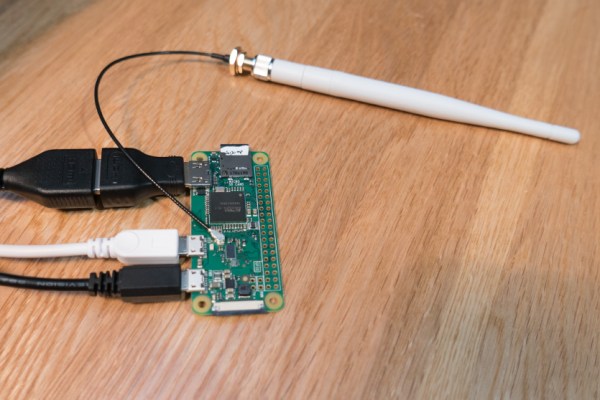
The new Raspberry Pi Zero W’s antenna is pretty innovative, but sometimes you need an external antenna to reach out and touch someone. Luckily, adding an external antenna to the Zero W isn’t that tough at all, as [Brian Dorey] shows us. The Pi Zero W’s designers thoughtfully included solder pads for an ultra-miniature surface-mount UHF jack. The jack pads are placed very close to the long, curving trace that acts as a feedline to the onboard antenna. There’s even a zero ohm SMT resistor that could be repositioned slightly to feed RF to the UHF jack. A little work with a soldering iron and [Brian]’s Pi was connected to an external antenna.

[Brian] includes test data, but aside from a few outliers, the external antenna doesn’t seem to offer a huge advantage, at least under his test conditions. This speaks to the innovative design of the antenna, which [Roger Thornton] from the Raspberry Pi Foundation discussed during last week’s last week’s Hack Chat. Check out the archive for that and more.

Thanks to [theEngineer] for the tip.

Open Source Firmware For A Cheap Programmable Power Supply

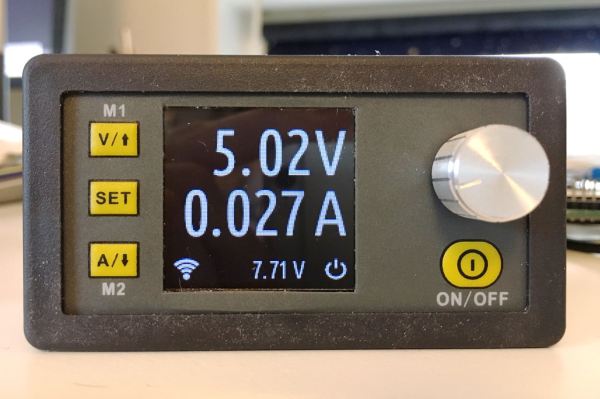
A few months ago, someone clued us in on a neat little programmable power supply from the usual Chinese retailers. The DPS5005 is a programmable power supply that takes power from a big AC to DC wall wart and turns it into a tiny bench-top power supply. You can pick one of these things up for about thirty bucks, so if you already have a sufficiently large AC to DC converter you can build a nice 250 Watt power supply on the cheap.

[Johan] picked up one of these tiny programmable power supplies. His overall impression was positive, but like so many cheap products on AliExpress, there wasn’t a whole lot of polish to the interface. Additionally, the DPS5005 lacked the ability to be controlled over a serial port or WiFi.

This programmable power supply is built around an STM32, with the programming pads exposed and labeled on the PCB. The changes [Johan] wanted to make were all in software, leading him to develop OpenDPS, a firmware replacement for the DPS5005. Continue reading “Open Source Firmware For A Cheap Programmable Power Supply”

Saved By The Bel — Understanding Decibels

If you’ve hung around electronics for any length of time, you’ve surely heard of the decibel (often abbreviated dB). The decibel is a measure of a power ratio. Actually, the real measure is a bel, but you almost never see that in practice. If you are versed in metric, you won’t be surprised to learn a decibel is 1/10 of a bel. Sometimes in electronics, we deal with really large ratios, so the decibel is logarithmic to cope with this. Doubling the number of decibels doesn’t double the ratio, as you will soon see. It’s all about logarithms, and this ends up being extremely useful when measuring something like antenna or amplifier gain.

Besides antennas, decibels are often used to measure sound and light. The reason is that human ears and eyes have a logarithmic response to those quantities. Your ear, for example, has a huge dynamic range. That is to say, you can hear a whisper or a space shuttle launch. That ratio is about 1 trillion to 1, but that’s only 120 dB. This is also why potentiometers made for volume controls have a logarithmic taper. A linear pot would seem off because, for example, a tenth of a turn at one extreme will affect the apparent volume much more than a tenth of a turn at the other extreme. This holds true whether or not those knobs go up to eleven.

Continue reading “Saved By The Bel — Understanding Decibels”

Fixing Fake FTDIs

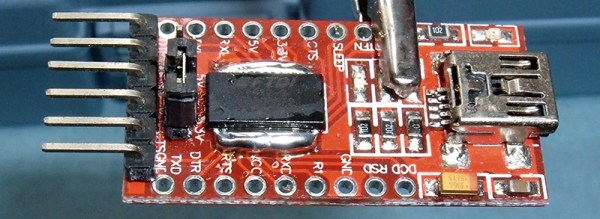
If you know where to go on the Internet, you can pick up an FTDI USB to Serial adapter for one dollar and sixty-seven cents, with free shipping worldwide. The chip on this board is an FTDI FT232RL, and costs about two dollars in quantity. This means the chips on the cheap adapters are counterfeit. While you can buy a USB to serial adapter with a legitimate chip, [Syonyk] found a cheaper solution: buy the counterfeit adapters, a few genuine chips, and rework the PCB. It’s brilliant, and an excellent display of desoldering prowess.

Why is [Syonyk] replacing non-genuine chips with the real FTDI? The best reason is FTDIgate Mk. 1, where the official FTDI driver for Windows detected non-genuine chips and set the USB PID to zero. This bricked a whole bunch of devices, and was generally regarded as a bad move. FTDIgate Mk. 2 was a variation on a theme where the FTDI driver would inject garbage data into a circuit if a non-genuine part was found. This could also brick devices. Notwithstanding driver issues, the best reason for swapping out fake chips for real ones is the performance at higher bit rates; [Syonyk] is doing work at 3 Mbps, and the fake chips just don’t work that fast.

To replace the counterfeit chip, [Syonyk] covered the pins in a nice big glob of solder, carefully heated both sides of the chip, and slid the offending chip off when everything was molten. A bit of solder braid, and the board was ready for the genuine chip.

With the new chip, the cheap USB to serial adapter board works perfectly, although anyone attempting to duplicate these efforts might want to look into replacing the USB mini port with a USB micro port.

What Voltage For The All-DC House?

The war of the currents was fairly decisively won by AC. After all, whether you’ve got 110 V or 230 V coming out of your wall sockets, 50 Hz or 60 Hz, the whole world agrees that the frequency of oscillation should be strictly greater than zero. Technically, AC won out because of three intertwined facts. It was more economical to have a few big power plants rather than hundreds of thousands of tiny ones. This meant that power had to be transmitted over relatively long distances, which calls for higher voltages. And at the time, the AC transformer was the only way viable to step up and down voltages.

acdc
No, not that AC/DC

But that was then. We’re right now on the cusp of a power-generation revolution, at least if you believe the solar energy aficionados. And this means two things: local power that’s originally generated as DC. And that completely undoes two of the three factors in AC’s favor. (And efficient DC-DC converters kill the transformer.) No, we don’t think that there’s going to be a switch overnight, but we wouldn’t be surprised if it became more and more common to have two home electrical systems — one remote high-voltage AC provided by the utilities, and one locally generated low-voltage DC.

Why? Because most devices these days use low-voltage DC, with the notable exception of some big appliances. Batteries store DC. If more and more homes have some local DC generation capability, it stops making sense to convert the local DC to AC just to plug in a wall wart and convert it back to DC again. Hackaday’s [Jenny List] sidestepped a lot of this setup and went straight for the punchline in her article “Where’s my low-voltage DC wall socket?” and proposed a few solutions for the physical interconnects. But we’d like to back it up for a minute. When the low-voltage DC revolution comes, what voltage is it going to be?

Continue reading “What Voltage For The All-DC House?”