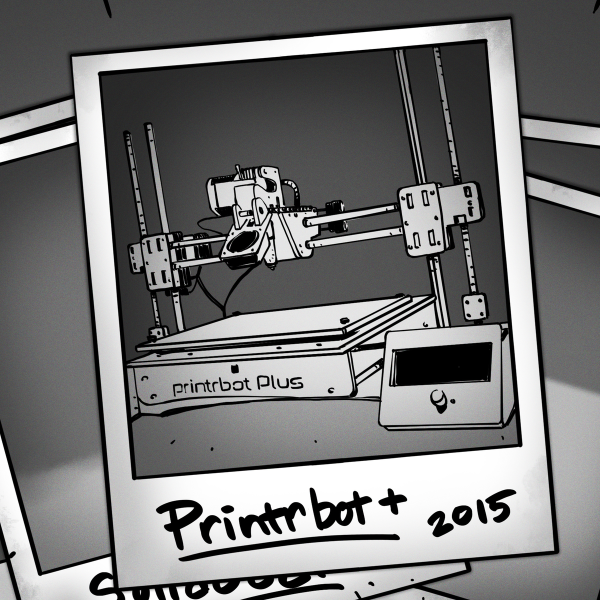
Let’s get it out of the way right up front: you still need to etch the boards. However, [Mikey77] found that flexible plastic (Ninjaflex) will adhere to a bare copper board if the initial layer height is set just right. By printing on a thin piece of copper or conductive fabric, a resist layer forms. After that, it is just simple etching to create a PCB. [Mikey77] used ferric chloride, but other etchants ought to work, as well.
Sound simple, but as usual, the devil is in the details. [Mikey77] found that for some reason white Ninjaflex stuck best. The PCB has to be stuck totally flat to the bed, and he uses spray adhesive to do that. Just printing with flexible filament can be a challenge. You need a totally constrained filament path, for one thing.
When we see a new build by [Gord] from Gord’s Garage, we never know what to expect. He seems to be pretty skilled at whatever he puts his hand to, with a great design sense and impeccable craftsmanship. You might expect him to tone it down a little for a STEM-outreach wind turbine project then, but when you get a chance to impress 28 fifth and sixth graders, you might as well go for it.
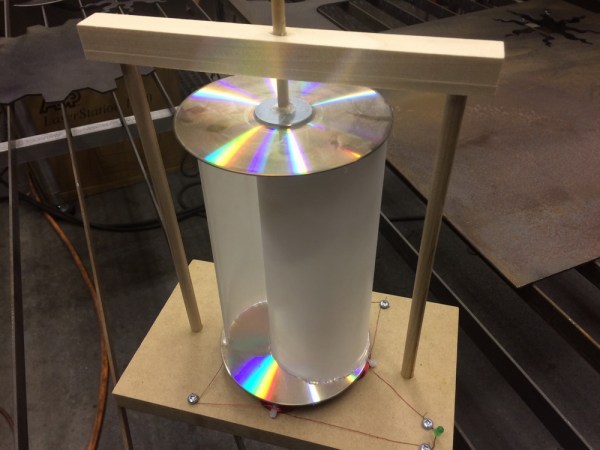
Starting with an idea from his daughter’s teacher for wind turbines each kid could make, [Gord] applied a little lean methodology so the kids would be able to complete the build in the allotted time. The design is simple – a couple of old CDs holding vertical sections of PVC tubing to catch the breeze and spin neodymium magnets over four flat coils of magnet wire. It’s enough to light a single LED and perhaps a kid’s imagination.
As simple as the turbine is, the process of building it needed to be stripped of as much unnecessary work as possible, and [Gord] really shines here. He built jigs and fixtures galore, pre-built some assemblies, and set up well-organized workstations for each step of the build. Everything was clearly labeled, adult volunteers were trained using the video after the break, and a good time was had by all.
Sometimes the hack isn’t in the product but in the process, and [Gord] managed to hack a success out a potential disaster of disappointed kids. If getting a taste of [Gord]’s style makes you want to see more, check out his guitar fretting jig or his brake rotor mancave clock.
There was a time when Radio Shack offered an incredible variety of supplies for the electronics hobbyist. In the back of each store, past the displays of Realistic 8-track players, Minimus-7 speakers, Patrolman scanners, and just beyond the battery bin where you could cash in your “Battery of the Month Club” card for a fresh, free 9-volt battery, lay the holy of holies — the parts. Perfboard panels on hinges held pegs with cards of resistors for 49 cents, blister packs of 2N2222 transistors and electrolytic capacitors, and everything else you needed to get your project going. It was a treasure trove to a budding hardware hobbyist.
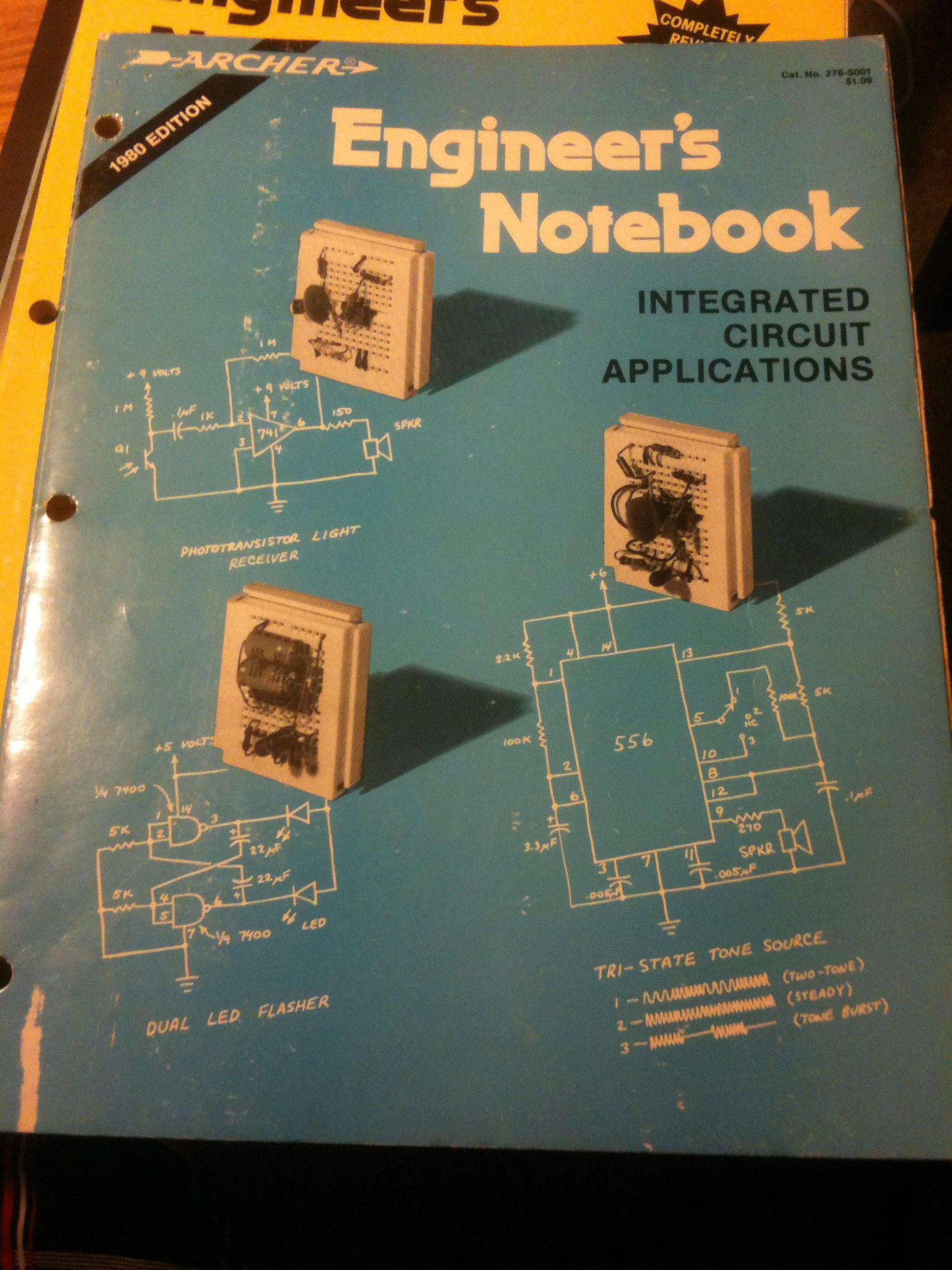
But over on the side, invariably near the parts, was a rack of books for sale, mostly under the Archer brand. 12-year old me only had Christmas and birthday money to spend, and what I could beg from my parents, so I tended to buy books — I figured I needed to learn before I started blowing money on parts. And like many of that vintage, one of the first books I picked up was the Engineer’s Notebook by Forrest M. Mims III.
Wish I could find my original copy from 1979. I just bought this one from Amazon.
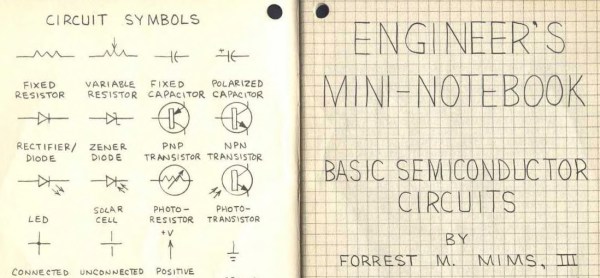
Many years rolled by, and my trusty and shop-worn first edition of Mims’ book, with my marginal notes and more than one soldering iron burn scarring its pulp pages, has long since gone missing. I learned so much from that book, and as I used it to plan my Next Big Project I’d often wonder how the book came about. Those of you that have seen the book and any of its sequels, like the Mini-notebook Series, will no doubt remember the style of the book. Printed on subdued graph paper with simple line drawings and schematics, the accompanying text did not appear to be typeset, but rather hand lettered. Each page was a work of technical beauty that served as an inspiration as I filled my own graph-paper notebooks with page after page of circuits I would find neither the time nor money to build.
I always wondered about those books and how they came about. It was a pretty astute marketing decision by Radio Shack to publish them and feature them so prominently near the parts — sort of makes the string of poor business decisions that led to the greatly diminished “RadioShack” stores of today all the more puzzling. Luckily, Forrest Mims recently did an AMA on reddit, and he answered a lot of questions regarding how these books came about. The full AMA is worth a read, but here’s the short story of those classics of pulp non-fiction.
Accurate timing is one of the most basic requirements for so much of the technology we take for granted, yet how many of us pause to consider the component that enables us to have it? The quartz crystal is our go-to standard when we need an affordable, known, and stable clock frequency for our microprocessors and other digital circuits. Perhaps it’s time we took a closer look at it.
The first electronic oscillators at radio frequencies relied on the electrical properties of tuned circuits featuring inductors and capacitors to keep them on-frequency. Tuned circuits are cheap and easy to produce, however their frequency stability is extremely affected by external factors such as temperature and vibration. Thus an RF oscillator using a tuned circuit can drift by many kHz over the period of its operation, and its timing can not be relied upon. Long before accurate timing was needed for computers, the radio transmitters of the 1920s and 1930s needed to stay on frequency, and considerable effort had to be maintained to keep a tuned-circuit transmitter on-target. The quartz crystal was waiting to swoop in and save us this effort.
See those blue and green dots in the GIF? Those aren’t pixels on an LCD display. Those are actual drops of liquid moving across a special PCB. The fact that the droplets are being manipulated to play a microfluidics game of “Frogger” only makes OpenDrop v 2.0 even cooler.
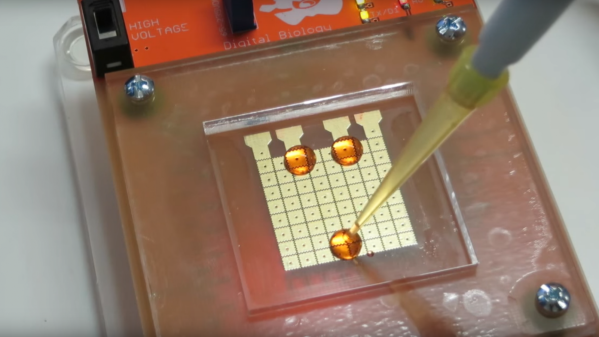
Lab biology is mainly an exercise in liquid handling – transferring a little of solution X into some of solution Y with a pipette. Manual pipetting is tedious, error prone, and very low throughput, but automated liquid handling workstations run into the hundreds of thousands of dollars. This makes [Urs Gaudenz]’s “OpenDrop” microfluidics project a potential game changer for the nascent biohacking movement by offering cheap and easy desktop liquid handling.
Details are scarce on the OpenDrop website as to exactly how this works, but diving into the literature cited reveals that the pads on the PCB are driven to high voltages to attract the droplets. The PCB itself is covered with a hydrophobic film – Saran wrap that has been treated with either peanut oil or Rain-X. Moving the droplets is a simple matter of controlling which pads are charged. Splitting drops is possible, as is combining them – witness the “frog” getting run over by the blue car.
There is a lot of cool work being done in microfluidics, and we’re looking forward to see what comes out of this open effort. We’ve covered other open source efforts in microfluidics before, but this one seems so approachable that it’s sure to capture someone’s imagination.
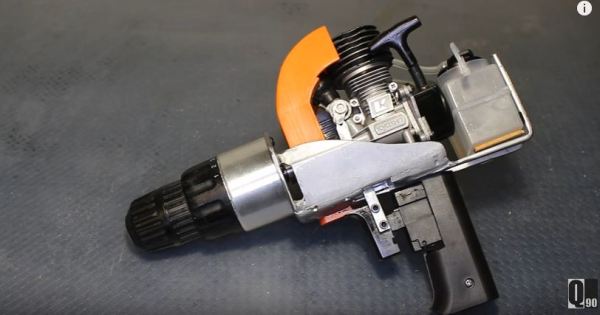
There are few projects on how to make your own cordless drill, but what sets [Johnnyq90’s] amazing project apart is the fact that his power plant is a nitro engine. Not an easy task of course, but he makes it look easier than it is, and we really enjoyed the construction process.
He uses an RC Kyosho GX12 engine that was previously modified, changing the cooling head with a larger one. The engine drives a gearbox that was taken from another drill. All other parts were hand made. The clutch was carefully machined, and the cooling fan was made in a 3D printer. Other necessary parts were the frame, brass spacers to adjust the engine height and alignment, throttle arm and handle. In the end even the gearbox had to be modified for higher speed. The finished drill sure looks and sounds terrific, and seems to be perfectly capable of doing its job.
As with other mechanical projects from [Johnnyq90], the video has good timing and attention to detail. His channel is definitely worth a visit, specially if you like turbines.
I heard a “Year in Review” program the other day on NPR with a BBC World Service panel discussion of what’s ahead for 2017. One prediction was that UAV delivery of packages would be commonplace this year, and as proof the commentator reported that Amazon had already had a successful test in the UK. But he expressed skepticism that it would ever be possible in the USA, where he said that “the first drone that goes over somebody’s property will be shot down and the goods will be taken.”
He seemed quite sincere about his comment, but we’ll give him the benefit of the doubt that he was only joking to make a point, not actually grotesquely ignorant about the limitations of firearms or being snarky about gun owners in the US. Either way, he brings up a good point: when autonomous parcel delivery is commonplace, who will make sure goods get to the intended recipient?