Desuiciding Capcom Arcade Boards

Capcom’s CPS2 – or CP System II – was the early to mid-90s arcade hardware famous for Super Street Fighter II, Alien vs. Predator, and a few of the Marvel and Capcom crossover arcade games. As you would expect, these boards have become collectors items. Unfortunately for future generations, Capcom took some short-sighted security measures to prevent copying the games, and the boards have been failing over the last two decades.

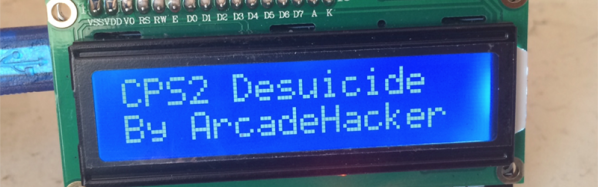
After months of work, [ArcadeHacker] and several other arcade enthusiasts have reverse engineered the security protocol and devised a method of de-suiciding these arcade boards, allowing for the preservation of this hardware and these games. The code that does the trick is up on GitHub.

Last year, [ArcadeHacker] reverse engineered the on-chip security for Capcom’s Kabuki processor, the CPU used in some of Capcom’s earlier arcade boards. It used a similar protection scheme. In the Kabuki hardware, the on-chip ROM was interspersed with a few XOR gates on the processor’s bus. With a security key kept in battery-backed memory, this was enough to keep the code for the game secret, albeit at the cost of preventing historical preservation.

Over the next few weeks, [ArcadeHacker] will post more detailed information about the copy protection scheme of the CPS2 board, but the proof-of-concept works right now. It’s now possible to revive a CPS2 board that has killed itself due to a dead battery, and the hardware is as simple as an Arduino and a few test clips. You can check out a video of the exploit in action below.
Continue reading “Desuiciding Capcom Arcade Boards”

3D Printering: Aramid And Carbon Fiber Infused ABS

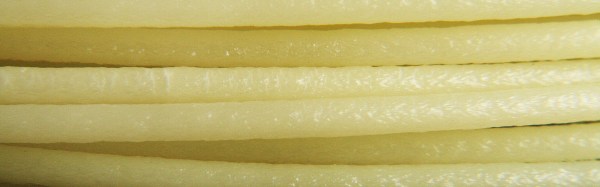
Last week, we had a look at a carbon-infused PETG filament. This week, I’d like to show you two composites based on a more common thermoplastic in 3D printing: ABS. Among a whole lot of other engineering plastics, the french company Nanovia manufactures Kevlar-like aramid-fiber-infused and carbon-fiber-infused ABS 3D printing filaments. These materials promise tougher parts with less warping while being just as easy to print as regular ABS. Let’s check them out!

Continue reading “3D Printering: Aramid And Carbon Fiber Infused ABS”

ESP32 Hands-On: Awesome Promise

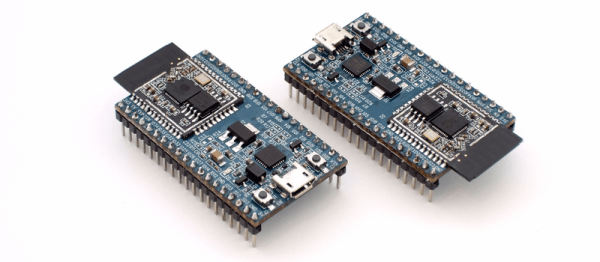
The ESP32 is looking like an amazing chip, not the least for its price point. It combines WiFi and Bluetooth wireless capabilities with two CPU cores and a decent hardware peripheral set. There were modules in the wild for just under seven US dollars before they sold out, and they’re not going to get more expensive over time. Given the crazy success that Espressif had with the ESP8266, expectations are high.

And although they were just formally released ten days ago, we’ve had a couple in our hands for just about that long. It’s good to know hackers in high places — Hackaday Superfriend [Sprite_tm] works at Espressif and managed to get us a few modules, and has been great about answering our questions.

We’ve read all of the public documentation that’s out there, and spent a week writing our own “hello world” examples to confirm that things are working as they should, and root out the bugs wherever things aren’t. There’s a lot to love about these chips, but there are also many unknowns on the firmware front which is changing day-to-day. Read on for the full review.

Continue reading “ESP32 Hands-On: Awesome Promise”

MIT Researchers Can Read Closed Books (and Defeat CAPTCHA)

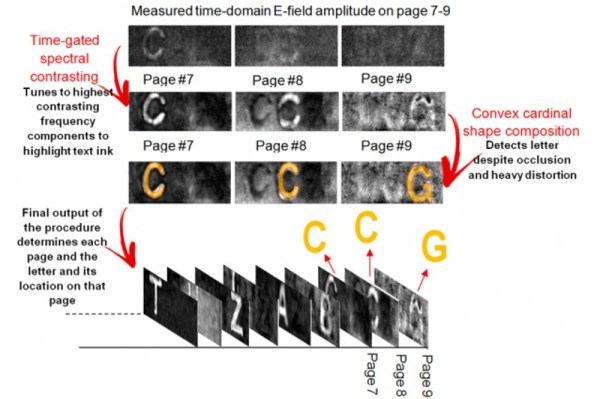
Ten years ago, MIT researchers proved that it was possible to look through an envelope and read the text inside using terahertz spectroscopic imaging. This research inspired [Barmak Heshmat] to try the same technique to read a book through its cover. A new crop of MIT researchers led by [Heshmat] have developed a prototype to do exactly that, and he explains the process in the video after the break. At present, the system is capable of correctly deciphering individual letters through nine pages of printed text.

They do this by firing terahertz waves in short bursts at a stack of pages and interpreting the return values and travel time. The microscopic air pockets between the pages provide boundaries for differentiation. [Heshmat] and the team rely on these pockets to reflect the signal back to a sensor in the camera. Once they have the system dialed in to be able to see the letters on the target page and distinguish them from the shadows of the letters on the other pages, they use an algorithm to determine the letters. [Heshmat] says the algorithm is so good that it can get through most CAPTCHAs.

The most immediate application for this technology is reading antique books and other printed materials that are far too fragile to be handled, potentially opening up worlds of knowledge that are hidden within disintegrating documents. For a better look at the outsides of things, there is Reflectance Transformation Imaging.

Continue reading “MIT Researchers Can Read Closed Books (and Defeat CAPTCHA)”

Staring At The Sun: Erasing An EPROM

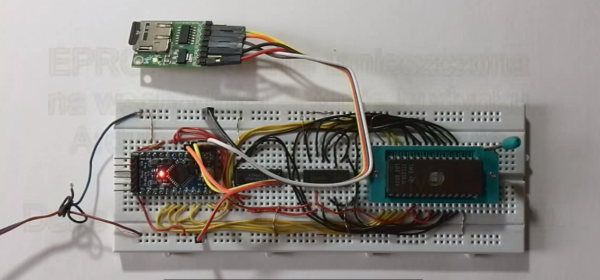
Flash memory is the king today. Our microcontrollers have it embedded on the die. Phones, tablets, and computers run from flash. If you need re-writable long term storage, flash is the way to go. It hasn’t always been this way though. Only a few years ago EPROM was the only show in town. EPROM typically is burned out-of-circuit in a programming fixture. When the time comes to erase the EPROM, just pop it under an ultraviolet (UV) bulb for 30 minutes, and you’re ready to go again. The EPROM’s quartz window allows UV light to strike the silicon die, erasing the memory.

The problem arises when you want to use an EPROM for long term storage. EPROM erasers weren’t the only way to blank a chip. The sun will do it in a matter of weeks. Even flourescent light will do it — though it could take years.

Continue reading “Staring At The Sun: Erasing An EPROM”

Furuta Style Inverted Pendulum Is King Of Geek Desk Ornaments

Newton’s Cradle is thought of as the most elegant of executive desk toys. But that 20th-century dinosaur just got run off the road as [Ben Katz]’s Furuta pendulum streaks past in the fast lane, flipping the bird and heralding a new king of desk adornments.

This Furata pendulum has wonderfully smooth movement. You can watch it go through its dance in the video after the break. Obviously you agree that this is the desk objet d’art for the modern titan of industry (geek). Just don’t stop at watching it in action. The best part is the build log that [Ben] put together — this project has a little bit of everything!

Continue reading “Furuta Style Inverted Pendulum Is King Of Geek Desk Ornaments”

Complex, Beautiful Device Is Limited To Text-speak And Cat Pictures (WTF, LOL)

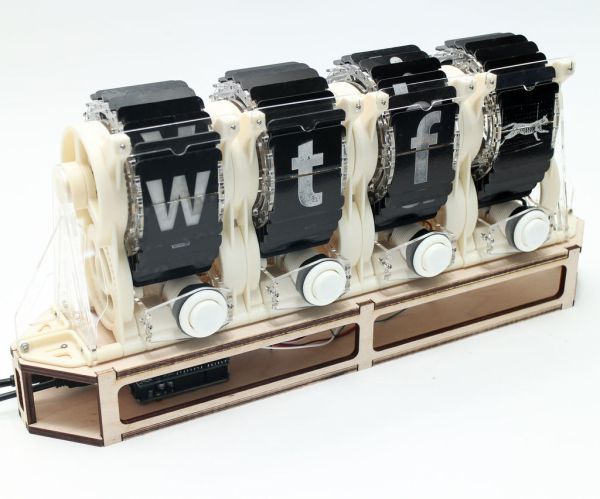
Beautifully documented, modular, and completely open-source, this split flap display project by [JON-A-TRON] uses 3D printing, laser cutting and engraving, and parts anyone can find online to make a device that looks as sharp as it is brilliantly designed. Also, it appears to be a commentary on our modern culture since this beautifully engineered, highly complex device is limited to communicating via three-letter combos and cat pictures (or cat video, if you hold the button down!) As [JON-A-TRON] puts it, “Why use high-resolution, multi-functional devices when you can get back to your industrial revolution roots?” Video is embedded below.

Continue reading “Complex, Beautiful Device Is Limited To Text-speak And Cat Pictures (WTF, LOL)”