How Analog Tide Predictors Changed Human History

If you’re completely landlocked like I am, you may dream of ocean waves lapping at the shore, but you probably don’t think much about the tides. The movement of the ocean tides is actually quite important to many groups of people, from fishermen to surfers to coastal zone engineers. The behavior of the tides over time is helpful data for those who study world climate change.

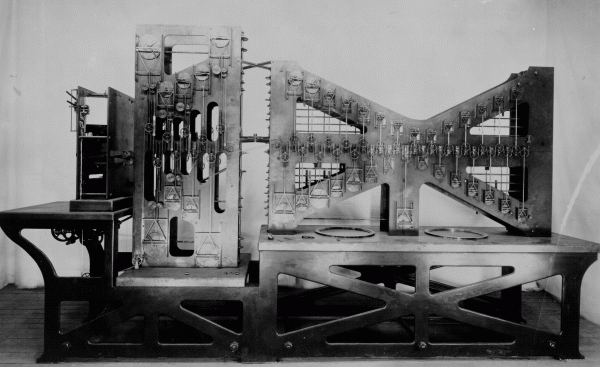
Early tide prediction was based on observed changes in relation to the phases of the Moon. These days, tide-predicting is done quickly and with digital computers. But the first purpose-built machines were slow yet accurate analog computation devices that, as they were developed, could account for increasing numbers of tidal constituents, which represent the changes in the positions of tide-generating astronomical bodies. One of these calculating marvels even saved the Allies’ invasion of Normandy—or D-Day— in World War II.

Continue reading “How Analog Tide Predictors Changed Human History”

Google OnHub Can Has Root

It’s always nice to get down to the root directory of a device, especially if the device in question is one that you own. It’s no huge surprise that a Google product allows access to the root directory but the OnHub requires locating the hidden “developer mode” switch which [Maximus64] has done. The Google engineers have been sneaky with this button, locating it at the bottom of a threaded screw hole. Has anyone seen this implemented on other hardware before?

There isn’t a blog post regarding this, however [Maximus64] shared a video on YouTube walking us through the steps to root and un-root Google’s OnHub, which is embedded after the break. He also states “wiki coming soon” in the description of the video, so we’ll keep eye on it for an update.

We covered the product announcement back in August and have heard a few reviews/opinions about the device but not enough to make an opinionated assumption. Rooting the device doesn’t seem to increase the OnHub’s number of LAN ports but we think it’s still worth the effort.

Continue reading “Google OnHub Can Has Root”

ARMs And FPGAs Make For Interesting Dev Boards

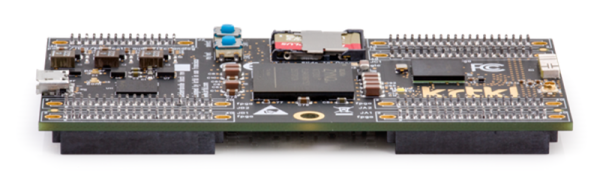
Tiny Linux computers are everywhere, and between BeagleBones, Raspberry and Banana Pis, and a hundred other boards out there, there are enough choices to go around. There is an extremely interesting ARM chip from Xilinx that hasn’t seen much uptake in the field of tiny credit-card sized computers: the Zynq. It’s an ARM Cortex-A9 coupled with an FPGA. It’s great for building peripherals that wouldn’t normally be included on a microcontroller. With Zynq, you just instantiate the custom bits in the FPGA, then interface them with a custom Linux driver. Thanks to CrowdSupply, there’s now a board out there that brings this intriguing chip to a proper development platform. It’s called the Snickerdoodle, and if you’ve ever wanted to see the capabilities of an FPGA tightly coupled to a fast processor, this is the board to watch.

The core of the Snickerdoodle is a Xilinx Zynq that features either a 667 MHz ARM Cortex A9 and a 430k gate FPGA (in the low-end configuration) or an 866 A9 and 1.3M gate FPGA. This gives the Snickerdoodle up to 179 I/O ports – far more than any other tiny Linux board out there.

Fully loaded, the Snickerdoodle comes with 2.4 and 5GHz WiFi, Bluetooth, 1GB of RAM, and an ARM Cortex A9 that should far surpass the BeagleBone and Raspberry Pi 2 in capabilities. This comes at a price, though: the top-shelf Snickerdoodle has a base price of about $150.

Still, the power of a fast ARM and a big FPGA is a big draw and we’re expecting a few more of these Zynq boards in the future. There are even a few projects using the Zynq on hackaday.io, including one that puts the Zynq in a Raspberry Pi-compatible footprint. That’s exceedingly cool, and we can’t wait to see what people will build with a small, fast ARM board coupled to an FPGA.

Conference Badges Are The Newest Form Of Hardware Art

About four decades ago, many European truck drivers started placing electronic LED badges in their windshields. Most of them were simple; nothing more than an animated heart pierced by an arrow. It became a common distraction in the highway night panorama of that time, at least until it became illegal. Most motorists became accustomed to seeing them, and the idea of the truck drivers making a statement with electronics always stuck with me. Now I have the chance to help people make a similar statement. Conference badges are not just a way to identify those who have registered, but a fashion statement and a mark of pride for conference organizers. They’ve become an art form, and engineers always want to stretch the limits of what is possible.

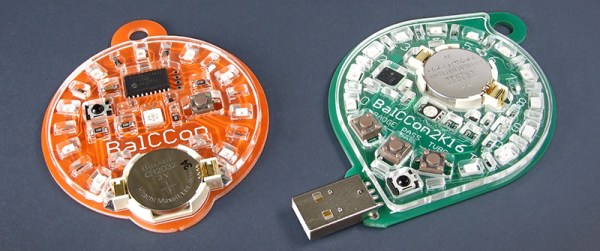
Every September, we have BalCCon, an international hacker’s conference at Novi Sad, Serbia. I was asked to design a badge for the 2016 event, and this is the first (well, the second) release. It is based on the PIC18LF24K50 and consists of a circle of LEDs which randomly displays pre-defined patterns. Every badge has its own infrared transceiver (LED-receiver pair), so the fun begins when two or more badges spot each other: they go from Adagio to full on Rondo, losing their default, dull visual pattern for a more dynamic, attention grabbing one, but most importantly – they synchronize. This means that, in a group of people, all badges will play the same pattern in unison. Every badge can spread the pattern code, so the whole group, however large, soon becomes synchronized. But if one of them “gets lost” somehow, it will try to learn it back from a neighbor or it might even launch into its own, randomly generated one. Sometimes it manages to spread it further and you get to witness a battle for light show domination.

This isn’t merely a story of designing badges, but of design choices that come in on budget while achieving a look that will delight those who end up wearing the hardware.

Continue reading “Conference Badges Are The Newest Form Of Hardware Art”

Electronics For Aliens

We are surrounded by displays with “millions” of colors and hundreds of pixels per inch. With super “high fidelity” sound producing what we perceive to be realistic replicas of the real world.

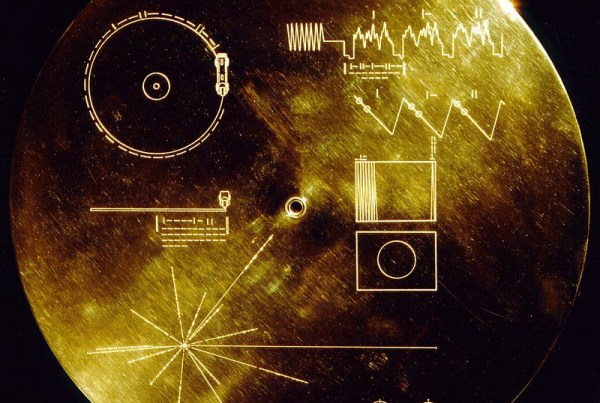
Of course this is not the case, we rarely stop and think how our electronic systems have been crafted around the limitations of human perception. So to explore this issue, in this article we ask the question: “What might an alien think of human technology?”. We will assume a lifeform which senses the world around it much as we do. But has massively improved sensing abilities. In light of these abilities we will dub it the Oculako.

Let’s begin with the now mostly defunct CRT display and see what our hypothetical alien thinks of it. The video below shows a TV screen shot at 10,000 frames per second.

Continue reading “Electronics For Aliens”

Georgia Tech Pumps Water Through Silicon For Chip Cooling

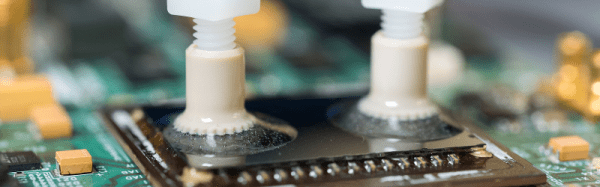
One of the things that stops electronic devices from going faster is heat. That’s why enthusiasts go as far as using liquid nitrogen to cool CPU chips to maximize their overclocking potential. Researchers at Georgia Tech have been working on cutting fluid channels directly into the back of commercial silicon die (an Altera FPGA, to be exact). The tiny channels measure about 100 micron and are resealed with another layer of silicon. Water is pumped into the channels to cool the device efficiently.

A comparable air-cooled device would operate at about 60 degrees Celsius. With the water cooling channels cut into the die and 20 degree water pumped at 147 ml/minute, the researchers kept the chip operating about less than 24 degrees Celsius.

Continue reading “Georgia Tech Pumps Water Through Silicon For Chip Cooling”

Deuterium Powered Homes And The Return Of Cold Fusion Hype

We’ve been sent this press release claiming a new kind of fusion reaction that works at small scales using an incredibly exotic fuel material: ultra-dense deuterium. We looked into it with an open mind, and if we’re being kind we’ll conclude that there’s a ten-year long research project being undertaken by [Leif Holmlid], a single scientist whose claims would win him one or two Nobel prizes if any of it were true.

If we drop the kindness and approach it rationally, this doesn’t smell right and can’t be believed until it has been reliably reproduced by someone not associated with the original research. Let’s delve into the claim of Deuterium powered reactions, and circle around on the cold-fusion hype we found so sadly entertaining back in the ’90s.

Continue reading “Deuterium Powered Homes And The Return Of Cold Fusion Hype”