RTLSDR

Decoding Satellite-based Text Messages With RTL-SDR And Hacked GPS Antenna

[Carl] just found a yet another use for the RTL-SDR. He’s been decoding Inmarsat STD-C EGC messages with it. Inmarsat is a British satellite telecommunications company. They provide communications all over the world to places that do not have a reliable terrestrial communications network. STD-C is a text message communications channel used mostly by maritime operators. This channel contains Enhanced Group Call (EGC) messages which include information such as search and rescue, coast guard, weather, and more.

Not much equipment is required for this, just the RTL-SDR dongle, an antenna, a computer, and the cables to hook them all up together. Once all of the gear was collected, [Carl] used an Android app called Satellite AR to locate his nearest Inmarsat satellite. Since these satellites are geostationary, he won’t have to move his antenna once it’s pointed in the right direction.
Hacked GPS antenna
Hacked GPS antenna

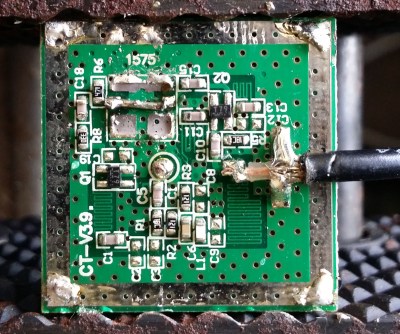
As far as antennas go, [Carl] recommends a dish or helix antenna. If you don’t want to fork over the money for something that fancy, he also explains how you can modify a $10 GPS antenna to work for this purpose. He admits that it’s not the best antenna for this, but it will get the job done. A typical GPS antenna will be tuned for 1575 MHz and will contain a band pass filter that prevents the antenna from picking up signals 1-2MHz away from that frequency.

To remove the filter, the plastic case must first be removed. Then a metal reflector needs to be removed from the bottom of the antenna using a soldering iron. The actual antenna circuit is hiding under the reflector. The filter is typically the largest component on the board. After desoldering, the IN and OUT pads are bridged together. The whole thing can then be put back together for use with this project.

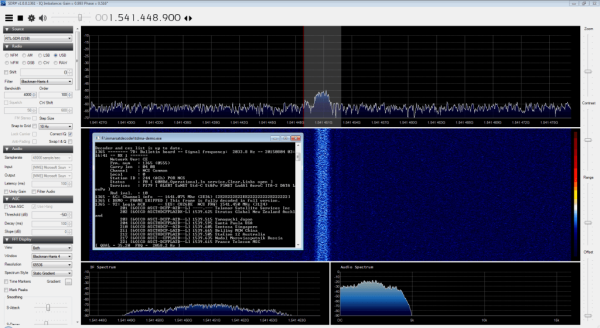
Once everything was hooked up and the antenna was pointed in the right place, the audio output from the dongle was piped into the SDR# tuner software. After tuning to the correct frequency and setting all of the audio parameters, the audio was then decoded with another program called tdma-demo.exe. If everything is tuned just right, the software will be able to decode the audio signal and it will start to display messages. [Carl] posted some interesting examples including a couple of pirate warnings.

If you can’t get enough RTL-SDR hacks, be sure to check out some of the others we’ve featured in the past. And don’t forget to send in links to your own hacking!

Drivers For 3D Printers And Why We Need Them

Manufacturers of 3D printers have a lot to do before they catch up with makers of the cheapest 2D, paper-based printers. If you’ve ever taken an inkjet apart, you’ll most likely find some sort of closed-loop control on at least one of the axes. The 2D printer will tell you when you’re out of ink, when a 3D printer will go merrily along, printing in air without filament. File formats? Everything is Gcode on a 3D printer, and there are dozens, if not hundreds of page description languages for 2D printers.

The solution to some of these problems are drivers – software for a 3D printer that slowly consumes the slicing of an object, printer settings, and placing an object on the bed. It’s coming, and the people who are responsible for making your 2D printer work with your computer are busy at work messing up the toolchain for your 3D printer.

The latest version of CUPS (C Unix Printing System) adds support for 3D printers. This addition is based on meetings, white papers, and discussions in the Printer Working Group (PWG). There has already been a lot of talk about what is wrong with the current state of 3D printer toolchains, what can be improved, and what should be completely ignored. Let’s take a look at what all of this has accomplished.

Continue reading “Drivers For 3D Printers And Why We Need Them”

The EM Drive Might Not Work, But We Get Helicarriers If It Does

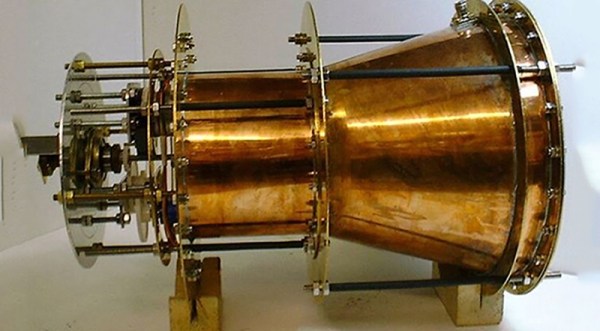
There is a device under test out there that promises to take humans to another star in a single lifetime. It means vacations on the moon, retiring at Saturn, and hovercars. If it turns out to be real, it’s the greatest invention of the 21st century. If not, it will be relegated to the history of terrible science right underneath the cold fusion fiasco. It is the EM drive, the electromagnetic drive, a reactionless thruster that operates only on RF energy. It supposedly violates the laws of conservation of momentum, but multiple independent lab tests have shown that it produces thrust. What’s the real story? That’s a little more complicated.

The EM Drive is a device that turns RF energy — radio waves — directly into thrust. This has obvious applications for spacecraft, enabling vacations on Mars, manned explorations of Saturn, and serious consideration of human colonization of other solar systems. The EM drive, if proven successful, would be one of the greatest inventions of all time. Despite the amazing amount of innovation the EM drive would enable, it’s actually a fairly simple device, and something that can be built out of a few copper sheets.

Continue reading “The EM Drive Might Not Work, But We Get Helicarriers If It Does”

clock

Ferrofluid Clock Is A Work Of Art

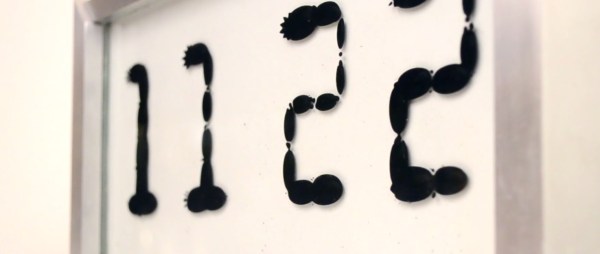
It is not usually too difficult to separate functionality from art. Consider a clock. It’s a machine that has a clear and distinct function. It provides information. Nothing could be more different from a clock on a wall than a piece of artwork.  A painting, for instance has no clear function and provides no information. It’s just…art. It’s nice to look at. If we were to ask you to build a functioning, information providing clock that is also a piece of artwork, you would surely have your hands full. Where would you even start? If your name was [Zelf Koelma], you’d grab a bottle of ferrofluid and build us a beautiful, almost mesmerizing clock.

clock_01There’s little to no information on the details of how the clock works other than the use of ferrofluid. But it’s not hard to guess that it uses dozens of electromagnets and an Arduino. You can even pick one up for a cool $8,300 if you’re lucky enough to get a spot on the list, as he’s only making 24 of them.
Want to make one of your own? Pick up some ferrofluid and keep us updated. We’d love to hear from you in the comments on how you’d implement a build like this one. We had a fun time hearing your ideas when we covered the clock made of clocks.

Continue reading “Ferrofluid Clock Is A Work Of Art”

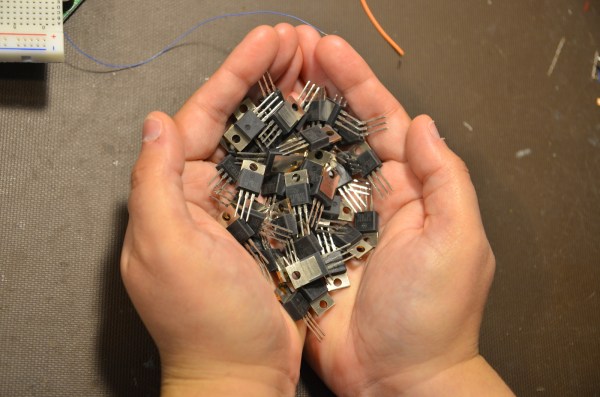
You Can Have My TIPs When You Pry Them From My Cold, Dead Hands

We’ve seen a growing number of posts and recommendations around the net regarding components, specifically transistors. “Don’t use old parts” they cry,  “Go with newer components.”  You can often find these recommendations on Arduino forums. This all came to a head with a page called “Do Not TIP,” which was linked in the Arduino subreddit.  This page belongs to [Tom Jennings], creator of Fidonet, and one of the early authors of what would become Phoenix BIOS. [Tom] and a few others have been calling for everyone to send their old parts to the landfill – not use them, nor gift them to new experimenters. Get them out of the food chain. No offense to [Tom], but we have to disagree. These parts are still perfectly usable for experienced designers, and have a lot to offer new hardware hackers.

TIP is the part number prefix for a series of power transistors created by Texas Instruments.  In fact, “TIP” stands for Texas Instruments Power. The series was originally released in 1969. Yes, that’s right, 1969. Why are we still using parts designed when man first walked on the moon? The same reason people are still using the 555 timer: they’re simple, they’re easily available, they’re robust, and most of all, they get the job done. The TIP series has been used in thousands of classes, tutorials both online and off, and millions of projects over the years. Much of that documentation is already out there on the internet. The TIP series is also out in the distribution channel – they’ve been used for 40 years. Any retail shop that stocks a few electronics parts will have at least one of the TIP series.

The TIP series aren’t always the best transistors for the job. However, for most hobbyist-designed circuits, we don’t need the best performance, nor the best price – we’re going to use the parts we have on hand. There is always room to improve once you get the basic circuit working.

Continue reading “You Can Have My TIPs When You Pry Them From My Cold, Dead Hands”

The Machine That Japed: Microsoft’s Humor-Emulating AI

Ten years ago, highbrow culture magazine The New Yorker started a contest. Each week, a cartoon with no caption is published in the back of the magazine. Readers are encouraged to submit an apt and hilarious caption that captures the magazine’s infamous wit. Editors select the top three entries to vie for reader votes and the prestige of having captioned a New Yorker cartoon.

The magazine receives about 5,000 submissions each week, which are scrutinized by cartoon editor [Bob Mankoff] and a parade of assistants that burn out after a year or two. But soon, [Mankoff]’s assistants may have their own assistant thanks to Microsoft researcher [Dafna Shahaf].

[Dafna Shahaf] heard [Mankoff] give a speech about the New Yorker cartoon archive a year or so ago, and it got her thinking about the possibilities of the vast collection with regard to artificial intelligence. The intricate nuances of humor and wordplay have long presented a special challenge to creators. [Shahaf] wondered, could computers begin to learn what makes a caption funny, given a big enough canon?

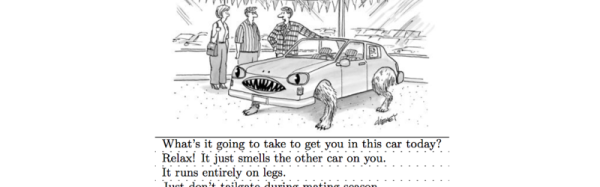
[Shahaf] threw ninety years worth of wry, one-panel humor at the system. Given this knowledge base, she trained it to choose funny captions for cartoons based on the jokes of similar cartoons. But in order to help [Mankoff] and his assistants choose among the entries, the AI must be able to rank the comedic value of jokes. And since computer vision software is made to decipher photos and not drawings, [Shahaf] and her team faced another task: assigning keywords to each cartoon. The team described each one in terms of its contextual anchors and subsequently its situational anomalies. For example, in the image above, the context keywords could be car dealership, car, customer, and salesman. Anomalies might include claws, fangs, and zoomorphic automobile.

The result is about the best that could be hoped for, if one was being realistic. All of the cartoon editors’ chosen winners showed up among the AI’s top 55.8%, which means the AI could ultimately help [Mankoff and Co.] weed out just under half of the truly bad entries. While [Mankoff] sees the study’s results as a positive thing, he’ll continue to hire assistants for the foreseeable future.

Humor-enabled AI may still be in its infancy, but the implications of the advancement are already great. To give personal assistants like Siri and Cortana a funny bone is to make them that much more human. But is that necessarily a good thing?

[via /.]

Skysphere

Living In A Sphere In The Sky

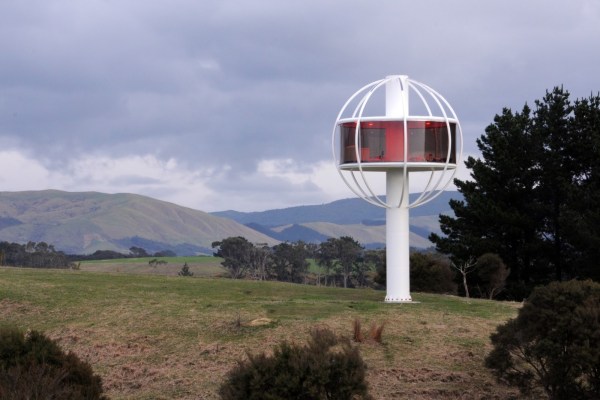
Wow. Looking to live off the grid in style? [Jono Williams] just finished off his rather ambitious Skysphere project.

Using industrial materials (is that highway lamp post tower?), [Jono] designed and built his ultimate apartment tower out in the country. Kind of looks like a futuristic outlook or security post — something straight out of that [Tom Cruise] flick, Oblivion.

The project has been in the works for years, and [Jono] estimates its taken about 3000 hours so far — not to mention $50,000 USD in building materials. It’s solar powered, Android controlled, has a fingerprint scanner at the door, an integrated beer fridge in the couch, RGB LED lighting, WiFi, a stargazing platform, a custom queen size bed, his own AI voice, wireless sound, and automated heat management!  Continue reading “Living In A Sphere In The Sky”